


Inlaid Banjo Barometer
An inlaid banjo barometer combines precise meteorological instrumentation with elegant cabinetwork, offering both practical utility and refined wall decoration.

Inlaid Banjo Barometer
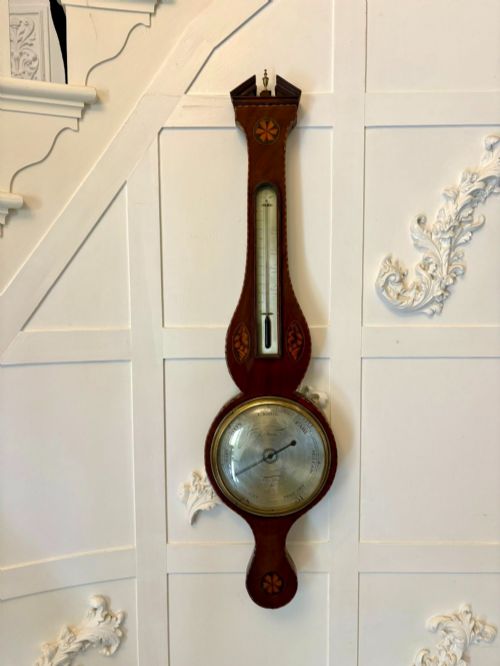
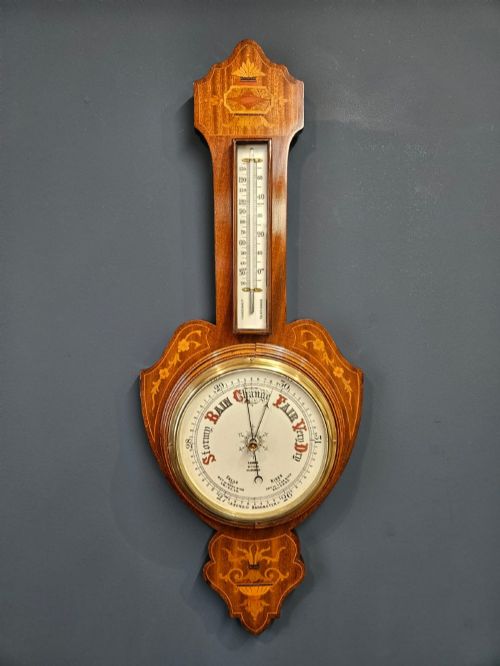
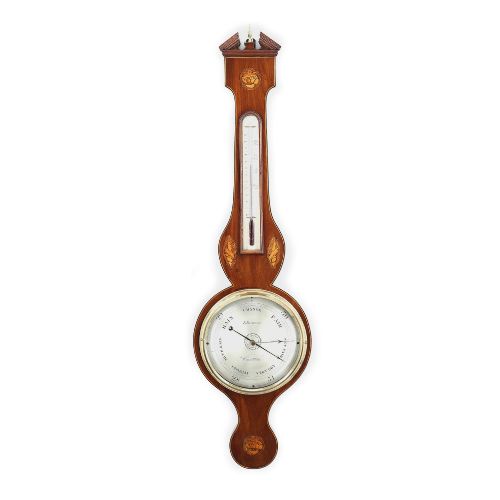
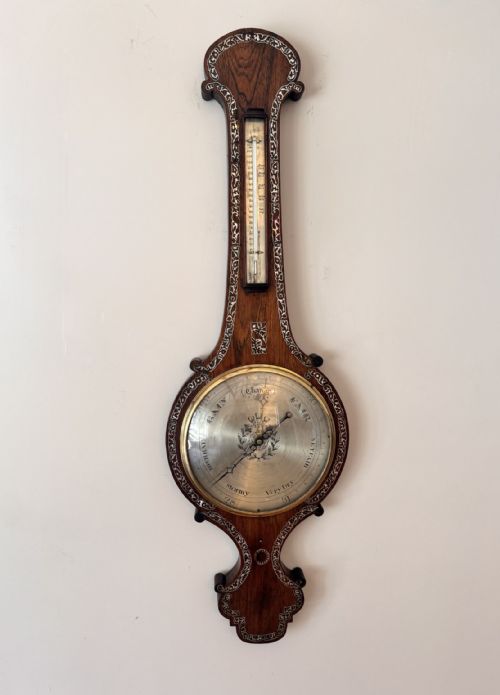
An inlaid banjo barometer is a domestic wall instrument characterised by its distinctive shape, featuring a narrow stem topped by a damp-testing hygrometer or thermometer, leading down to a circular dial at the base. These pieces emerged as a popular household fixture during the Georgian and Victorian periods, blending scientific utility with decorative cabinetwork.
The versions most commonly met on this page are constructed from rich timbers such as mahogany or rosewood, frequently detailed with contrasting boxwood and satinwood stringing. Many examples incorporate shell marquetry or mother-of-pearl accents set directly into the wooden trunk above or below the central dial.
Originating largely from the late eighteenth century through to the Edwardian era, these wall barometers reflect the changing aesthetic tastes of British homes. Makers across provincial towns and London workshops produced these items to serve both as reliable weather glasses and as statement pieces for domestic halls and reception rooms.
What varies in quality
The refinement of the cabinetwork heavily influences the distinction between standard and superior examples, particularly in the crispness and complexity of the wood inlay. Dense satinwood stringing, precisely cut shell paterae, and well-figured mahogany veneers indicate skilled workshop production rather than mass output.
The legibility and engraving quality of the silvered brass dial also dictate overall merit, alongside the presence of secondary instruments like spirit thermometers or hygrometers. Original brass bezels, damp-proof glass covers, and signed makers' plates on the register scale elevate the stature of the instrument.
Early Italian instrument makers often travelled across Britain carrying weather glasses on their backs, trading accurate forecasts for lodgings.
B Besozzi of Weymouth·Ganthony of London·Prada of High Wycombe·Molton of Norwich·Luisetti of London·Fagioli of Clerkenwell London·Giana Shrewsbury·L Casatelli of Liverpool·Vecchio and Co of Shaftsbury·A Rivolta·J Groce York·F Salteri and Co Nottingham·Dominic Gatty·Schiavi of Chesham·Walter Gough London·A Abraham of Liverpool·Maples of London
The Inlaid Banjo Barometer Glossary
- Aneroid barometer
- A meteorological instrument that measures atmospheric pressure using a flexible metal vacuum capsule rather than a column of liquid mercury. This design eliminated the need for a liquid reservoir and allowed for more robust transport.
- Marquetry
- Decorative woodwork where thin pieces of veneer are assembled to form pictorial or geometric patterns across a surface. Artisans use contrasting woods to create detailed motifs such as shells and floral sprays.
- Silvered metal
- Brass or copper dials treated with a silver compound to produce a bright, matte finish before being engraved with weather scales and numbers. This technique reduces glare and enhances legibility.
- Stringing
- Narrow strips of contrasting timber inlaid into shallow grooves along the edges of furniture or barometer stems. It creates a fine border that accentuates the structural lines of the piece.
- Wheel barometer
- Another term for the banjo barometer, describing the circular dial used to display pressure readings driven by a wheel and pulley mechanism. The layout allows for clear visibility across a room.
Inlaid Banjo Barometer: Frequently Asked Questions
How do I read a mercury barometer?
The pointer indicates atmospheric pressure in inches or millibars, moving clockwise as weather conditions improve and anticlockwise for stormy periods. Many dials feature descriptive text alongside numbers to help interpret upcoming changes.
Secondary indicators, such as the manual pointer set by hand over the primary needle, allow you to track whether pressure is rising or falling since your last observation.
Where should I hang my banjo barometer?
Choose an interior wall free from direct sunlight, central heating radiators, and excessive damp to protect the delicate wood veneers and internal mechanisms. Stable indoor temperatures ensure the instrument remains accurate over time.
Ensure the wall anchor is secure, as these traditional wooden cases possess substantial weight due to the dense hardwoods and internal glass components.
How do I date an inlaid barometer?
Examine the style of the case, the complexity of the wood inlay, and the signature on the dial plate to establish a period of origin. Earlier Georgian models often feature broken arch pediments and delicate shell paterae, while Edwardian versions lean towards lighter satinwood banding.
Internal construction methods, such as hand-beaten brass fittings and older mercury tube fixings, also provide clues regarding the decade of manufacture.
Can these barometers still be calibrated?
Most traditional mercury and aneroid mechanisms can be adjusted using the internal screw accessible through the back or via the front bezel. Professional calibration ensures the instrument responds accurately to local barometric pressure.
Mercury models require careful handling during any adjustment or relocation to prevent air bubbles from entering the glass tube.