
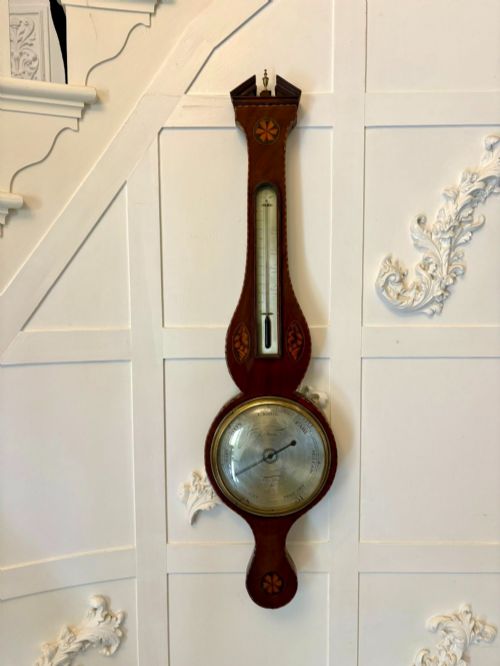
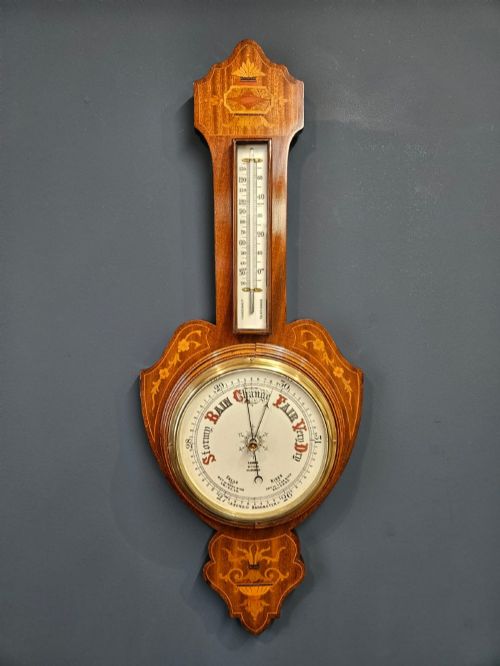
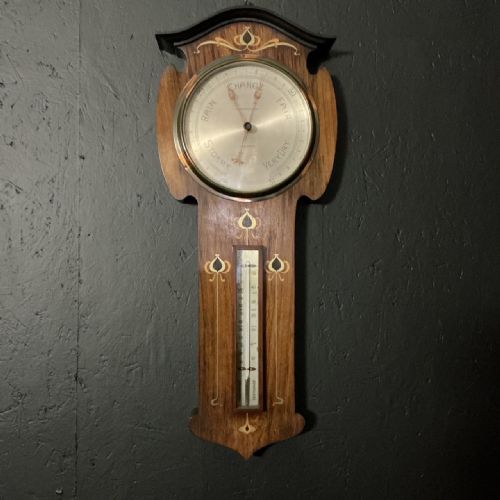
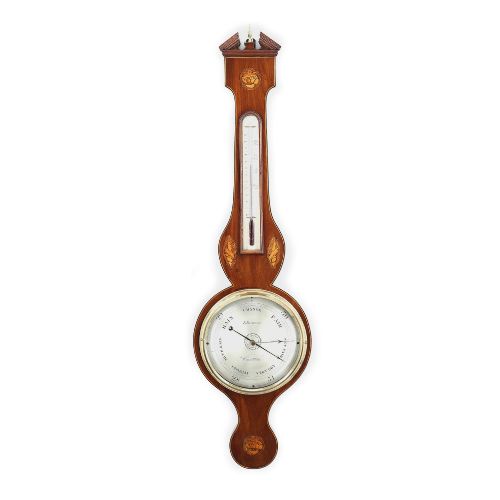
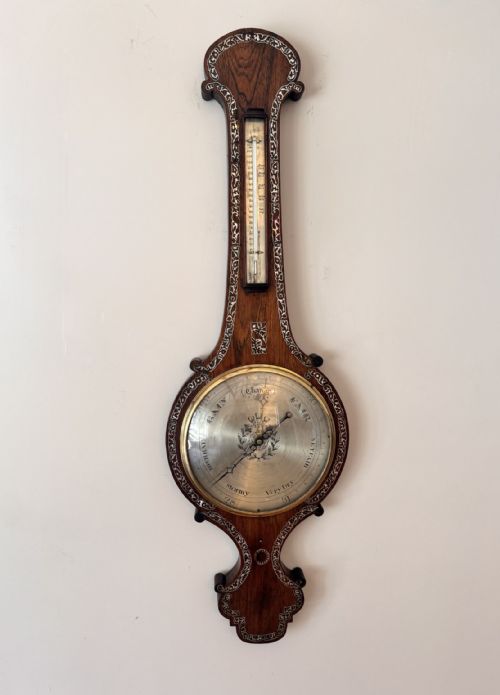


Inlaid Mahogany Wall Barometer
An inlaid mahogany wall barometer brings practical weather observation together with fine cabinetmaking.
Inlaid Mahogany Wall Barometer
An inlaid mahogany wall barometer combines functional weather forecasting with decorative cabinetry designed to hang securely in a domestic interior.
The selections available span multiple eras, including Georgian, Regency, Victorian, and Edwardian periods.
Makers utilised rich timbers and contrasting stringing to elevate the visual appeal of these scientific instruments.
Distinguishing quality factors
Superior examples display crispness in the cabinetmaker's inlay work and refinement in the engraved silvered scale plates.
The overall proportion of the wooden case and the clarity of the dial markings dictate the standing of an individual piece.
Makers occasionally added a convex mirror to the top of a banjo barometer so homeowners could check their posture while reading the weather.
B Besozzi of Weymouth·Ganthony of London·Prada of High Wycombe·Molton of Norwich·Luisetti of London·Giana Shrewsbury·L Casatelli of Liverpool·Vecchio and Co of Shaftsbury·A Rivolta·J Groce York·Charles Aiano London·A Pozzo London·Pinchetti and Co London·F Salteri and Co Nottingham·Dominic Gatty·Schiavi of Chesham
The Inlaid Mahogany Wall Barometer Glossary
- Banjo barometer
- A household weather glass housed in a distinctively shaped wooden case resembling a banjo, featuring a damp-measuring dial at the top and a larger dial below.
- Stick barometer
- A tall, narrow wall instrument that displays atmospheric pressure through a vertical mercury column viewed against a graduated scale.
- Silvered metal
- A brass or copper dial plate treated to achieve a silvery finish, then engraved with figures and filled with dark wax for legibility.
- Stringing
- A narrow strip of contrasting timber inlaid into a channel cut into the mahogany surface to form decorative borders.
Inlaid Mahogany Wall Barometer: Frequently Asked Questions
How do I hang a wall barometer?
Secure a sturdy picture hook or screw directly into a wall stud to support the weight of the mahogany case safely.
Ensure the instrument hangs completely vertical so the internal components remain balanced and accurate.
Are these barometers in working order?
Many surviving examples retain functioning mechanisms, though older mercury instruments require careful handling during transport.
Changes in atmospheric pressure cause the internal mechanics to respond, though vintage barometers serve primarily as decorative historic objects.
How do I clean the mahogany case?
Dust the wood gently using a soft, dry cloth to remove surface particles without disturbing the polished finish.
Avoid harsh chemical cleaners or excess moisture, which can damage the delicate boxwood stringing and antique veneers.
How do I tell a Georgian barometer from a Victorian one?
Georgian and Regency instruments often feature restrained Neo-Classical shell inlay and refined proportions characteristic of eighteenth-century cabinetmaking.
Victorian and Edwardian versions tend to incorporate heavier framing, mother-of-pearl accents, or aneroid dials that do not rely on a visible mercury column.