


Industrial Ceiling Light
An industrial ceiling light brings utilitarian strength and direct illumination into domestic and commercial spaces.
Industrial Ceiling Light
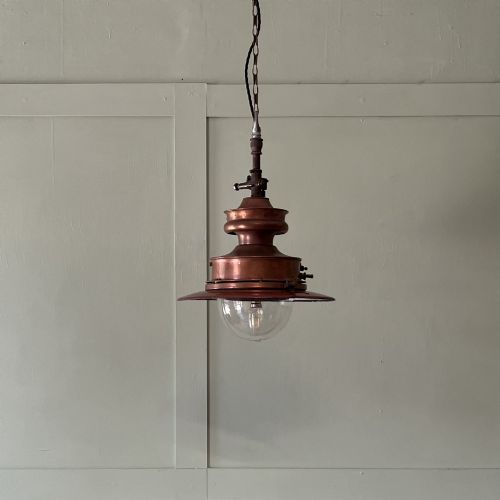
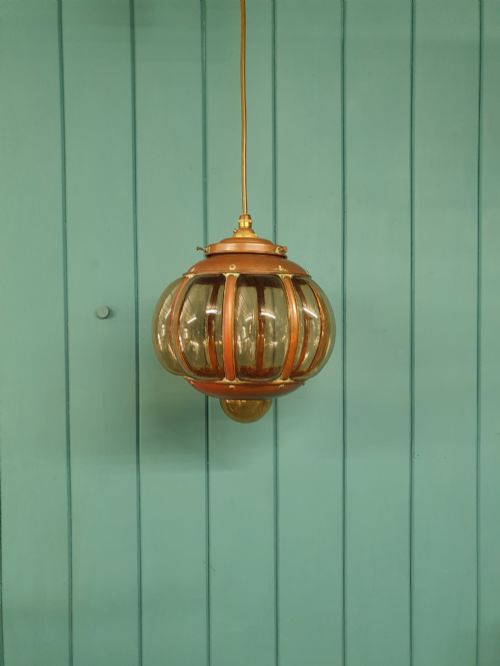
An industrial ceiling light brings robust utility to a room through utilitarian forms designed for workshops, factories, and railway settings. These fixtures appear primarily as pendant lights, chandeliers, and ceiling lights spanning the Victorian period through the mid-twentieth century. Buyers encounter robust brass, steel, and copper framing paired with utilitarian glass shades.
The selection ranges from early twentieth-century factory pendants to Edwardian nautical lanterns and Art Deco copper designs. Enamel light fittings and chapel lights also populate the range, alongside larger cast iron models originating from specific historical buildings. Many items survive as pairs or larger sets, particularly from the 1920s and 1930s.
Materials and Construction
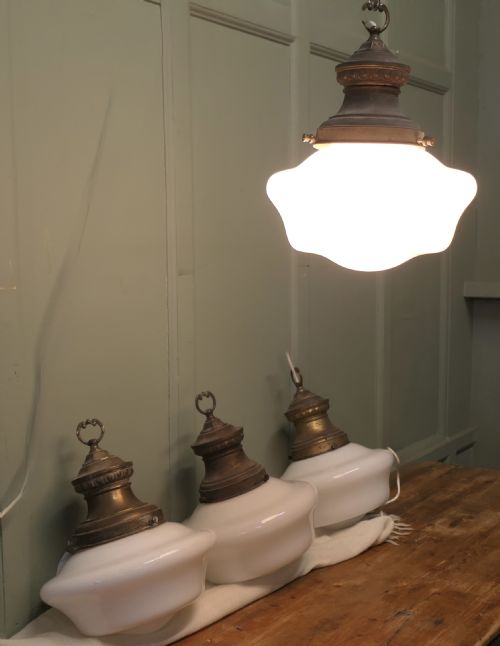
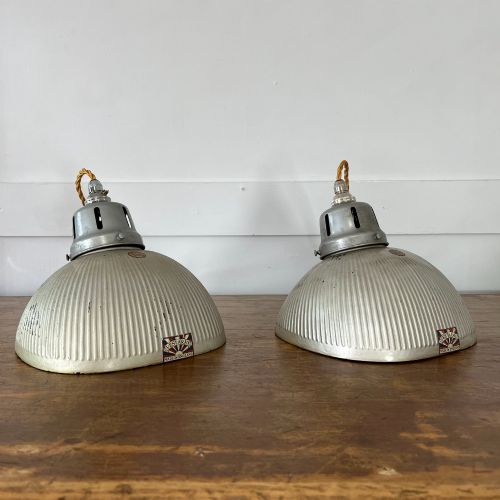
Shades are fashioned from specialised glass types such as prismatic, opaline, mercury mirrored, and smoked glass alongside enameled metal. Holophane shades dominate the selection, engineered with ribbed optical surfaces to diffuse and direct illumination efficiently across large workspaces.
Quality Variations
The standard of an industrial ceiling light depends upon the integrity of its original components and the complexity of its glasswork. Pieces retaining their original signed shades, authentic galleries, and untouched metal patina command greater interest from collectors.
Casting depth and weight distinguish superior heavy-duty factory and railway fixtures from lighter domestic adaptations. The optical quality of specialised glassware, such as double prismatic or heavy opaline glass, further dictates the refinement of the piece.
Gecoray·VESTARAY·Holophane
The Industrial Ceiling Light Glossary
- Holophane
- A brand of scientific glass shade featuring prismatic ribs designed to manipulate light distribution. These shades appear frequently across early twentieth-century pendants.
- Opaline Glass
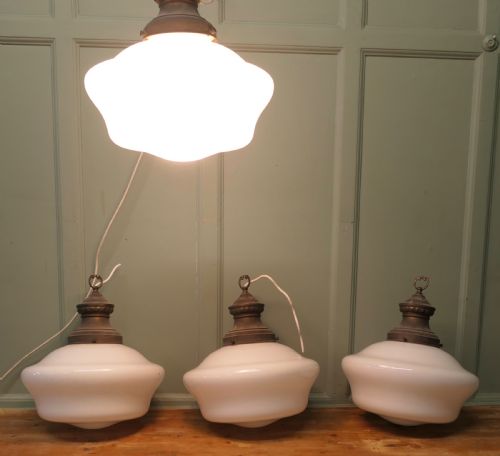
- A milky, translucent white glass used to soften glare while transmitting maximum luminosity. It frequently forms large chapel and factory pendants.
- Gallery
- The metal fitting at the top of a shade that connects the glass body to the suspension rod or flex. Galleries are often cast from brass or chrome.
- Pendant Light
- A single light fixture suspended from the ceiling by a cord, chain, or metal rod. This is the most common form found in industrial lighting.
- Prismatic Glass
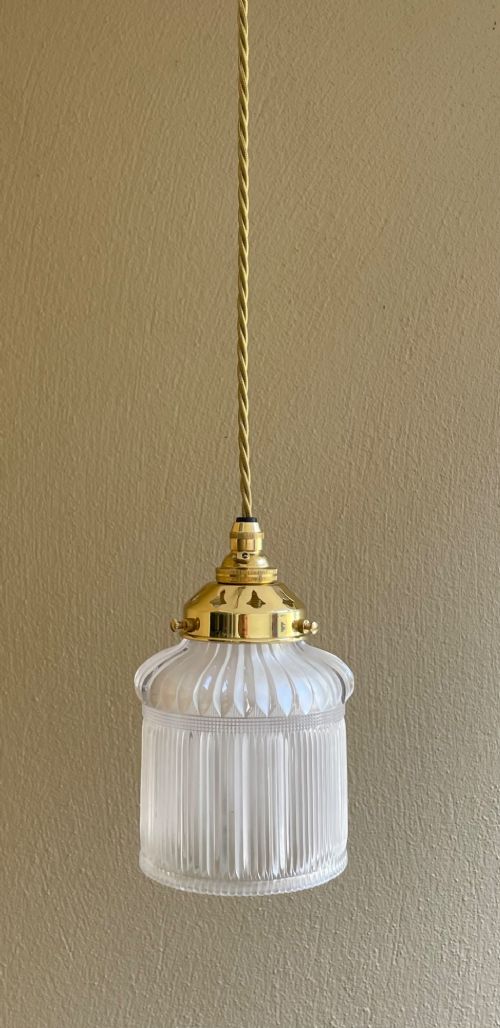
- Glass moulded with geometric ridges on the surface to refract and diffuse light efficiently. Double prismatic versions feature complex optical patterns.
Industrial Ceiling Light: Frequently Asked Questions
How do I hang an industrial ceiling light?
Suspension methods depend on the weight of the specific metal fixture and the height of the room. Heavier cast iron and iron wagon wheel chandeliers require secure ceiling joist anchorage.
Lighter pendant lights utilise standard flex or chain drops connected to appropriate ceiling roses. Professional electrical installation ensures safe operation with modern wiring.
What rooms suit an industrial ceiling light?
These fixtures suit kitchens, hallways, and dining spaces where direct, functional illumination creates a distinct focal point. Larger pendant lights and sets of four function effectively over kitchen islands or long tables.
Smaller single fixtures illuminate compact entryways or utility rooms while retaining historical character. The robust materials complement both contemporary and traditional interior schemes.
How do I date an industrial ceiling light?
Dating relies on identifying material choices, manufacturing techniques, and stylistic markers associated with specific periods from the Victorian era to the 1940s. Early twentieth-century examples often display heavy brass galleries, specific enamel colours, or distinct prismatic glass stampings.
Art Deco models favor streamlined copper and steel geometries, while Victorian pieces incorporate heavy cast iron and copper hardware. Archival records and maker marks on shades provide precise chronological reference points.
Are original glass shades important?
Original shades significantly impact the authenticity and historical value of any industrial fixture. Surviving opaline, mercury mirrored, or Holophane glass components retain the specific optical qualities intended by the original makers.
Matched sets with original shades are particularly scarce and desirable for uniform installations. Replacements lack the period manufacturing flaws and patina found in genuine vintage glass.