

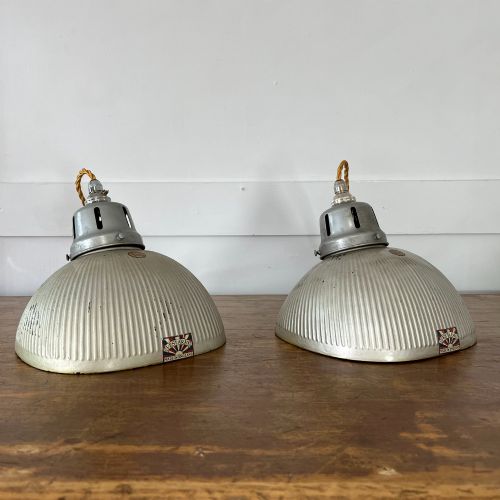


Mid Century Industrial Light
These mid century industrial light pieces are rugged utilitarian survivors built for work, offering serious task illumination and raw workshop character.
Mid Century Industrial Light
You are most likely to meet pendant lights and ceiling lights from the 1930s and 1940s, often associated with British industrial design. These fixtures were originally installed in commercial or transport settings rather than domestic homes. Their robust construction and straightforward utility define the group of items gathered here.
How they were made
Makers utilised durable materials such as brass, aluminium, iron metal, and opaline glass to withstand demanding workshop environments. Components were cast, spun, or sheet-formed to create functional shades and protective housings. Fabric flex and wood elements also appear in wiring and structural fittings.
The construction prioritised utility and longevity over decorative finish, resulting in visible fixings and honest structural joints. Engineering requirements dictated the forms, from angled pendant brackets to heavy-duty tripod bases and machine-age chrome plating.
Mid Century Industrial Light Retail Price Guide 2026
Typical asking prices for mid century industrial light among the pieces listed under this phrase on Sellingantiques today, from the lower quarter to the upper quarter. They describe what is for sale here now, not the wider market.
The listings span five decades from 1900 to 1960, incorporating materials such as brass, oak, and opaline glass.
What varies in quality
Quality in a mid century industrial light lies in the integrity of the original materials and the sophistication of the mechanical adjustment mechanisms. Pieces cast with heavier gauge metals and finished with substantial opaline glass shades sit at the top of the range. Lighter gauge commercial items sit at the other end.
The retention of original maker components, such as branded collars or specialised mounting brackets, distinguishes superior examples. The purity of the industrial form, whether reflecting art deco restraint or machine age modernism, dictates the desirability of each piece.
VESTARAY·STRAND SPOT LIGHT·BRITISH RAIL
The Mid Century Industrial Light Glossary
- Pendant Light
- A hanging fixture suspended from the ceiling by a cord, chain, or metal rod. These units directed concentrated light downwards onto work surfaces in factories and offices.
- Opaline Glass
- A milky, translucent white glass used for lamp shades to diffuse light evenly and reduce harsh glare. This material is characteristic of mid-century commercial lighting.
- Machine Age
- A design style spanning the 1920s and 1930s that celebrated industrial machinery, motion, and new metals like chrome. It influenced the sleek profiles of desk lamps and task lighting.
- Plan Chest
- A large wooden cabinet with wide, shallow drawers originally used for storing architectural drawings and maps. These sturdy pieces frequently accompany industrial lighting in workspaces.
- Signal Lamp
- A specialised lighting device used by transport networks, such as railways, for communication and safety. These robust units often featured heavy metal housings and oil or electric burners.
Mid Century Industrial Light: Frequently Asked Questions
What is a mid century industrial light?
A mid century industrial light is a utilitarian fixture designed for factories, offices, and transport networks between the early and mid-twentieth century. These lamps were engineered for durability and direct task illumination.
They utilise robust materials such as metal, aluminium, and opaline glass to survive harsh working conditions. Today, collectors use them to bring historical utility into modern interiors.
How were these lights used?
These fixtures were mounted above workstations, suspended from high factory ceilings, or placed on desks to provide focused illumination for manual labour. Railway and trade lights served specialised signaling and commercial display functions.
Their primary purpose was functional rather than decorative, ensuring workers could see clearly in industrial environments. This strict utility shaped their distinct aesthetic.
How do I live with industrial lighting?
Industrial lighting integrates well into modern and traditional interiors by offering a striking contrast of raw metal and glass against domestic furnishings. Pendant lights work effectively suspended over dining tables or kitchen islands.
Desk lamps and adjustable floor models provide practical task lighting for studies and living spaces. Their neutral metallic tones allow them to anchor diverse interior colour schemes.
How do I date an industrial light?
Dating these pieces involves examining the manufacturing techniques, electrical components, and stylistic markers such as art deco lines or machine age chrome. Earlier twentieth-century examples often feature heavy cast metal components and simpler wiring.
Mid-century items may incorporate aluminium and specific switch designs associated with the 1940s and 1950s. Associated maker names stamped on the metalwork also help establish a precise period.