
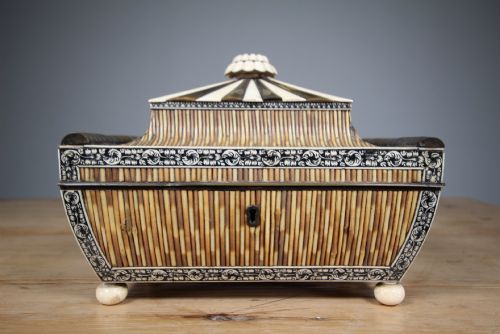


Indian Carved Ebony Box
An indian carved ebony box brings heavy, dark wood and intricate detail straight to a desk, holding letters or trinkets with colonial authority.
Indian Carved Ebony Box
An indian carved ebony box is a heavy, dense container shaped in forms ranging from small trinket boxes and card cases to large trunks, coffers, and writing slopes. Most examples found here belong to the nineteenth century, including Victorian, Regency, and eighteen-fifty periods, alongside occasional nineteen-thirty pieces.
The decorative styles seen on these pieces span Anglo-Indian, Anglo-Indian Colonial, and colonial work originating from regions like Ceylon and Sri Lanka. Buyers will frequently encounter writing boxes and decorative boxes featuring detailed carving and reeded decoration across solid ebony, camphor wood, and satinwood.
How they were made
Maker's hands shaped solid ebony and hardwoods using sharp carving tools to produce deep relief patterns and reeded surface details. These dark woods were frequently contrasted with lighter materials such as bone, brass, and porcupine quill work.
Internal fittings for writing slopes and boxes required careful carpentry to house compartments, while trunks and chests utilised brass hardware for structural strength and closure.
Current listings feature nineteenth-century pieces incorporating ebony, camphor wood, brass, bone, and porcupine quill in forms ranging from card cases to large trunks.
What varies in quality
Quality rests in the crispness of the carved detail and the density of the ebony used in the construction. Pieces displaying sharp, deep relief work and well-preserved contrasting inlays of bone or porcupine quill stand apart from plainer variants.
The complexity of the form also dictates the standard, with fitted writing boxes and large trunks showing greater joinery skill than simple card cases or small trinket boxes.
The Indian Carved Ebony Box Glossary
- Ebony
- A dense, heavy dark hardwood prized for its deep colour and ability to hold fine carved detail. It forms the primary body of these colonial pieces.
- Writing Slope
- A box with a sloping lid designed to provide a slanted surface for letter writing, often opening to reveal internal compartments and inkwells.
- Reeded Decoration
- Parallel convex moulding carved directly into the surface of the wood. This technique adds texture and linear rhythm to box lids and sides.
- Anglo-Indian
- A style describing decorative arts and furniture produced during the British rule in India, combining British forms with local materials and carving traditions.
- Porcupine Quill
- Natural quills utilised in decorative banded patterns across box exteriors. They create a distinctive spiky texture contrasting with the dark wood.
Indian Carved Ebony Box: Frequently Asked Questions
What is an indian carved ebony box used for?
These boxes served practical purposes in colonial households, functioning as secure desks for correspondence or safe containers for jewellery and small valuables.
Today, they perform similar roles on desks or dressing tables while adding texture and historical weight to an interior.
How do I date an indian carved ebony box?
Dating relies on observing the stylistic markers and secondary materials associated with periods like the Regency era or the Victorian decades. Writing slopes and camphor wood trunks often carry construction traits typical of nineteenth-century workshop practices.
Examining the interior layout, hinges, and the style of any brass hardware helps narrow down the decade of manufacture.
How do I care for solid ebony?
Ebony requires stable room conditions away from direct heat sources and strong sunlight to prevent the dense wood from drying out or splitting. Gentle dusting with a dry cloth keeps the surface clean without stripping the natural finish.
Avoid using harsh liquid polishes or abrasive cleaners that can damage delicate carved details and bone inlays.
What is Anglo-Indian style?
The Anglo-Indian style fuses traditional British furniture forms, such as writing slopes and sarcophagus boxes, with indigenous Indian and Ceylonese carving techniques. Local artisans applied dense floral motifs and geometric patterns to familiar European shapes.
This aesthetic reflects the cross-cultural exchange of the colonial period.