
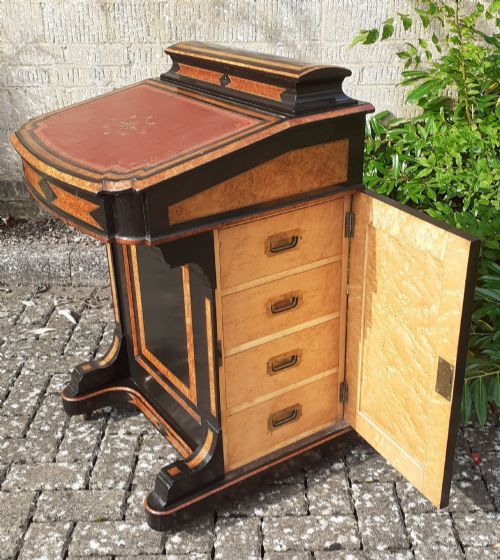


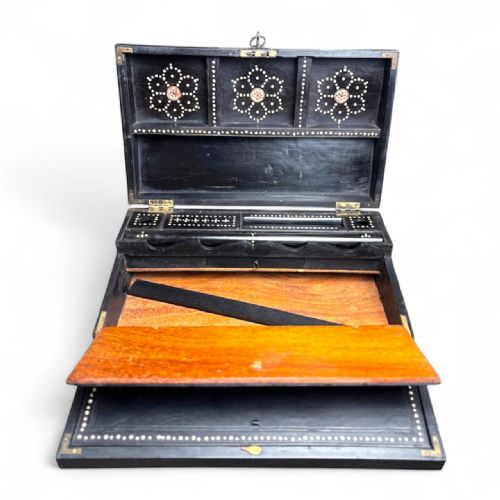


Antique Ebony Slope Desk
These antique ebony slope desk pieces are dense, dark writing boxes designed for travel and correspondence.
Antique Ebony Slope Desk
An antique ebony slope desk encompasses portable writing boxes and writing slopes fashioned from dark ebony wood, alongside related Davenport desks and writing tables. These pieces emerge primarily from the 19th Century and the Victorian era, spanning Regency examples to pieces dated around 1870.
The forms span solid ebony writing slopes, campaign writing boxes, and correspondence boxes equipped with internal compartments. Many items display specific regional origins such as Ceylon, Sri-Lankan, and Anglo-Indian Colonial styles, reflecting British imperial trade and craftsmanship abroad.
On this page, a buyer most frequently encounters 19th-Century Anglo-Indian and Ceylonese writing boxes. These versions often incorporate contrasting details like amboyna, satinwood, ivory inlay, or reeded decoration alongside fitted brass hardware.
How they were made
Carpenters constructed these pieces using dense ebony, frequently combining the dark primary wood with lighter contrasting timbers such as satinwood and amboyna. Solid ebony forms appear alongside veneered carcasses, demonstrating rigorous colonial and domestic woodworking standards.
Craftspeople integrated functional hardware made of brass and metal, securing corners and hinges for travel durability. Detailed decoration relied on reeded surface carving and intricate ivory inlay work set directly into the ebony surfaces.
Writing slopes incorporated fitted leather writing surfaces inside the folding cases to provide a smooth plane for ink and paper. Campaign styling dictated robust construction methods intended to withstand long sea voyages and tropical climates.
Travellers trusted these heavy ebony boxes to keep their inkwells from spilling across the British Empire.
What varies in quality
The refinement of the decorative inlay and carved elements separates standard boxes from superior examples. Precision in the ivory inlay work and the sharpness of reeded decoration indicate the skill of the original workshop.
The choice of secondary and contrasting timbers impacts the overall execution. Pieces that pair ebony with fine amboyna or satinwood interiors demonstrate a higher grade of material selection than simpler constructions.
Marsh & Tatham
The Antique Ebony Slope Desk Glossary
- Ebony
- A dense, heavy black or dark brown heartwood prized for its fine texture and ability to take a high polish. It forms the primary structural and decorative material for these writing boxes.
- Writing Slope
- A portable desk featuring a slanted writing surface that folds flat when not in use. Inside, it conceals compartments for pens, inkwells, and paper.
- Amboyna
- A highly figured, warm reddish-brown wood derived from Pterocarpus indicus trees. Makers used its decorative grain for interior veneers and contrasting panels.
- Reeded Decoration
- A series of parallel, convex mouldings carved directly into the wooden surface. This technique adds texture and linear detail to the exterior of the box.
- Campaign
- A descriptor for portable furniture designed to dismantle or fold easily for military officers and travellers on the move. These pieces utilise brass mounts to protect corners during transit.
Antique Ebony Slope Desk: Frequently Asked Questions
What is an antique ebony slope desk?
An antique ebony slope desk is a portable writing box or sloping desk constructed from dense ebony timber. These objects date primarily from the 19th Century and were utilised for correspondence while travelling.
Many examples originate from colonial workshops in Ceylon and India, featuring fitted interiors for paper and inkwells.
How were these writing boxes used?
Owners opened the hinged slope to reveal a sloping leather-lined writing surface and various small compartments for stationery. They served as portable offices for writers, travellers, and military officers.
When closed, the secure brass-bound box protected the writing materials during long journeys by land or sea.
How do I identify a Regency piece?
Regency pieces date from the early 19th Century and often incorporate classical architectural lines alongside contrasting woods like mahogany and ebony. They reflect the restrained elegance of the Regency period before Victorian ornamentation became dominant.
Makers working in the manner of established firms produced sophisticated writing tables during this era.
What is Anglo-Indian colonial style?
Anglo-Indian colonial style refers to furniture made in India by local artisans using British cabinet-making forms combined with indigenous materials and carving techniques. These pieces often feature dense ebony and intricate ivory inlay.
They represent the cross-cultural exchange of design during the British colonial period.
How do I care for antique ebony?
Keep antique ebony furniture out of direct sunlight and away from rapid temperature fluctuations to prevent the wood and ivory inlay from splitting. Dust regularly with a soft, dry cloth.
Avoid using modern liquid polishes that can build up a residue in the carved reeded decoration or damage the leather surfaces.