



Impressionist Marine Watercolour
Impressionist marine watercolour works capture shifting light and coastal atmosphere on paper through fluid pigment.
Impressionist Marine Watercolour
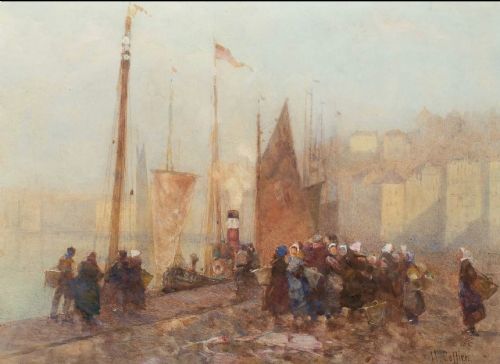
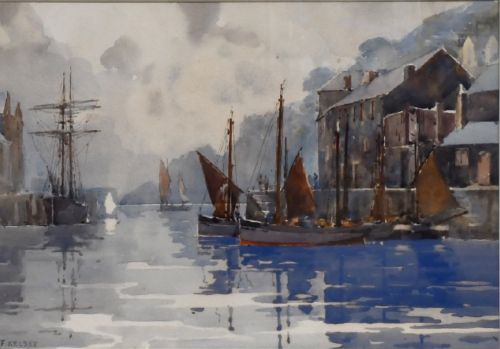
An impressionist marine watercolour brings harbour life, fishing boats and coastal scenes to paper through fluid brushwork and light. These works record moments on the water from the nineteenth century into the mid twentieth century.
You will most frequently meet British examples from regional artistic centres such as St Ives, Newlyn and Whitby. Artists worked outdoors to capture changing tides, coastal skies and working vessels in ports.
The subjects range from Venetian canals to Cornish harbours and Yorkshire fishing piers. Each sheet reflects the particular atmosphere of its coastal location through washes of pigment.
Materials and technique
Artists applied watercolour pigment onto paper support, sometimes incorporating bodycolour or gouache to build opaque highlights on the water. These materials allowed rapid application outdoors to catch transient weather effects.
Protective framing under glass with wood mouldings preserved the delicate pigment surfaces from moisture and light damage over decades.
Geographic subjects span Whitby, St Ives, Polperro, Venice, and Boulogne harbour.
Judging quality
Quality rests upon the confidence of the brushwork and how successfully the artist manages the transparency of the pigment. Strong works capture movement in the water and atmosphere in the sky without overworking the paper surface.
The strength of the composition and the clarity of light distinguish finer marine sheets from routine topographical sketches. A master hand conveys the weight of shipping craft and the motion of choppy tides with economical strokes.
William Banks Fortescue·Hector Caffieri·Frank Kelsey·William Lee Hankey·Fred Lawson·Edward Seago·Frederick William Hattersley·Clara Montalba·Ernest F Hill·Frederick Stuart Richardson·William Tatton Winter·Frank Wasley·S J Lamorna Birch·Frank Rousse·Rowland Henry Hill·Robert Leslie Howey·Edward Aubrey Hunt·Henry Scott Tuke
The Impressionist Marine Watercolour Glossary
- Watercolour pigment
- Finely ground colour mixed with a water-soluble binder, applied in washes to paper.
- Gouache
- An opaque watercolour medium containing white pigment, used by artists to add dense highlights to marine scenes.
- Wash
- A fluid layer of diluted pigment spread across the paper to represent skies or open water.
- Newlyn School
- An artist colony in Cornwall focused on plein air painting of coastal life and local fisherfolk.
Impressionist Marine Watercolour: Frequently Asked Questions
How should I hang a watercolour?
Keep watercolours away from direct sunlight to prevent the pigment from fading across the paper surface over time.
Ensure rooms maintain stable humidity levels so moisture does not harm the paper support or the inner mount.
Were these painted outdoors?
Many artists worked directly on location by the harbour or beach to capture changing light and weather conditions quickly.
Studio work often followed these plein air sketching sessions to refine larger compositions for exhibition.
How do I identify the period?
Stylistic touches, artist signatures and framing materials often point toward specific decades between the Victorian era and the mid twentieth century.
Subject dress, vessel types and coastal architecture also provide clear clues to the date of execution.
What subjects are most common?
Fishing boats, harbour walls, cobles and coastal towns dominate these maritime scenes across British shores and European ports.
Venetian canals and Cornish coastal inlets appear frequently among regional works from this period.