



Impasto Flower Painting
Impasto flower painting brings thick, textured oils and vibrant floral subjects into a room, capturing light and depth with remarkable physical presence.
Impasto Flower Painting
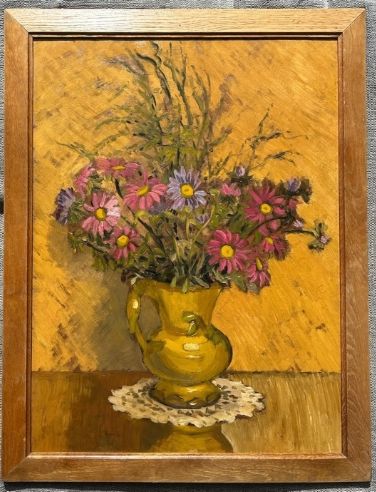
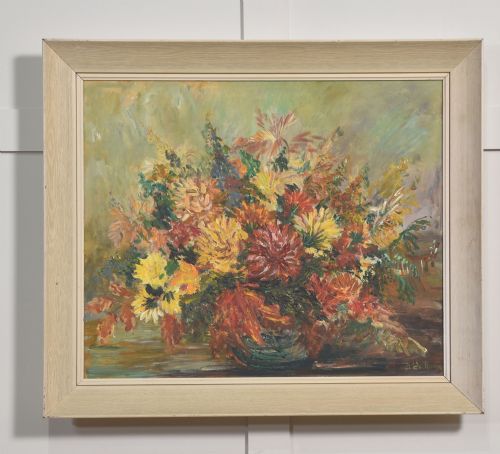
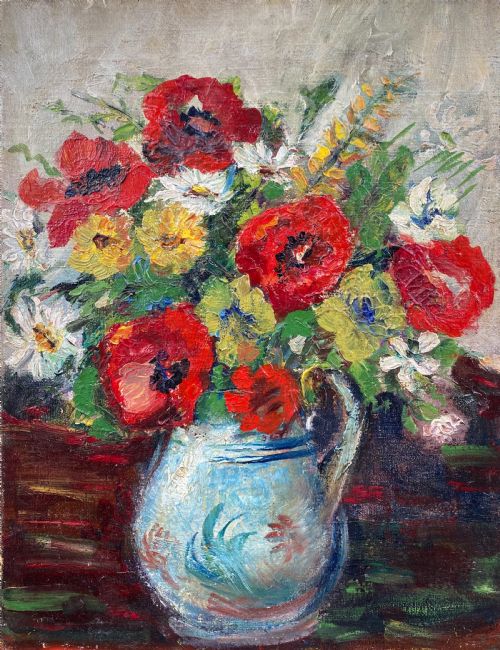
An impasto flower painting displays floral still life subjects rendered with heavy, raised applications of oil paint that stand proud of the surface. Buyers searching for impasto flower painting want works that combine bold texture with botanical subjects.
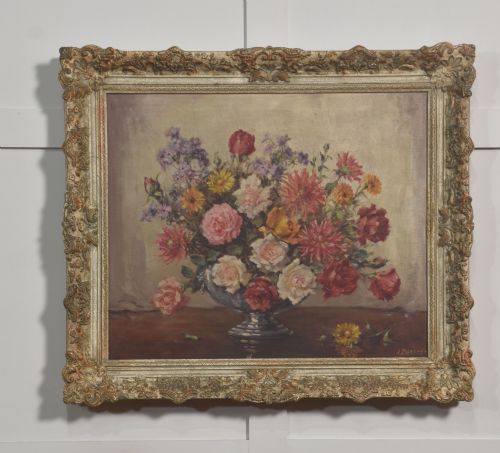
The pieces on this page span from the nineteenth century through the mid twentieth century, encompassing styles such as post-impressionism, mid-century modernism, and French modernist works. Most examples present vases of flowers, bowls of dahlias, or wild poppies rendered with visible brushwork.
Canvas and board serve as the primary supports for these works, often housed within gilt or plaster frames that complement the heavy application of pigment. The overall visual effect relies on the interplay between thick paint and natural light.
How they were made
Artists built these compositions using oil paint applied thickly with brushes or palette knives directly onto canvas or wooden board. This technique allowed the pigment to retain ridges and peaks, creating a tangible relief on the surface.
Gilt and plaster frames were frequently utilised to finish the works, providing a structural border that enhanced the dimensional quality of the heavy paint layers. The combination of durable canvas supports and rich oil mediums ensured the longevity of the textured surfaces.
Several artists clearly enjoyed squeezing yellow pigment straight onto the board, letting the flowers fairly burst off the canvas.
What varies in quality
Quality in these works rests upon the confidence of the brushwork and the skillful management of thick pigment to describe form and light. A stronger piece uses the physical weight of the paint to build depth rather than mere surface bulk.
The harmony of the palette and the structural composition of the floral arrangement distinguish finer examples from simpler decorative studies. Attention to the interplay between the blooms and their vessels reveals the hand of a more accomplished artist.
Kenneth Cozens·I. Berezny·D. L. Williams·Sir Matthew Smith·Elizabeth T. Sutcliffe·Bertoldo Taubert
The Impasto Flower Painting Glossary
- Impasto
- A technique where paint is laid onto a canvas or board in very thick layers, usually thick enough that the brush or palette knife strokes are visible. This method allows the artwork to capture and reflect light from multiple angles.
- Still life
- A work of art depicting mostly inanimate subject matter, typically commonplace objects which may be either natural or man-made. In these selections, the focus rests specifically on floral arrangements in vases, bowls, or pots.
- Post-Impressionism
- An art movement that developed from about 1886 up to the start of the twentieth century, extending Impressionism while rejecting its limitations. Artists of this style relied on symbolic colours and heavy brushwork.
- Gilt
- A thin layer of gold leaf or gold paint applied to wood or plaster surfaces, commonly seen on the frames enclosing these paintings. It adds a warm metallic sheen that frames the vibrant colours of the canvas.
Impasto Flower Painting: Frequently Asked Questions
What is impasto flower painting?
Impasto flower painting involves applying thick layers of oil paint to depict floral still life subjects. The heavy pigment creates a textured surface that stands out from the canvas.
These works range from nineteenth-century pieces to mid-century modern examples, all sharing a focus on raised brushwork and vibrant botanical forms.
How should I display these paintings?
These works suit spaces with good natural light, which highlights the raised texture and heavy brushstrokes of the oil paint. Placing them away from direct heat sources protects the canvas and board supports.
Most pieces come with period gilt or plaster frames that complement the bold style of the artwork.
What periods do these paintings cover?
The pieces span from the nineteenth century through the 1920s, 1930s, 1940s, 1950s, and 1960s. Styles shift from Edwardian impressionism to post-impressionism and mid-century modernism.
Each decade brings subtle shifts in colour palettes and the boldness of the paint application.
What surfaces were used for these works?
Artists painted these floral studies primarily on canvas or wooden board. Oil paint served as the standard medium due to its ability to hold thick, sculptural brushstrokes without losing form.
Secondary materials include plaster and gilt used in framing the finished works.