





Impasto Floral Still Life
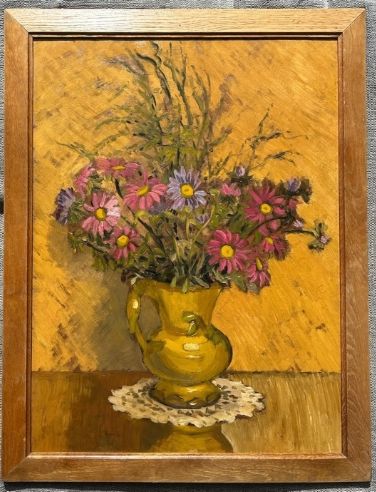
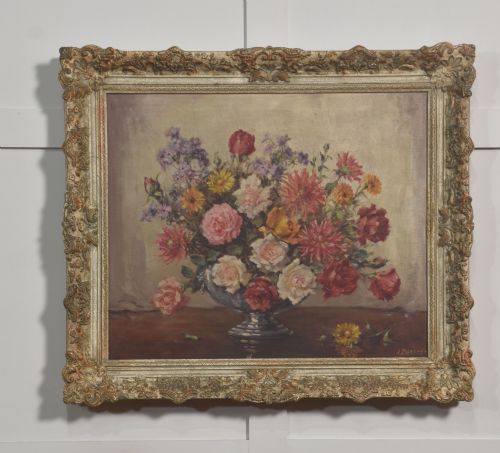
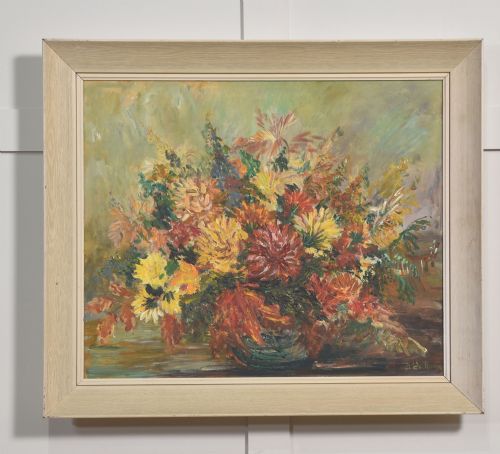
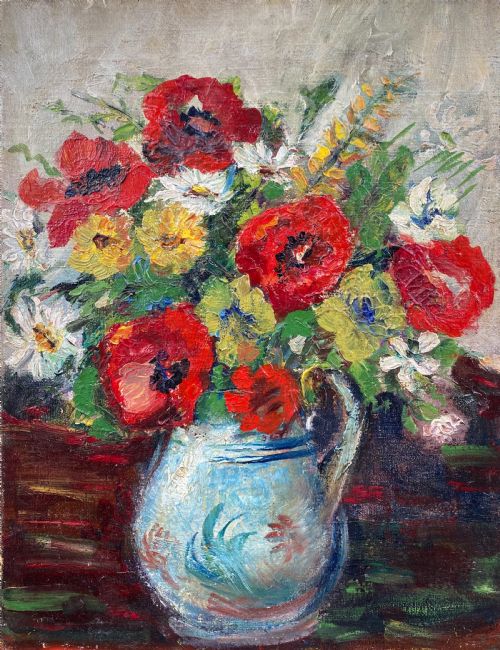
Impasto floral still life paintings bring tactile depth to walls through thickly applied oil paint on canvas or board.
Impasto Floral Still Life
An impasto floral still life presents flowers, vases, and botanical arrangements built up with thick layers of oil paint that stand proud of the canvas or board. These works capture light and shadow across three-dimensional pigment, giving petals and leaves a tangible physical presence.
The pieces on this page span from the nineteenth century through the 1920s, 1930s, 1940s, 1950s, and 1960s. Styles range across Edwardian Impressionism, Post-Impressionism, French Modernist, and Mid-Century Modern.
Buyers will encounter subjects such as poppies in vases, dahlias in bowls, and country flowers rendered by named artists and anonymous hands alike. Forms remain chiefly oil paintings and wall art executed on canvas, board, or wood panels.
How they were made
Artists built these compositions using heavy oil paint applied directly to stretched canvas, wooden board, or plaster-gilded grounds. The pigment was loaded onto brushes and palette knives to create raised ridges and tactile surfaces.
Supports varied between traditional woven canvas and rigid wooden boards, often framed in gilt moulding that complements the dense layers of colour. The physical manipulation of paint allows the brushstrokes and knife marks to remain fully visible within the finished study.
Impasto Floral Still Life Retail Price Guide 2026
Typical asking prices for impasto floral still life among the pieces listed under this phrase on Sellingantiques today, from the lower quarter to the upper quarter. They describe what is for sale here now, not the wider market.
Chestnut leaves unfurl beside poppies and dahlias, proving that even a vase of flowers needs good foliage.
What varies in quality
Quality rests upon the confidence of the brushwork and the deliberate handling of heavy pigment rather than flat application. Superior examples demonstrate a clear structural control over colour and light within the vase or interior setting.
The relationship between the floral subject and the surrounding space dictates the visual success of the composition. Stronger works balance the weight of the impasto texture with a coherent sense of proportion and depth.
Kenneth Cozens·I. Berezny·D. L. Williams·Sir Matthew Smith·Elizabeth T. Sutcliffe·Bertoldo Taubert
The Impasto Floral Still Life Glossary
- Impasto
- Paint applied thickly to a canvas or board so that it stands out from the surface. This technique allows the marks of the brush or palette knife to retain their own physical shape.
- Still life
- A work of art depicting mostly inanimate subject matter, typically commonplace objects such as flowers, fruit, and vases. These arrangements allow artists to focus on colour, form, and texture.
- Post-Impressionism
- An art movement extending roughly from the late nineteenth century that rejected naturalistic depiction in favour of expressive use of colour and form. Painters emphasised symbolic content and heavy application of pigment.
- Gilt
- Covered thinly with gold leaf or gold paint. Frames finished in this manner frequently accompany mid-century and earlier oil paintings.
Impasto Floral Still Life: Frequently Asked Questions
How do I hang an impasto oil painting?
Ensure the wall hooks match the weight of the wooden frame and canvas support. Secure picture wire directly to the heavy wooden stretcher bars rather than relying on old hardware.
Keep the painting away from direct sunlight and excessive heat sources that might affect the oil paint and canvas over time.
How are canvas and board paintings different?
Canvas provides a flexible woven support that responds to atmospheric changes and requires proper tension behind the wooden frame. Board offers a rigid wooden surface that does not flex under thick layers of pigment.
Both supports were widely used across the nineteenth and twentieth centuries for oil painting studies.
What periods do these floral paintings cover?
The selection spans from nineteenth-century botanical studies through the Edwardian period and interwar years. Post-war examples from the 1950s and 1960s represent mid-century modernist and impressionist approaches.
Stylistic shifts trace the evolution from traditional floral arrangement to abstracted cubist forms.