



Imari Pattern Ironstone Tureen
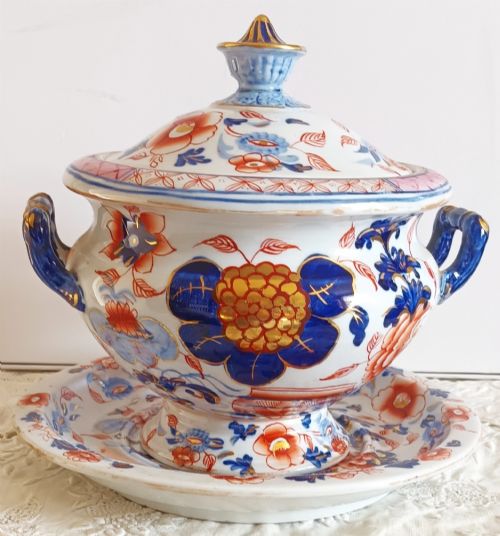
An imari pattern ironstone tureen brings vibrant English Chinoiserie colour to the table through robust 19th Century ceramic forms.
Imari Pattern Ironstone Tureen
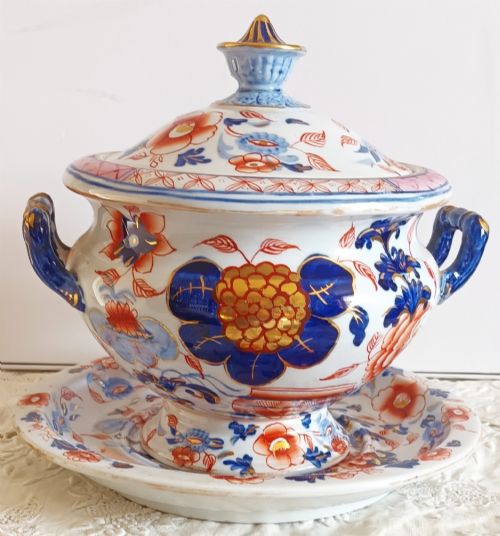
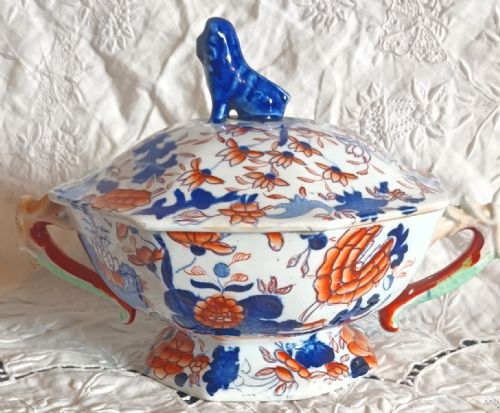
An imari pattern ironstone tureen combines heavy utilitarian ceramic bodies with striking cobalt blue, iron red, and gilt decoration. These serving vessels span soup tureens, vegetable tureens, and smaller sauce tureens designed for formal 19th Century dining tables.
The evidence shows English production primarily originating in the Georgian and Victorian eras, often taking the form of covered bowls and stands. Pieces range from large soup vessels with matching covers to paired sauce tureens equipped with ladles.
Makers utilised dense earthenware and ironstone china as durable canvases for intricate English Chinoiserie and Japan patterns. Buyers frequently encounter these robust pieces complete with original lids, stands, and decorative handles.
How they were made
Potters shaped dense ironstone ceramic and earthenware bodies to create thick, heavy walls capable of retaining heat and resisting daily wear. These sturdy forms were then coated in a smooth glaze before receiving hand-painted enamel decoration and gold leaf accents.
Designers applied traditional English Chinoiserie motifs, combining underglaze blue with vibrant iron red enamels and gilded highlights. Artisans fired these ceramic vessels multiple times to fix the complex patterns and secure the rich surface colours.
Imari Pattern Ironstone Tureen Retail Price Guide 2026
Typical asking prices for imari pattern ironstone tureen among the pieces listed under this phrase on Sellingantiques today, from the lower quarter to the upper quarter. They describe what is for sale here now, not the wider market.
What varies in quality
Quality rests in the precision of the hand-painted enamel work and the crispness of the underglaze blue transfer or brushwork. Superior examples display dense, rich applications of gold leaf alongside cleanly delineated Imari colour palettes.
The crispness of moulded details on handles, finials, and stands distinguishes finer vessels from simpler utilitarian wares. Completeness also dictates standard standing, as surviving matching covers, under-stands, and ladles elevate a piece significantly.
Mason's·Coalbrookdale
The Imari Pattern Ironstone Tureen Glossary
- Ironstone china
- A patented ceramic body developed in the 19th Century to provide a durable, vitreous alternative to porcelain. It offers immense strength while remaining receptive to intricate coloured glazes.
- Imari pattern
- A decorative style inspired by Japanese export porcelain featuring a distinct palette of cobalt blue, iron red, and gilt. English potteries adapted this aesthetic extensively during the Georgian and Victorian periods.
- Chinoiserie
- European artistic interpretations of Chinese and East Asian decorative motifs. This style heavily influences the painted scenes found across many 19th Century ceramic serving dishes.
- Sauce tureen
- A small covered vessel specifically designed for holding gravies, sauces, or melted butter at the dining table. They frequently appear in matched pairs alongside ladles and matching stands.
- Vegetable tureen
- A large covered serving dish utilised for presenting side dishes during formal meals. These pieces typically feature robust handles and fitted lids to retain heat.
Imari Pattern Ironstone Tureen: Frequently Asked Questions
What is an imari pattern ironstone tureen?
It is a heavy 19th Century ceramic serving vessel decorated in the distinctive Japanese export palette of cobalt blue, iron red, and gold.
These pieces were produced by English potteries to serve soups, vegetables, or sauces at formal dining tables.
How do I date an ironstone tureen?
Dating relies on identifying the ceramic body, maker's marks where present, and stylistic markers such as Georgian or Victorian forms.
The listings show pieces predominantly concentrated in the 19th Century, utilising dense ironstone and earthenware materials.
Were these tureens meant for everyday use?
Ironstone was specifically formulated to withstand the rigours of daily Victorian and Georgian dining without sacrificing decorative appeal.
The dense ceramic body provides exceptional durability compared to standard earthenware.
What items typically accompany a tureen?
Many serving tureens include fitted covers to keep contents warm at the table, along with matching ceramic under-stands.
Some smaller sauce versions also retain their original ladles for serving.