

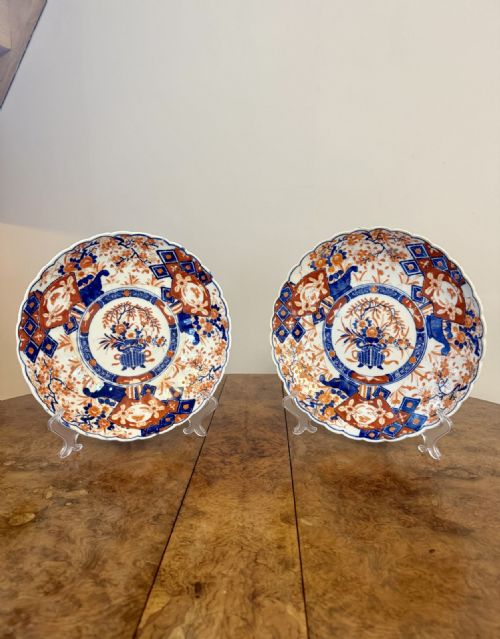


Imari Floral Motif Dish
An imari floral motif dish brings rich colour and pattern to a room, drawing the eye with traditional painted designs.
Imari Floral Motif Dish
When you search for an imari floral motif dish, you encounter painted porcelain pieces spanning the eighteenth, nineteenth, and early twentieth centuries. These items appear as decorative plates, chargers, bowls, and platters created in Japanese Imari, Chinese Export, and Edo Period Imari styles.
The version you are most likely to meet on this page is an antique Japanese imari plate from around nineteen hundred, often featuring a scalloped shaped edge. Alongside these plates, larger chargers and bowls offer bolder statements for display.
Originating from traditions in East Asia, these wares cross centuries of ceramic history. The pieces range from straightforward blue and white imari to richly decorated examples that combine multiple colours and gilding.
How they were made
These pieces rely on porcelain or ceramic bodies shaped into plates, bowls, and chargers. Potters formed scalloped edges and unusual shapes by hand or mould before firing the clay.
Decoration involves the application of glaze and enamel pigments, frequently accented with gold leaf. Artisans painted intricate floral motifs directly onto the surface, utilising the contrasting tones of cobalt blue and iron red.
Object forms include chargers, scalloped edge bowls, platters, and decorative plates finished with glaze, enamel, and gold leaf.
What varies in quality
The fineness of the painted floral motif separates standard production from superior examples. Precision in the brushwork and the vibrancy of the enamel and gold leaf dictate the visual impact of the piece.
Form and potting also define the hierarchy of these items. Scalloped edges, unusual shapes, and robust porcelain bodies demonstrate greater ambition from the potter and painter.
The Imari Floral Motif Dish Glossary
- Imari
- A style of ceramic decoration originating in Japan, known for a palette of cobalt blue, iron red, and gold. Pieces in this tradition often feature dense floral and geometric patterns.
- Charger
- A large decorative plate or platter intended for display rather than table service. These substantial pieces showcase expansive painted scenes.
- Edo Period
- The historical era in Japan lasting from sixteen hundred and three to eighteen hundred and sixty-eight. Ceramics from this time display characteristic forms and painting styles.
- Scallop Edge
- A border shaped into a series of continuous curves resembling the edge of a scallop shell. This shaping appears frequently on antique plates and bowls.
- Gold Leaf
- Hammered sheets of gold applied to the ceramic surface for decorative accent. This material highlights specific details within the painted design.
Imari Floral Motif Dish: Frequently Asked Questions
How old are these dishes?
The pieces span several periods, ranging from eighteenth-century Edo examples to nineteenth-century and early twentieth-century items.
Dating relies on stylistic clues, potting techniques, and historical context recorded in the listings.
Were these dishes used for food?
Larger chargers and decorative plates were primarily intended for display on walls or sideboards. Smaller dishes and bowls served practical functions in dining settings.
Over time, many of these decorative pieces transitioned purely into display items for collections.
How do I display an imari dish?
These dishes suit plate stands on mantels, tables, or within cabinets where their colours can catch the light. Wall mounting is also common for larger chargers.
Pairing them with neutral backgrounds allows the intricate floral motifs and gold leaf details to stand out.