


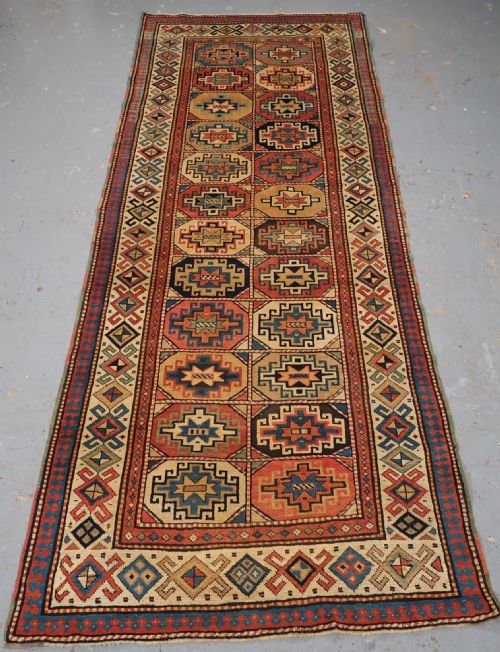


Hooked Medallion Rug
These hooked medallion rug examples bring geometric tribal artistry into a room through enduring wool and camel hair construction.
Hooked Medallion Rug
A hooked medallion rug is a tribal or village textile featuring geometric central motifs, most frequently seen originating from Caucasian and Kurdish weaving traditions. Buyers searching for a hooked medallion rug will encounter pieces spanning from the late nineteenth century into the early twentieth century.
The format ranges from square area rugs to elongated runner rugs designed for hallways and galleries. Moghan Kazak and Kurdish tribal weaving styles dominate the selections, often displaying latch hook designs across wool grounds.
What varies in quality
The sophistication of the geometric drawing and the clarity of the latch hook motifs dictate the calibre of each piece. Variations in the saturation of soft colours and the density of the wool pile also separate standard village weaving from finer tribal examples.
Listings span production dates from eighteen seventy through to nineteen twenty, featuring Caucasian and Kurdish regional styles.
The Hooked Medallion Rug Glossary
- Kazak
- A style of rug originating from the Caucasus region, known for bold geometric patterns and strong primary hues. These pieces are traditionally woven by village artisans using hand-spun wool.
- Latch hook
- A recurring geometric ornament resembling a hook or stepped triangle shape. It appears frequently in the central medallions of tribal carpets.
- Medallion
- A distinct central ornamental motif set within the field of a rug. It commands visual focus and anchors the surrounding border designs.
- Runner
- A long and narrow format of floor covering created for hallways or corridors. These pieces accommodate linear spaces while maintaining traditional village patterns.
Hooked Medallion Rug: Frequently Asked Questions
How do I place a runner?
Runners fit well in narrow hallways, corridors, and bedside spaces where linear floor coverage works best. Their elongated proportions draw the eye along the length of a room.
Ensure an appropriate underlay is used beneath the wool pile to prevent slipping on hard flooring surfaces.
How do I clean an old rug?
Professional specialist cleaning is advised for nineteenth and early twentieth century wool textiles to preserve the natural fibres. Avoid harsh chemical treatments and excessive water.
Regular gentle vacuuming without a beater bar removes surface dust and prevents dirt accumulation within the pile.
Where were these woven?
The pieces originate from tribal and village communities across the Caucasus and Kurdish regions. Weavers worked on portable or village looms using locally sourced materials.
Each weaving region developed distinct palettes and geometric vocabularies that help identify the origin of individual carpets.
What is camel hair?
Camel hair is a natural fibre utilised in select tribal weavings for its durability and warm undyed tone. It often forms the ground colour of the textile.
Over decades, the fibre develops a soft handle while maintaining structural resilience under foot.