


Historical Textile Wall Art
Historical textile wall art brings centuries of woven and stitched craft into a room, offering tactile depth that flat paint simply cannot match.
Historical Textile Wall Art
Historical textile wall art encompasses framed samplers, woven tapestries, and mounted panels spanning from the sixteenth century through the Victorian era. These pieces reflect diverse domestic and grand traditions, capturing centuries of needlework skill and textile production.
Origins range across European workshops, incorporating styles from the Renaissance and Baroque periods through to Gothic Revival and Victorian aesthetics. Each piece presents a distinct record of historic textile artistry preserved behind glass or mounted on canvas.
How they were made
Makers utilised natural fibres including wool, silk, linen, and cotton, often working upon a canvas or woven ground. Samplers demonstrate precise thread counts and varied stitch techniques executed by hand.
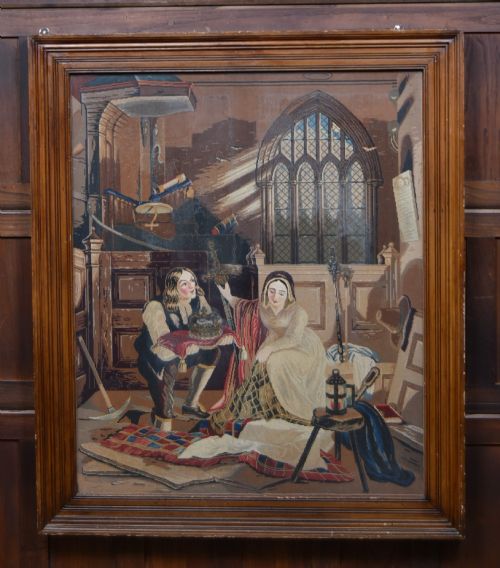
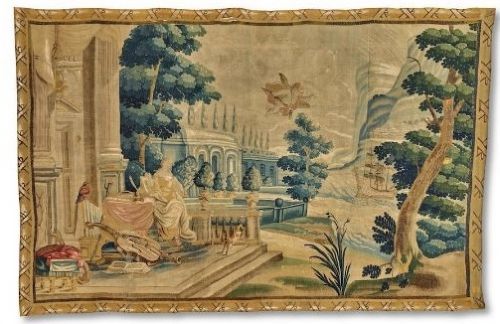
Larger wall tapestries required complex loom work, employing wool and silk threads to build pictorial depth and detailed mythological or verdure scenes. Wood and glass were subsequently used by later handlers to frame and protect these fragile textiles.
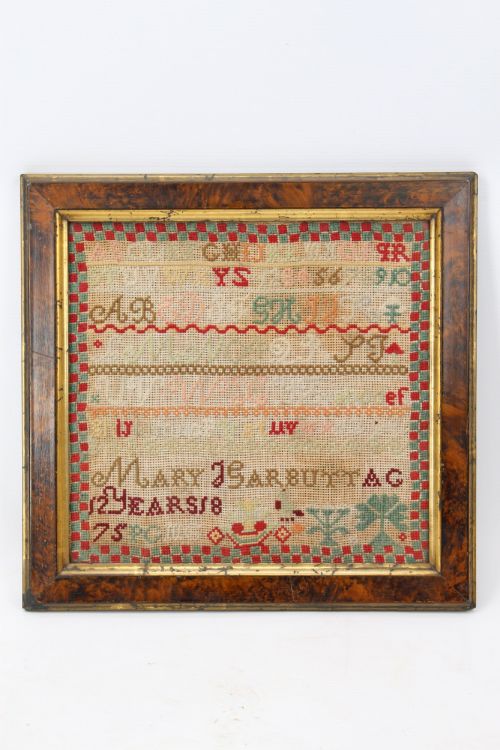
Young Mary J Garbutt recorded her needlework skills in 1875 at precisely twelve years of age.
What varies in quality
The standard of historical textile wall art rests upon the precision of the needlework and the complexity of the design. Elaborate figural compositions and finely rendered lettering on samplers demonstrate superior skill from the maker.
Preservation of the original fibres and the integrity of the ground material determine the endurance of the piece. Large-scale works that retain their rich wool and silk tones show greater material survival over the centuries.
The Historical Textile Wall Art Glossary
- Sampler
- A piece of needlework produced by a maker to demonstrate proficiency in various stitches and patterns. These often include alphabets, numerals, and genealogical details.
- Verdure Tapestry
- A woven wall hanging featuring a stylized landscape dominated by foliage, trees, and sometimes animals. These scenes were popular across European workshops.
- Needlework
- General term for decorative sewing and textile arts created using a needle and thread upon a ground fabric. This encompasses both flat embroidery and raised pile work.
- Flemish Tapestry
- A woven textile originating from Flanders, renowned for detailed mythological or historical narratives produced on large looms. These represent significant achievements in early textile art.
Historical Textile Wall Art: Frequently Asked Questions
How do I hang a tapestry?
Large tapestries require even weight distribution across a specialised hanging rod or mounted batten to prevent distortion of the weave.
Smaller framed pieces utilise standard picture-wire fixings secured directly to the wall studs.
What is a needlework sampler?
A needlework sampler is a historic textile created by a maker to practice and display different embroidery stitches. They frequently record the name, age, and date of the maker.
Examples on this page date from the Georgian and Victorian eras, often preserved within period frames.
Are these pieces framed?
Many items in this category are presented behind glass within wood frames to protect the delicate fibres from dust and handling. Larger wall hangings and tapestries may be mounted for wall display without traditional framing.
Listing titles indicate whether an item is framed or offered as a panel or hanging.