


Harvest Scene Artwork
Harvest scene artwork captures agricultural labour across the centuries, offering buyers rich depictions of rural fields and haymaking rendered in oil and watercolour.
Harvest Scene Artwork
When you search for harvest scene artwork, you encounter traditional depictions of agricultural life and rural landscapes dating from the seventeenth century through to the mid-twentieth century. The selection on this page relies heavily on nineteenth-century and early twentieth-century works, dominated by Edwardian and Victorian visual traditions.
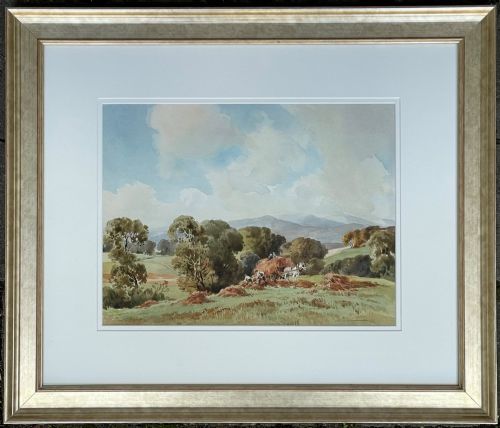
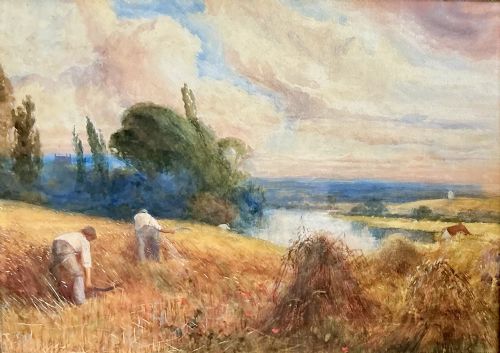
Most pieces depict labourers working in cornfields, hay carting, and riverbank harvesting scenes executed by named British painters and watercolourists. Subject matter spans from local English countryside views to specific regional landscapes involving wheat fields, hayricks, and seasonal farm labour.
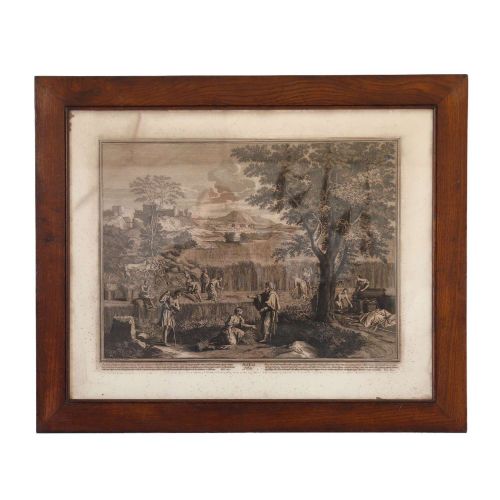
Forms include original oil paintings on canvas, delicate watercolours on paper, framed prints, and seventeenth-century engravings after classical compositions. Buyers find both intimate studies and large landscape canvases depicting rural settings at dusk or in full daylight.
How They Were Made
Artists captured these subjects using oil paint applied to stretched canvas or board, alongside transparent watercolours worked on paper supports. Canvas pieces often carry rich texture from layered oil pigments, whilst watercolours rely on fluid washes to build atmospheric skies and golden field tones.
Framed works commonly feature traditional timber frames that complement the period of the painting, sometimes preserved behind protective glass in the case of works on paper.
Listings feature works from the seventeenth century through to the nineteen-fifties, created in oil and watercolour on canvas and paper.
What Varies in Quality
Quality in these rural paintings rests upon the artist's handling of light, atmospheric depth, and the naturalistic movement of figures engaged in agricultural work. Masterful brushwork distinguishes works by established regional painters from simpler naive school compositions.
Condition plays a central role, with superior pieces retaining their original canvas tension, stable paint layers without extensive retouching, and vibrant pigments that have resisted fading over the decades.
Percy Lancaster·Frederick Hines·James William Booth·John Atkinson·William Grant Murray·J.C. Grey·Henry H Parker·Helmut Reuter·Walter Heath Williams·Walter Williams·Herbert Royle·Arthur Walker Redgate·Rowland Henry Hill·Frederick J.Knowles·Joseph Paulman·Henry John Kinnaird·Frederick William Jackson·Walter Duncan·George Hamilton Constantine·William Greaves·William Savage Cooper·Joseph Thors·David Heward·Wilmot Pilsbury·John Clayton Adams
The Harvest Scene Artwork Glossary
- Oil paint
- A slow-drying medium consisting of pigments suspended in a drying oil, typically linseed, allowing artists to build rich textures and deep tones on canvas.
- Watercolour
- A paint medium where colour pigments are suspended in a water-soluble vehicle, traditionally applied to paper to create luminous, translucent effects.
- Canvas
- Heavy woven fabric, usually linen or cotton, stretched tightly across a wooden frame to serve as the primary foundation for oil paintings.
- Engraving
- A printmaking technique where an image is incised into a metal plate, allowing multiple impressions to be transferred onto paper.
- Impressionism
- A style of painting that focuses on capturing the visual impression of the moment, particularly shifting light and natural outdoor colours.
Harvest Scene Artwork: Frequently Asked Questions
What periods do these artworks cover?
The pieces span from the seventeenth century through the Victorian and Edwardian eras up to the mid-twentieth century. Most works originate from the nineteenth and early twentieth centuries.
This broad timeframe encompasses various regional schools and changing approaches to rural landscape painting.
What materials are used in these works?
Artists utilised oil paint on canvas, watercolour on paper, and wood supports. Engravings on paper also appear alongside glass-fronted framed pieces.
These traditional materials define the physical character of each period's output.
How should I care for these paintings?
Keep watercolours and works on paper out of direct sunlight to prevent fading. Maintain stable indoor humidity and temperature for oil paintings on canvas.
Avoid hanging pieces in damp environments or areas prone to direct heat sources.
How do I identify different landscape styles?
Victorian pastoral works often emphasise narrative detail and idealised rural labour. British Impressionist pieces focus more on loose brushwork and natural outdoor light.
Examining the handling of sky, vegetation, and human figures reveals the artistic movement.