


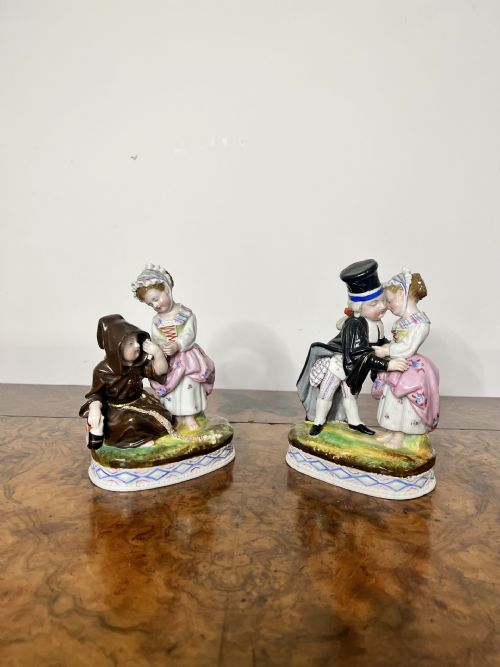


Hard Paste Porcelain Statuette
A hard paste porcelain statuette brings figures, groups, and animals from eighteenth-century and later workshops straight into your home.
Hard Paste Porcelain Statuette
When you search for a hard paste porcelain statuette, you find glazed ceramic figures and groups modelled in styles ranging from Rococo to Victorian Continental. These pieces depict street traders, musicians, gardeners, animals, and allegorical subjects created by European potteries.
You are most likely to meet Meissen and Samson of Paris figures on this page, spanning dates from the eighteenth century through to the nineteenth and early twentieth centuries. The selection includes single figurines alongside multi-figure groups such as The Broken Eggs and gardeners.
The physical forms take shape as porcelain figurines, decorative objects, and sculptural groups finished with enamel paint and occasional gilding. Each piece represents human or animal subjects captured in theatrical or domestic poses typical of European ceramic production.
How they were made
Makers shaped hard-paste porcelain using dense ceramic clay fired at high temperatures to achieve a vitreous, durable body. Artisans then applied white or tinted glaze to seal the surface before adding intricate enamel paint details.
Details such as gold leaf and gilt highlights were frequently applied over the glaze and fired again to fix the metallic lustre. Modelers sculpted subjects in moulds, assembling complex groups from multiple cast sections before final painting.
Hard Paste Porcelain Statuette Retail Price Guide 2026
Typical asking prices for hard paste porcelain statuette among the pieces listed under this phrase on Sellingantiques today, from the lower quarter to the upper quarter. They describe what is for sale here now, not the wider market.
Among the musicians and gardeners stands a Meissen monkey holding a child, proving that eighteenth-century porcelain modelling possessed a wonderfully eccentric sense of humour.
What varies in quality
The refinement of the modelling separates standard decorative output from superior sculptural work, particularly in the rendering of facial expressions, fingers, and drapery folds. Crisp definition in the pressed details and delicate brushwork on the enamel paint indicate skilled factory production.
The handling of the glaze and the precision of the gilt or gold leaf application reveal the care taken during finishing. Earlier pieces often display greater crispness in the form, while later reproductions or revival pieces vary in the weight and translucency of the porcelain body.
Meissen·Samson Paris
The Hard Paste Porcelain Statuette Glossary
- Hard-paste porcelain
- A true porcelain made from a mixture of kaolin and petuntse fired at very high temperatures. This composition results in a hard, vitrified body that resists scratching and holds sharp sculptural detail.
- Gilt
- A thin layer of gold applied to surface details such as garment borders and bases. It enhances the decorative appearance of the statuette.
- Rococo
- An artistic style characterised by elaborate ornamentation, asymmetrical curves, and scrollwork. Many eighteenth-century figures utilise this aesthetic for their bases and framing elements.
- Marcolini Period
- The tenure of Count Marcolini as director of the Meissen factory from the late eighteenth century. Pieces from this era often feature specific factory mark variations.
Hard Paste Porcelain Statuette: Frequently Asked Questions
How do I clean a porcelain statuette?
Use a soft, dry brush to gently remove dust from the crevices and delicate painted surfaces of the figure.
Avoid using water or chemical cleaners, as moisture can damage older enamel paint or flake delicate gilt highlights.
Where were these figures made?
These figures originated primarily in European factories, with Meissen in Germany producing many of the eighteenth-century examples.
Other pieces come from French makers such as Samson of Paris, who recreated earlier styles during the nineteenth century.
What is the difference between Meissen and Samson figures?
Meissen pieces date from the original German factory established in the eighteenth century and earlier.
Samson of Paris figures were produced in France during the nineteenth century as reproductions or interpretations of earlier styles.
How should I display a porcelain group?
Place figures in a stable cabinet away from direct sunlight and high traffic areas to protect them from accidental bumps.
Ensure shelves are level and sturdy enough to support the weight of denser porcelain groups.