



Harbour Wall Watercolour Painting
A harbour wall watercolour painting records maritime life and coastal architecture through delicate pigment washes on paper.
Harbour Wall Watercolour Painting
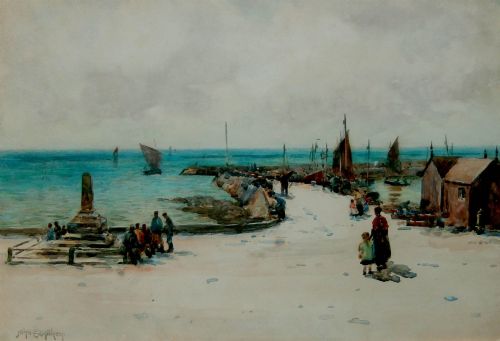
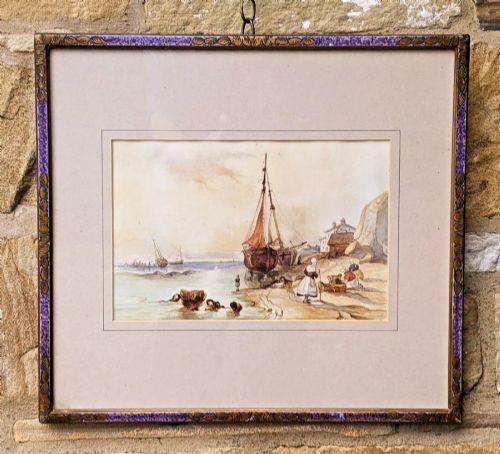
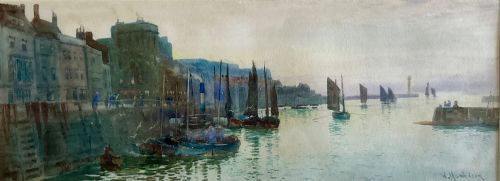
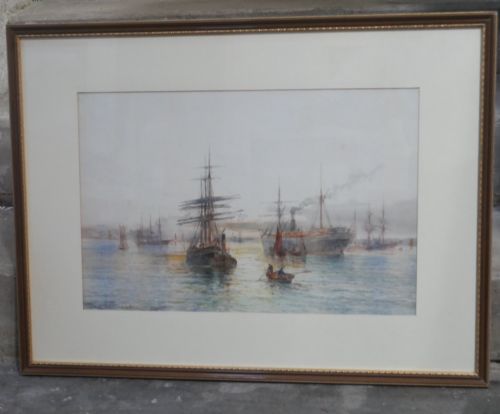
A harbour wall watercolour painting depicts maritime scenes, fishing fleets, quaysides, and coastal architecture along British and European shores. These works range from late Victorian maritime studies to early twentieth-century British Impressionist views.
The most common examples on this page date from the nineteenth century through to the mid-twentieth century, capturing busy ports, quiet havens, and sailing vessels. Artists frequently recorded specific locations such as Whitby, St Ives, and Mousehole.
Buyers encounter framed artworks that combine watercolour pigment and ink on paper, often protected beneath glass within wood or gilt wood frames. These paintings document the changing coastal light and maritime trade of past eras.
Materials and techniques
Artists applied watercolour pigment and ink onto paper surfaces, utilising the white of the paper to create highlights and luminous effects of light on water. Washes of transparent colour built up the tones of sky, sea, and stone masonry.
Works are typically presented behind glass in wood or gilt wood frames, which protected the delicate paper surfaces from atmospheric moisture and handling over the decades.
Listings feature works executed on paper using watercolour pigment and ink, housed within wood and gilt wood frames.
What separates the finest examples
Quality rests upon the sureness of the brushwork, the atmospheric handling of light and weather, and the topographical clarity of the coastal setting. The most successful pieces capture the movement of water and the texture of stone with economy and precision.
Condition of the paper and the preservation of pigment vibrancy distinguish superior examples. Works that retain their original colour intensity without excessive fading or toning represent the higher tier of the medium.
John E. Aitken·William Banks Fortescue·William Matthison·George F Pennington·Alfred George Morgan·Paul Delvaux·Commander Eric Tufnell·Richard Harry Carter·William Lee Hankey·Thomas Bush Hardy·Samuel Owen·Jan van Couver·Ernest F. Hill·Stanley Orchart·William Wyld·Alfred Robert Quinton·Percy Brooke·Ralph Todd·William Kay Blacklock·Rowland Henry Hill·Frank Wasley·Harry Wanless·Fred Mayor·Thomas Clavering Alder·S. J. Lamorna Birch
The Harbour Wall Watercolour Painting Glossary
- Watercolour pigment
- Finely ground colour particles mixed with a water-soluble binder, applied in translucent washes on paper.
- Gilt wood
- Timber framing finished with a thin layer of gold leaf or metallic gilding.
- British Impressionism
- A painting movement focusing on light, loose brushwork, and plein-air observation.
- Maritime
- Pertaining to the sea, shipping, harbours, and coastal activities.
Harbour Wall Watercolour Painting: Frequently Asked Questions
How should I hang a harbour wall watercolour painting?
Keep watercolours away from direct sunlight to prevent the pigments from fading over time. Environmental stability in the room protects both the paper and the frame.
Ensure secure wall fixings suited to the weight of the framed artwork. Professional framing with acid-free backing boards also safeguards the paper.
What periods do these watercolours come from?
The works span from the Victorian era and the nineteenth century through Edwardian times and into the mid-twentieth century. Many date from the early decades of the 1900s.
Stylistic shifts across these decades move from tight topographical accuracy to looser Impressionist interpretations of coastal light.
Are these paintings original works?
The selections consist of original watercolour paintings created by hand on paper rather than mechanical reproductions or prints. Each piece records the individual hand of the artist.
Signatures, dates, and inscriptions on the paintings or mounts often provide direct attribution to the creator.
Which locations appear most frequently?
British coastal towns and fishing ports feature prominently, particularly Yorkshire locations like Whitby and Scarborough, alongside Cornish harbours such as St Ives and Mousehole.
Scenes also extend to international waters, including European ports and distant harbours visited by naval personnel.