



Muted Grey Coastal Painting
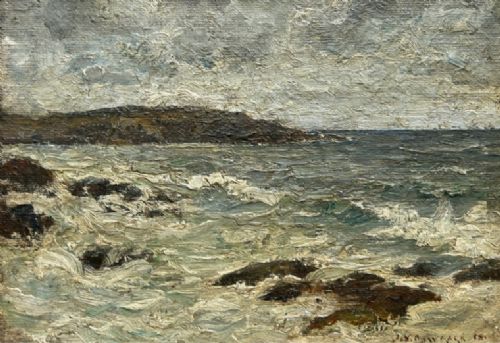
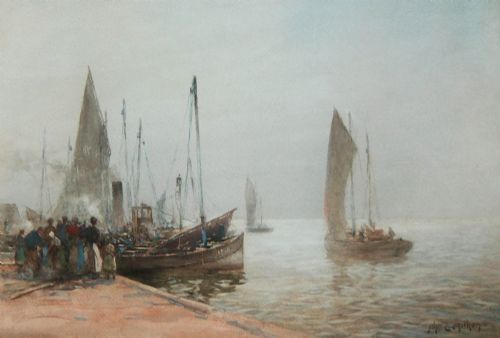
A muted grey coastal painting captures the subdued atmosphere of sea and shore through quiet tones and restrained brushwork.
Muted Grey Coastal Painting
A muted grey coastal painting brings together maritime subjects and restrained palettes, often recording harbours, fishing ports, and rocky shores. These works span from the nineteenth century through the mid twentieth century, encompassing Victorian, Edwardian, and post-war British approaches.
The version most frequently met on this page is a watercolour on paper or an oil painting on board depicting British and French coastal scenes. Artists recorded locations ranging from Scottish harbours to Yorkshire fishing villages and the French Riviera.
Makers and painters represented include named artists such as James E. Aitken, Tom Clough, James Watson, and William Lee Hankey. Their works focus on the quiet expanse of the sea, anchored by boats, quaysides, and coastal architecture.
Materials and technique
Works in this category rely primarily on watercolour pigment on paper or oil paint applied to board or canvas. Painters utilised the absorbent quality of paper to create translucent washes for skies and water, or built up thicker impasto layers in oil to render the texture of rocky coastlines.
Support materials range from traditional wood boards and stretched canvas to various weights of paper. Artists also employed pastel on paper for specific post-impressionist interpretations of northern harbours.
Period coverage extends from nineteenth century Victorian pieces through Edwardian works to mid twentieth century paintings.
Evaluating quality and execution
Quality rests upon the artist's handling of light and atmospheric tone rather than scale or subject complexity. Superior examples demonstrate a confident economy of mark-making, capturing the damp air and shifting grey light of the shore with precision.
The distinction between standard decorative works and finer pieces lies in the subtlety of the palette and the structural composition. Stronger paintings utilise the natural grain of the board or texture of the paper to enhance the sense of place.
James E Aitken·Tom Clough·James Watson·Ernest F Hill·Rowland Henry Hill·Hirst Walker·William Lee Hankey·William Collins·Harry Wanless·GM de L'Aubiniere·Carleton Grant·Cuthbert Crossley
The Muted Grey Coastal Painting Glossary
- Impasto
- Paint applied thickly to a surface so that it stands out in relief. This technique allows brush or palette knife marks to retain their physical dimension on board or canvas.
- Watercolour
- A paint consisting of colorants suspended in a water-soluble vehicle. It is typically applied to paper in transparent washes.
- Post-Impressionism
- An art movement extending roughly from the late nineteenth century to the early twentieth century. Artists rejected the naturalism of impressionism in favor of more expressive use of form and colour.
- Marine art
- Painting and other visual arts that depict the sea, ships, and shorelines. These works often focus on harbours, shipping, and coastal weather.
- Board
- A rigid flat piece of wood or compressed material used as a support for oil paintings. It offers a stable alternative to stretched canvas.
Muted Grey Coastal Painting: Frequently Asked Questions
What periods do these coastal paintings cover?
The listings include works from the nineteenth century, Victorian and Edwardian eras, through to mid twentieth century modernist and post-war periods.
Dates span from the 1870s up to the 1950s and 1960s, showing shifts in British and European landscape painting.
How are these marine artworks executed?
Artists worked primarily in watercolour on paper, alongside oil paintings on board and canvas, plus occasional pastel works.
Techniques range from thin, translucent washes capturing damp coastal air to heavy impasto strokes defining rocky shores.
Where do the depicted coastal scenes originate?
Subjects record locations across Britain, including Yorkshire harbours, Scottish coasts, Welsh waters, and St. Ives.
Other works document continental locations such as the French Riviera and Rouen in Normandy.
How should I frame an antique watercolour?
Watercolours require conservation mounting with acid-free board to prevent the paper from touching the glass.
Keep them away from direct sunlight to protect the pigments from fading over time.