


Edwardian Coastal Watercolour
Edwardian coastal watercolour paintings capture British maritime life on paper, offering collectors authentic scenes of harbours, fishing boats and coastal villages.
Edwardian Coastal Watercolour
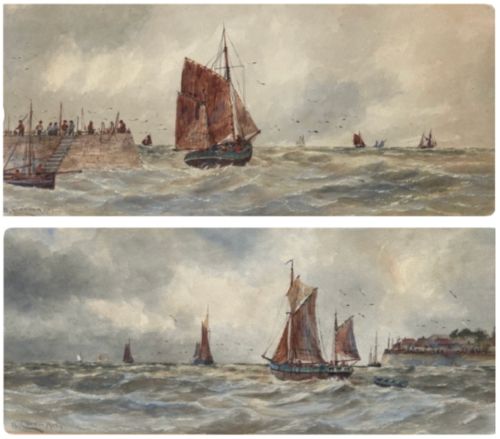
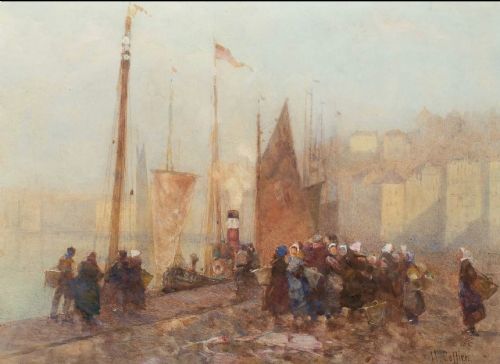
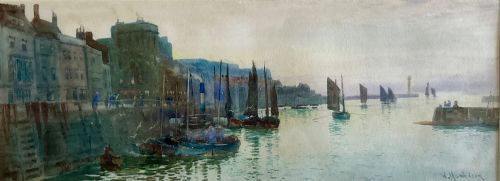
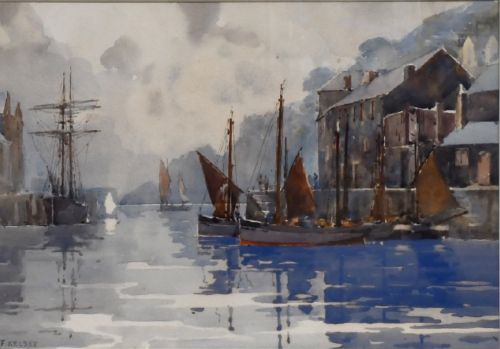
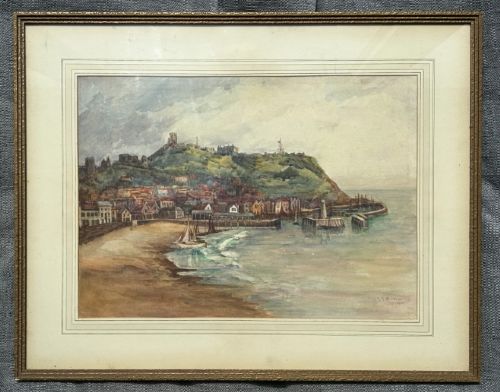
An edwardian coastal watercolour typically portrays British maritime subjects, from bustling Yorkshire fishing ports like Whitby to quiet Cornish harbours and South Coast anchorages. These works record regional working life, capturing luggers, trawlers, and fleets awaiting return under changing skies.
Most examples date from the early twentieth century, spanning Edwardian and Victorian periods, with occasional pieces stretching into the interwar decades. Painters of this era worked directly from coastal observation, producing atmospheric depictions of local docks, quaysides, and open seas.
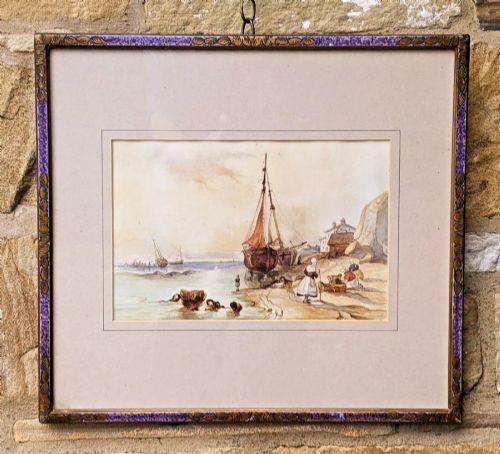
The format ranges from intimate studies to framed gallery pieces, executed on paper and frequently housed behind glass within wooden or gilt frames. Buyers encounter both signed works by known regional artists and unsigned topographical views of coastal landscapes.
Materials and technique
Artists painted primarily with watercolour pigment on paper supports, sometimes introducing gouache to add opacity and highlight foaming waves or bright sails. The transparency of the medium allowed washes of blue, grey, and ochre to build atmospheric light across skies and open water.
Finished works received protection beneath glass and were mounted in wooden frames, frequently finished in gilt to complement the palette of the painting. Paper preparation and pigment quality determined how effectively these coastal scenes preserved their tone over time.
The selection documents British coastal scenery, focusing on Yorkshire harbours, Cornish fishing villages, and southern estuaries.
Distinctions in quality
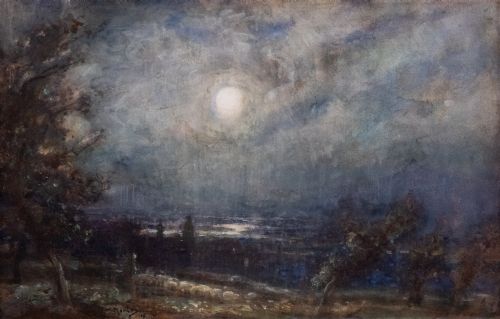
Quality rests on the sureness of the brushwork and the artist's ability to capture the specific light, weather, and movement of a coastal location. Stronger paintings convey atmospheric depth in the sky and sea rather than relying on stiff topographical recording.
Condition remains central, distinguishing clean sheets with vibrant pigments from works damaged by damp, foxing, or fading caused by exposure to light. The presence of original framing materials and clear signatures by recognised regional painters further elevates an individual piece.
William Cannon·Thomas William Morley·Hector Caffieri·William Matthison·Frank Kelsey·George F Pennington·Alfred George Morgan·Richard Harry Carter·Arthur Tucker·Tom Clough·Fred Waugh·James Watson·George Hamilton Constantine·Frank Wood·James Thomas Watts·Leslie Rackham·Herbert Hughes-Stanton·H E Tidmarsh·Ernest F Hill·Frederick Stuart Richardson·Edith E Caswall·Percy Brooke·Alfred Robert Quinton·Albert Robert Quinton·William Tatton Winter
The Edwardian Coastal Watercolour Glossary
- Watercolour
- A painting method where fine pigment is suspended in a water-based solution and applied to paper. It relies on the white of the paper showing through transparent washes to create light and luminosity.
- Gouache
- An opaque water-based paint similar to watercolour but mixed with a binding agent and white pigment to create solid, heavier coverage. Artists used it alongside watercolour to add highlights to water and clouds.
- Newlyn School
- An art colony based in Cornwall during the late nineteenth and early twentieth centuries. Painters associated with this group focused on naturalistic depictions of local fisherfolk and coastal life.
- Lugger
- A traditional small sailing vessel rigged with lugsails, commonly used by British fishermen along the Channel and West Country coasts. These boats frequently appear in early twentieth-century maritime scenes.
- Foxing
- Small brownish spots or patches that develop on old paper due to chemical reactions over time. Collectors monitor this fungal or iron-related discolouration when assessing the condition of vintage works.
Edwardian Coastal Watercolour: Frequently Asked Questions
Where were these coastal watercolours painted?
These paintings were executed at various British ports and shorelines, with strong representation from Yorkshire locations like Whitby and Staithes, alongside Devon and Cornwall.
Artists also recorded scenes along the Hampshire coast, East Anglian broads, and overseas locations such as Corfu and Arabian landscapes.
How should I frame and hang them?
Watercolours on paper require protection from direct sunlight to prevent the pigments from fading over time. Standard framing with acid-free mounts and glass keeps atmospheric moisture away from the paper surface.
Positioning them on interior walls away from direct heat sources ensures the paper and wooden frames remain stable for decades.
How do I distinguish regional schools?
Regional styles often reflect the specific coastal communities where artists gathered to paint, such as the distinct fisherfolk studies emerging from West Country colonies. Subject matter, handling of local light, and particular maritime architecture help identify specific coastal areas.
Signatures or inscriptions on the reverse frequently confirm the exact harbour or beach depicted.
Are gouache and watercolour combined?
Many works on paper from this period combine transparent watercolour washes with opaque gouache highlights. Artists utilised this mixed technique to build texture on cresting waves, sails, and clouds.
This combination added greater tonal contrast to maritime scenes without altering the primary medium.