
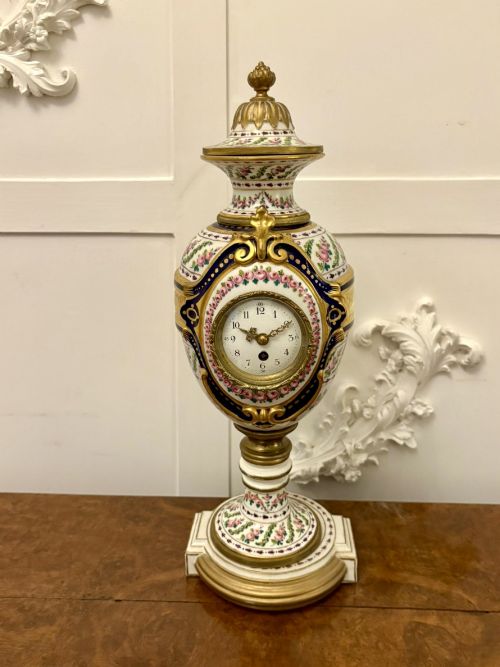

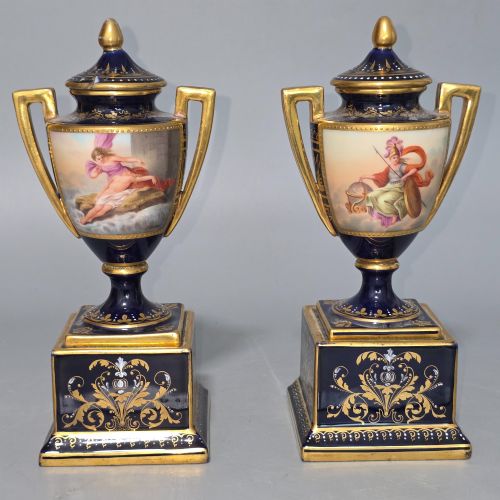


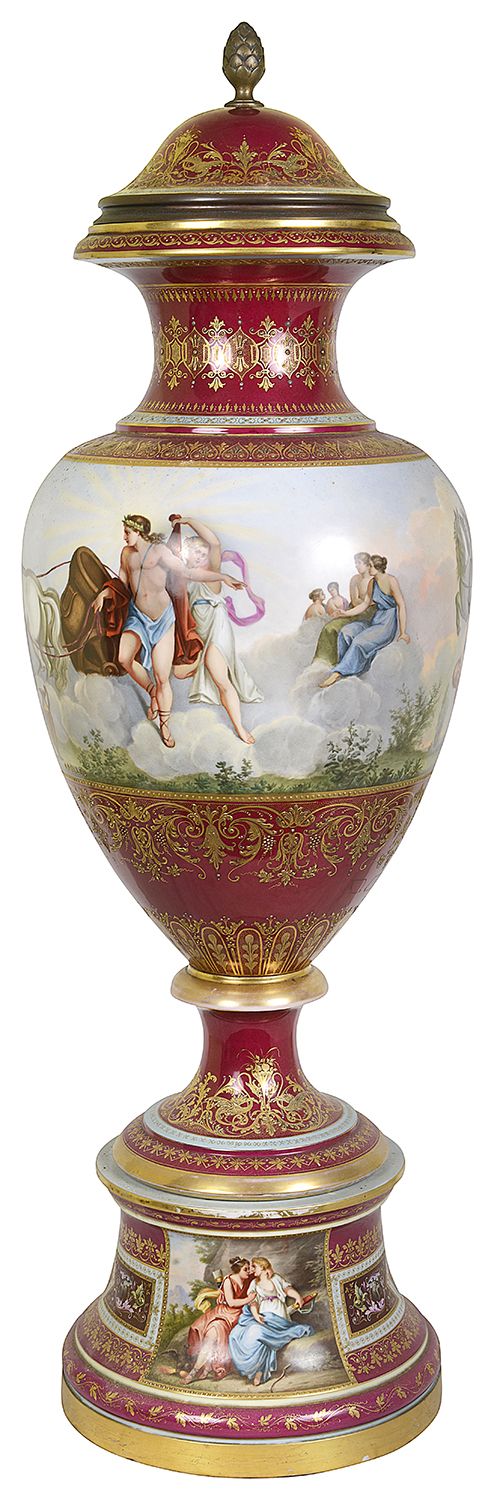
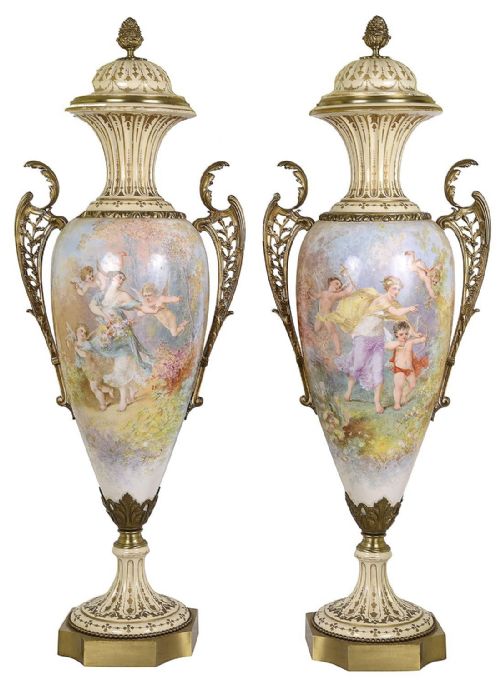
Hand Painted Classical Urns
These hand painted classical urns bring the weight of nineteenth century porcelain and ormolu into a room.
Hand Painted Classical Urns
When you search for hand painted classical urns, you encounter porcelain vases, lidded vessels, and mantle clock garnitures originating mainly from the nineteenth century. The selection leans heavily toward Vienna, Sevres style, and Italian manufacture, often taking the form of paired display pieces or single monumental urns. Makers and decorators utilised neoclassical, empire, and rococo revival styles to shape these ceramic bodies into formal decorative objects.
The objects take various functional and decorative forms, including pedestal vases, ewers, amphoras, table lamps, and complete garniture sets of three. Many sit upon matching porcelain bases or incorporate brass and ormolu mounts to heighten their architectural presence. Most examples date from the late nineteenth century, reflecting a strong Victorian taste for continental ceramic tradition.
How they were made
The foundation of these pieces rests on hard paste porcelain and majolica bodies, shaped on the wheel or cast in moulds before receiving their initial firing. Artisans then applied polychrome enamel pigments by hand, rendering figural portraits, floral panels, and classical scenes directly onto the ceramic surface. Gilding with gold leaf, gilt, and ormolu accents finished the rims, handles, and bases.
Metal components such as brass, gilt bronze, and ormolu mounts were cast separately and fitted mechanically or fixed with adhesives to the porcelain bodies. Glass variations appear in Bohemian productions, utilising traditional hot working and enamelling techniques. Firing processes ensured the vitreous enamel colours bonded permanently with the underlying glaze.
What varies in quality
The refinement of the hand painting separates standard production wares from superior examples, with artist signed panels and detailed brushwork commanding attention. The crispness of the porcelain moulding and the weight of the associated ormolu mounts indicate the original workshop investment. Signed pieces and matched garniture sets demonstrate greater cohesion between the ceramic body and its decorative scheme.
Proportion and scale dictate visual impact, where larger monumental vases and balanced pairs maintain symmetry across handles, covers, and pedestals. The richness of the gilding and the preservation of enamel colours over time distinguish well kept pieces from those with heavy surface wear.
Royal Vienna·Meissen·Minton·KPM
The Hand Painted Classical Urns Glossary
- Garniture
- A set of matching decorative vessels, usually three or five pieces designed to sit together on a mantelpiece or sideboard.
- Ormolu
- Finely ground high carat gold applied to a bronze base, used for decorative mounts on nineteenth century porcelain.
- Amphora
- A two handled jar with a narrow neck, modelled on ancient Greek and Roman storage vessel forms.
- Ewer
- A large jug with a wide spout and elaborate handle, often paired with a basin or displayed as a decorative art piece.
- Majolica
- Heavy earthenware coated with an opaque tin glaze, brightly painted with historical or classical motifs.
Hand Painted Classical Urns: Frequently Asked Questions
What is a garniture set?
A garniture set consists of three or more matching vases or urns designed to be displayed together as a unified group on a mantelpiece.
These sets were produced in various nineteenth century European factories to create symmetrical focal points in formal rooms.
Were these urns used for flowers?
Most of these large decorative urns and lidded vases served strictly as ornamental display pieces rather than practical flower containers.
Their delicate hand painted surfaces and gilt mounts meant they were placed on side cabinets and pedestals to demonstrate taste and wealth.
How should I clean a painted porcelain urn?
Dust the surface gently with a soft, dry brush to prevent any accumulation of dirt within the intricate ormolu mounts and handles.
Avoid using water, liquid cleaners, or abrasive cloths, as these can damage the hand painted enamels and delicate gold leaf details.