
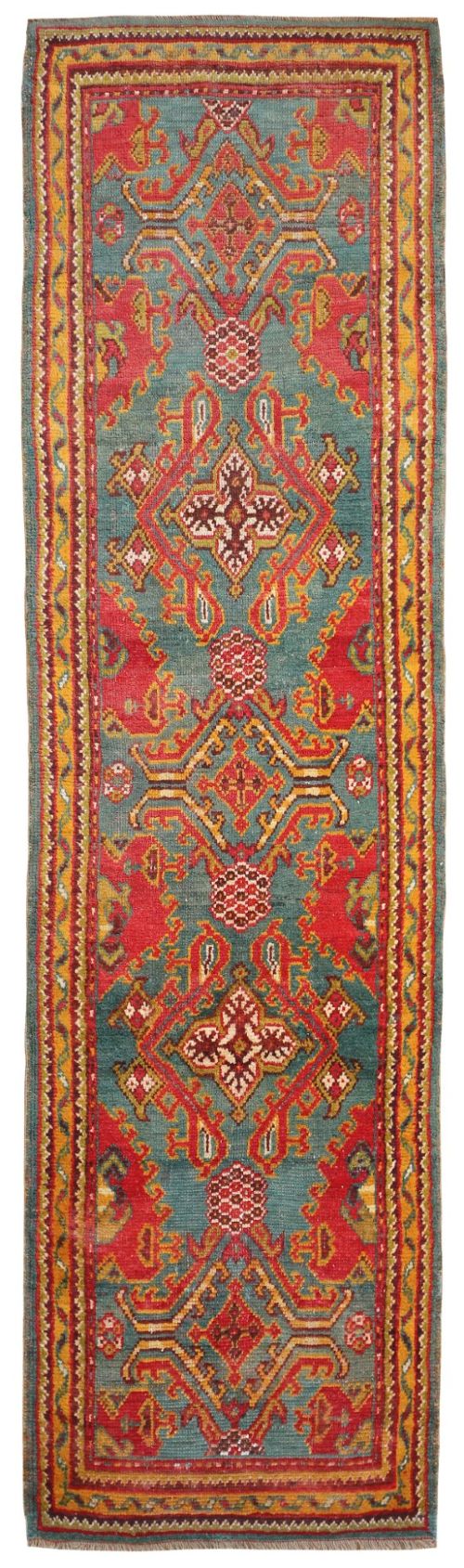



Hand Knotted Ushak
These hand knotted ushak carpets are grand Turkish floor coverings prized for their muted palettes and large scale decorative designs.
Hand Knotted Ushak
A hand knotted ushak represents a traditional Turkish weaving tradition originating from the town of Ushak in Anatolia. When searching for hand knotted ushak pieces, collectors encounter room sized carpets, square formats, and long runners dating from the late nineteenth century into the early twentieth century. These floor coverings bridge traditional Ottoman motifs and the paler, softer decorative schemes favoured by Western interiors during the Victorian era and later.
The pieces appearing here span specific decades from the 1870s through the 1920s, showing styles described variously as Ottoman, Anatolian, and Turkish. Formats range from modest rugs to oversize carpets measuring over four metres in length, alongside matched pairs of runners. Such variety allows these textiles to serve both as central drawing room focal points and as substantial hallway runners.
Materials and construction
These floor coverings rely on natural fibres, combining wool and cotton foundations and surface piles with specific inclusions of angora wool. Artisans tied individual knots by hand onto foundational warps and wefts, creating durable textiles designed to withstand generations of daily use. The inclusion of angora wool in certain examples yields a softer handle and a subtle lustre on the pile surface.
Dyes derived from natural sources interact with the wool and cotton to produce the characteristic faded tones seen across the period. The structural interplay between sturdy cotton foundations and plush woollen piles gives each rug its characteristic weight and drape on the floor.
Maples once operated as a grand London department store, occasionally stamping its name onto substantial Turkish carpets destined for stately British drawing rooms.
Judging quality and proportion
Quality in these carpets rests on the harmony of the overall design, the nuance of the faded colour palette, and the integrity of the weave. Finer examples display balanced medallions and crisp secondary motifs against ivory or saturated grounds, whilst simpler pieces lean on repetitive field patterns.
Scale and proportion separate standard room sizes from oversize decorative carpets. The fineness of the knotting and the clever use of angora wool fibres distinguish standard utilitarian production from the grander pieces commissioned for formal drawing rooms.
Maples
The Hand Knotted Ushak Glossary
- Ushak
- A town in western Anatolia renowned for producing distinctive Turkish carpets with large scale floral and geometric designs. These rugs are historically linked to Ottoman weaving workshops.
- Angora wool
- A soft fibre derived from angora goats, utilised in specific antique rugs to impart a silk like sheen and a particularly plush texture. This material catches the light differently than standard sheep's wool.
- Runner
- A long, narrow carpet format designed specifically for corridors, hallways, or alongside large beds. Surviving pairs of these narrow formats are particularly valued for symmetrical spaces.
- Medallion
- A central ornamental motif placed in the middle of the carpet field. In these Turkish pieces, medallions often feature curved floral or lobed geometries.
Hand Knotted Ushak: Frequently Asked Questions
How do I clean an antique ushak rug?
Maintenance requires gentle surface vacuuming without a beater bar to protect the delicate wool and cotton foundations. Professional textile conservators should handle deep washing to preserve the natural dyes.
Keeping the rug out of direct, harsh sunlight prevents the soft tones from fading unevenly. Rotating the floor covering periodically ensures even wear across high traffic areas.
Where were these carpets originally made?
Production centred on the historic town of Ushak in the Anatolian region of Turkey. Workshops here produced textiles for domestic Ottoman use and for export to European markets.
Design influences blended traditional Turkish motifs with Western decorative tastes, particularly during the late nineteenth and early twentieth centuries.
What is an angora ushak?
An angora ushak incorporates angora wool into the pile alongside traditional sheep's wool. This specific fibre gives the surface a distinctive soft handle and a gentle sheen.
These particular rugs often exhibit a particularly luminous quality when viewed from different angles in natural light.
How do I style a large ushak carpet?
Large formats work well as the foundational anchor for a drawing room or dining space, often layered over wooden floorboards. Their muted palettes allow them to complement both traditional antique furnishings and minimalist contemporary interiors.
Matching pairs of runners suit long hallways, grand galleries, or flanking spaces where symmetry is desired.