
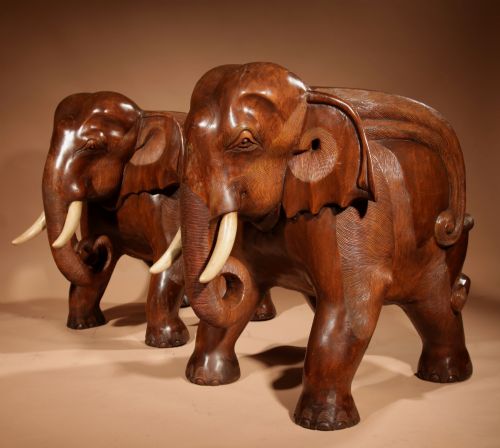
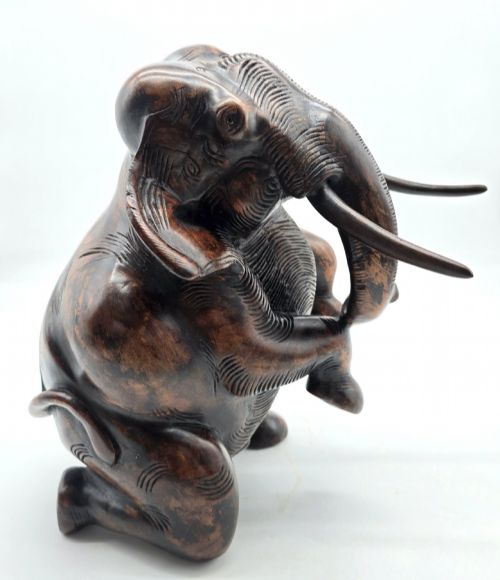


Hand Carved Hardwood Elephant
These hand carved hardwood elephant pieces bring tactile colonial craft and sculptural presence into a room.
Hand Carved Hardwood Elephant
When you search for hand carved hardwood elephant, you encounter a distinct group of decorative sculptures, occasional tables and armchairs from the late nineteenth and early twentieth centuries. These works emerge predominantly from the Anglo-Indian and Anglo-Burmese colonial periods, reflecting the complex cross-cultural design exchanges of the era. The selection spans from functional side tables supported by figurative legs to detailed animal studies and seating.
Tables form the most common format on this page, often featuring circular tops supported by carved elephant figures or motifs. Alongside these furniture pieces, you find standalone sculptures, bookends and armchairs that incorporate sculptural elements into their frames. The origins trace back to workshops in regions such as the Bombay Presidency and Burma, capturing a specific regional aesthetic.
How they were made
Artisans utilised dense timbers such as teak, ebony and general hardwoods to withstand intricate chisel work without splitting. These materials provided the structural integrity needed for both load-bearing furniture like armchairs and tables, and delicate animal studies. The natural grain of the wood often informed the surface texture and finish of the carving.
Materials recorded across the inventory include teak, ebony, bone, brass and general hardwoods.
What varies in quality
The degree of anatomical accuracy and depth of relief carving separates standard production from superior examples. Master carvers achieved realistic proportions and expressive postures in animal studies, whereas lesser pieces display rigid forms and shallow detailing. Natural variations in timber selection also influence the weight, grain pattern and overall visual depth of the object.
Integration between structural utility and sculptural form dictates the standard of furniture pieces. In better examples, the elephant figures support table tops or chair arms harmoniously without appearing tacked on. The condition of delicate inlays and the stability of joints further distinguish fine specimens from simpler regional items.
The Hand Carved Hardwood Elephant Glossary
- Anglo-Indian
- Pertaining to decorative arts produced in India during the period of British rule, combining local craftsmanship with European furniture forms. This style heavily influences the tables and seating seen in this category.
- Raj period
- The era of British crown rule in the Indian subcontinent, spanning from eighteen fifty-eight to nineteen forty-seven. Many sculptural studies and tables on this page originate from this specific timeframe.
- Ebonised
- Wood treated with a dark stain, dye or paint to imitate the appearance of genuine ebony. This technique was frequently applied to regional hardwoods to achieve a uniform black finish.
- Bone inlay
- Small pieces of animal bone fitted into shallow recesses carved into the wooden surface to form geometric or floral patterns. This decorative method enhances the visual contrast on select tables and occasional pieces.
- Relief carving
- A sculptural technique where figures or patterns project from a background plane of the same material. The depth of this carving determines the three-dimensional quality of the animal studies.
Hand Carved Hardwood Elephant: Frequently Asked Questions
What woods were used?
Makers utilised dense regional timbers including teak, ebony and general hardwoods. These materials provided the necessary strength for intricate carving.
Lighter woods also received ebonised treatments to replicate the dark appearance of solid ebony.
How do I date them?
Dating relies on stylistic markers, tool marks and historical context pointing to the late nineteenth and early twentieth centuries. Anglo-Indian and Raj period pieces typically display specific regional carving characteristics.
Construction methods and material choices further help place an item within this colonial era.
Where were they made?
Production centred in workshops across the Indian subcontinent and Burma during the colonial period. Specific regions, such as the Bombay Presidency, developed distinct carving traditions.
These local methods merged with British furniture demands to create tables and seating for export and local use.
How do I clean them?
Maintenance involves dusting with a soft, dry cloth to protect the intricate crevices of the hand-carved surfaces. Avoid liquid cleaners that might penetrate unsealed wood or damage bone inlays.
Applying a neutral wax occasionally helps preserve the finish of the hardwood.