
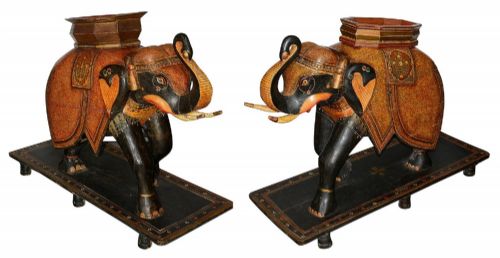
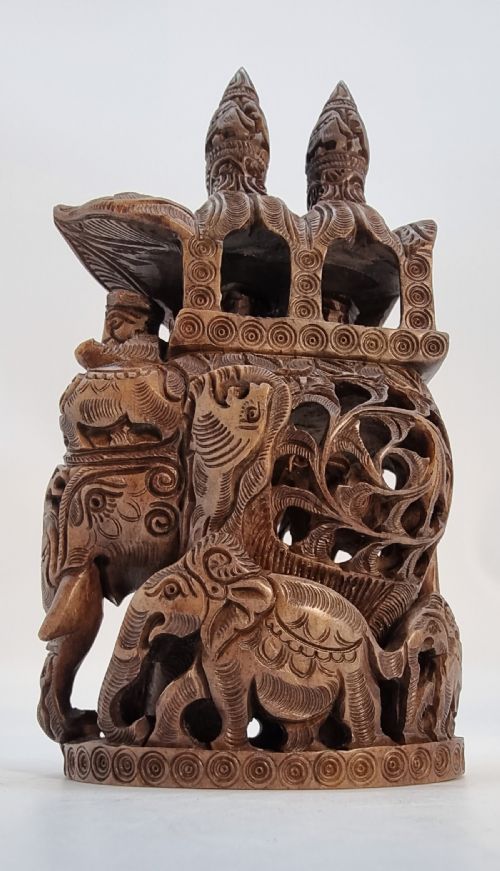


Indian Carved Elephant Figure
An indian carved elephant figure brings the character of the colonial era into a room through dense timber and bone.
Indian Carved Elephant Figure
When you search for an indian carved elephant figure, you encounter sculptures, bookends, and decorative studies originating from the nineteenth and early twentieth centuries. These objects span Victorian, Raj period, and Anglo-Indian colonial styles, capturing both ceremonial beasts and performing subjects.
Origins range from Kashmiri workshops to broader regional Indian production centres, alongside British adaptations from the Victorian era. Each format reflects the aesthetic exchanges of the nineteenth century through varied animal postures and mounted bases.
How they were made
Artisans carved these figures primarily from dense, dark timbers like ebony, teak, and coromandel, occasionally turning to soapstone or steatite for studies. Grain orientation dictated the crispness of the carving, allowing carvers to render detailed musculature and ceremonial caparisons directly into the solid material.
Lacquer, pigment, and gesso appear on specific Kashmiri examples to introduce colour and pattern to the wooden surface. Bone elements were shaped separately and inserted to represent tusks, contrasting sharply with the dark polished bodies of the ebony and hardwood sculptures.
Materials documented in the inventory include bone, hardwood, gesso, pigment, lacquer, soapstone, and steatite.
What varies in quality
The distinction between standard commercial work and superior examples lies in the precision of the carving and the selection of the timber. Dense, heavily figured hardwoods retain crisp lines in the rendering of feet, trunks, and decorative trappings over decades of handling.
Proportion and stance separate a static piece from a convincing study, particularly in figures depicting movement or carrying keepers. The integration of separate materials, such as bone tusks fitted neatly into carved sockets, indicates the hand of a more accomplished artisan.
The Indian Carved Elephant Figure Glossary
- Anglo-Indian
- Descriptive of decorative arts produced in India during the British colonial period, often combining local materials with European forms.
- Steatite
- A metamorphic rock also known as soapstone, valued for its soft texture which permits intricate hand carving.
- Gesso
- A plaster-like mixture applied to wooden surfaces to provide a smooth ground for the application of paint or lacquer.
- Coromandel
- A dense, heavily figured tropical hardwood imported from South Asia, dark in colour and closely related to ebony.
- Raj period
- The era of British crown rule in the Indian subcontinent, spanning from eighteen fifty-eight to nineteen forty-seven.
Indian Carved Elephant Figure: Frequently Asked Questions
What periods do these elephant figures come from?
The listings span the nineteenth and early twentieth centuries, encompassing the Victorian era and the Raj period.
Dating relies on stylistic markers and the specific timbers utilised by makers of those decades.
How were these carved figures used originally?
Many served as decorative sculptures on desks and mantelpieces, while others functioned practically as bookends.
Larger studies were displayed in libraries and drawing rooms as reminders of colonial travel and trade.
What materials are most common?
Hardwoods dominate the selection, with ebony, teak, and coromandel appearing frequently across the inventory.
Soapstone and bone also occur, alongside applied lacquer, gesso, and pigment on specific regional examples.
How do I care for a wooden elephant carving?
Keep the timber away from direct heat sources and sudden humidity changes to prevent splitting in the dense wood.
Dust gently with a dry cloth and avoid harsh cleaning products that might strip the historic polish or lacquer.