




Half Moon Sideboard
A half moon sideboard brings a curved presence and practical surface to a room, drawing the eye with its disciplined semicircular footprint.
Half Moon Sideboard
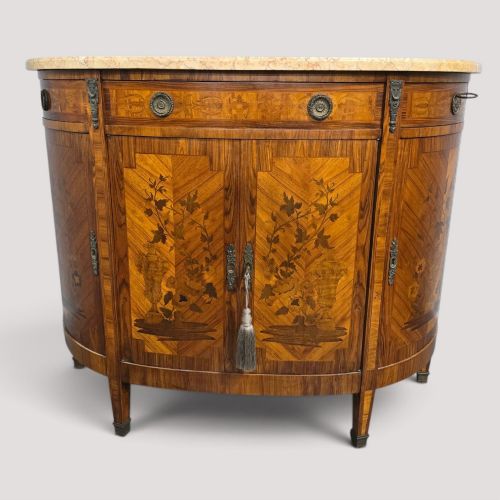
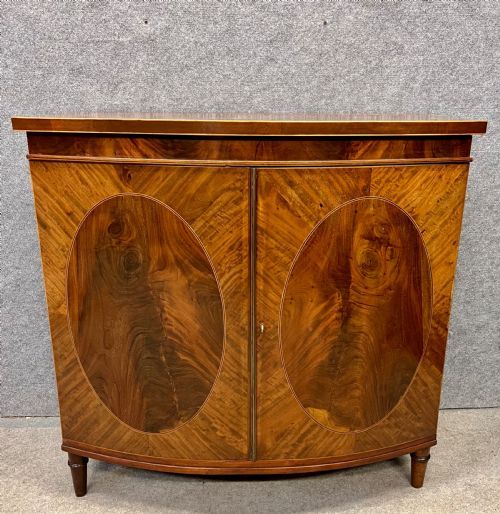
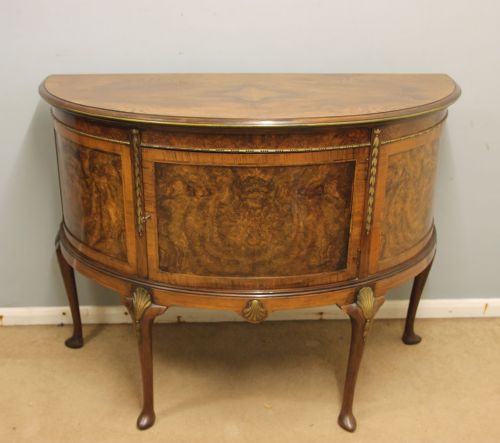
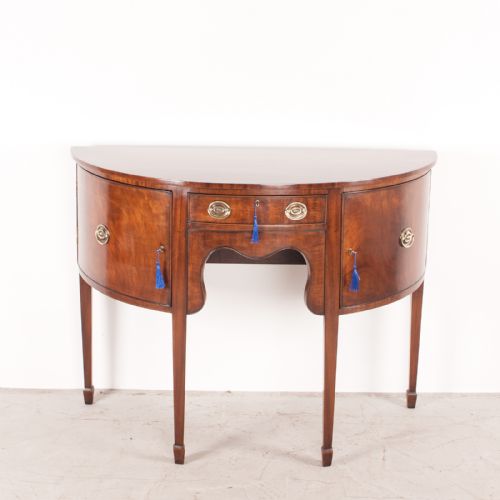
When you search for a half moon sideboard, you are looking at semicircular cabinets, commodes and sideboards designed to sit flush against a wall while offering surface display and interior storage. The pieces meeting this description span from the 18th century through the Edwardian era and into the early 20th century, encompassing styles such as Sheraton Revival, Neoclassical and French Louis XVI.
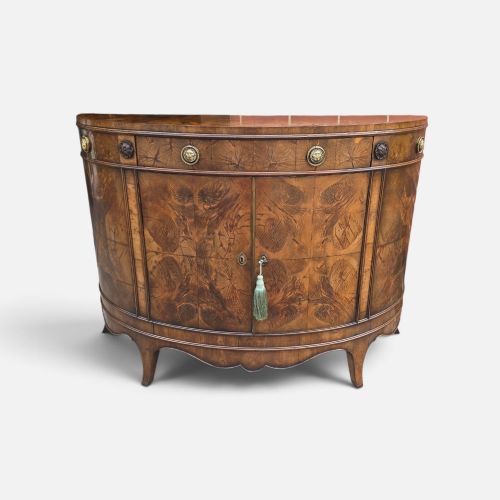
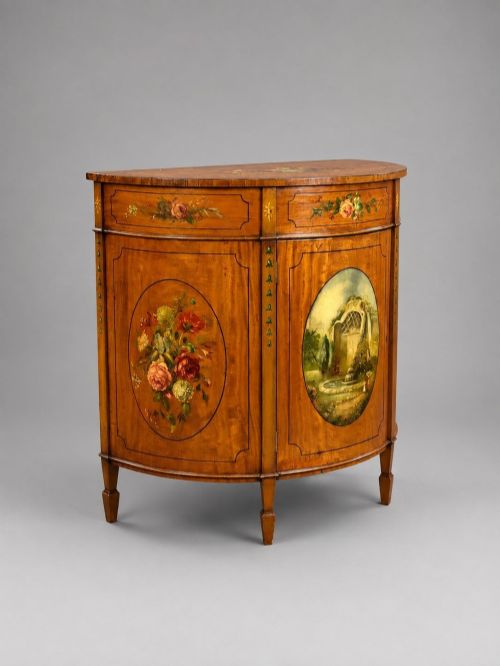
The form appears in various timber and decorative configurations, ranging from simple mahogany and walnut constructions to elaborate satinwood pieces decorated with marquetry and painted panels. You are most likely to encounter Edwardian and 1920s interpretations alongside earlier Georgian and 19th-century examples featuring marble tops or tambour doors.
How they were made
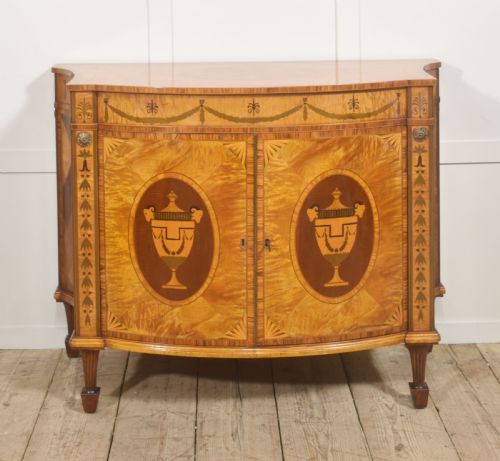
Cabinetmakers constructed these semicircular carcases using timbers such as mahogany, walnut, satinwood, yew and burr elm, often applying complex veneers and detailed marquetry inlay. Boxwood stringing and brass mounts frequently accent the edges and feet of the better examples.
Surface decoration relies heavily on hand-painted panels or elaborate marquetry motifs, executed within traditions that span the Neoclassical and Sheraton Revival styles. Ebonised finishes and marble tops also appear among the material combinations recorded in the pieces.
The listings span from the 18th century to the 1930s, featuring materials such as satinwood, mahogany, walnut, marble and brass.
What varies in quality
The standard of timber selection and marquetry work dictates the visual impact of the piece, separating plain utility examples from high-status items. Fine deployment of figured veneers like burr elm or satinwood, paired with crisp boxwood stringing, creates a sharper definition across the curved facade.
The execution of painted panels and decorative details marks the distinction between standard workshop production and exhibition quality output. Superior proportions and disciplined adherence to Neoclassical or Sheraton Revival idioms elevate the standing of a cabinet.
James Hicks·Pietro Ferrario·Kaufman
The Half Moon Sideboard Glossary
- Demi-lune
- A half-moon or semicircular shape used to describe the footprint of these cabinets and commodes. This French term frequently appears interchangeably with the phrase half moon sideboard in historical listings.
- Marquetry
- The art of applying pieces of veneer to a structure to form decorative patterns and pictures. It appears frequently on satinwood surfaces within this category.
- Commode
- A low cabinet or chest of drawers, often used interchangeably with side cabinet in descriptions of semicircular furniture from the 18th and 19th centuries.
- Stringing
- A narrow inlay of contrasting wood used to create fine linear borders around panels and drawer fronts. It adds subtle geometric definition to curved furniture.
- Tambour
- A sliding door made of narrow vertical strips of wood glued to a canvas backing. This mechanism allows access to storage around tight semicircular curves.
Half Moon Sideboard: Frequently Asked Questions
Where should I place a half moon sideboard?
The flat back allows these cabinets to sit snugly against a wall, making them suited for hallways, dining rooms or reception spaces where floor space is limited. Their curved front softens the geometry of a room while providing a useful surface for lamps or decorative objects.
Because they do not project as far into a room as rectangular sideboards, they work effectively in narrow passages or transitional areas without obstructing movement.
How do I identify a Georgian piece?
Authentic 18th-century examples typically display native timbers like mahogany or burr elm, constructed with traditional joinery methods appropriate to the period. The decoration relies on restrained veneer work and classical stringing rather than the heavier painted panels seen in later revivals.
Later reproductions and revival pieces often combine satinwood with extensive floral marquetry or hand-painted motifs characteristic of the Edwardian era or the 1920s.
What is the difference between a commode and a side cabinet?
In historical terminology, a commode generally refers to a low, drawer-equipped cabinet designed for formal rooms, whereas a side cabinet may feature doors opening to shelves. Within this specific furniture group, the terms frequently overlap depending on whether the maker incorporated drawers or interior cupboard space behind the curved doors.
Both forms utilise the same semicircular footprint and decorative vocabulary, meaning the choice depends on your preference for interior shelving versus drawer storage.
How do I care for satinwood and marquetry?
Protect the polished wooden surfaces and delicate inlay by keeping the cabinet away from direct sunlight and maintaining stable room humidity. Regular dusting with a soft, dry cloth preserves the finish without requiring heavy polishes that can build up over time.
Take care when placing items on marble-topped variants to avoid scratching the stone or staining vulnerable wood veneers adjacent to the surface.