
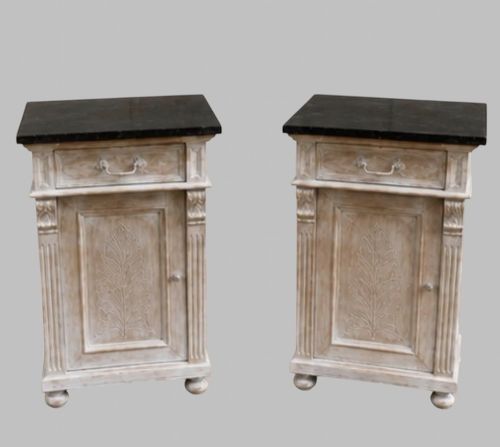


Gustavian Bedside Tables
Gustavian bedside tables bring pale Scandinavian elegance and practical storage to a bedroom through restrained neoclassical lines.
Gustavian Bedside Tables
Gustavian bedside tables embody the lighter, restrained Swedish interpretation of French neoclassical design that emerged during the late eighteenth century and continued through the nineteenth and early twentieth centuries. These pieces typically take the form of small bedside cabinets, cupboards, chests of drawers, and demilune console tables that serve beside a bed. Most examples found here appear as pairs, offering symmetrical storage with painted finishes, contrasting marble tops, or wooden surfaces.
The objects span several decades from the nineteenth century into the early twentieth century, incorporating related Scandinavian country, Biedermeier, and French provincial design influences. They function primarily as compact bedside storage units while maintaining the pale, sophisticated aesthetic characteristic of northern European country houses.
How they were made
Makers constructed these tables predominantly using pine and softwood, applying multiple layers of paint to achieve the characteristic pale surfaces seen on Scandinavian furniture. Satin birch also appears as a primary timber for pieces requiring a finer polished wood grain rather than a painted exterior.
Surfaces frequently feature painted faux marble or fitted slabs of genuine marble, paired with brass hardware for handles and key escutcheon plates. Joinery and hand-painting techniques reflect traditional regional workshops working within neoclassical design frameworks.
Materials recorded across current inventory include pine, metal, brass, marble, and painted softwood.
What varies in quality
Quality reveals itself in the crispness of the neoclassical carved detailing and the depth of the painted finishes, where hand-layered tones surpass flat modern repainting. The presence of genuine marble tops rather than painted wood alternatives elevates the standard of a piece.
Proportion and the integrity of the original pine or birch structure dictate the overall success of the furniture. Pairs that retain matching patina and cohesive wear across both cabinets demonstrate superior provenance compared to mismatched assemblages.
The Gustavian Bedside Tables Glossary
- Gustavian
- The Swedish neoclassical style named after King Gustav III, characterised by symmetry, fluted columns, and muted painted finishes. It adapts heavier continental forms into lighter northern aesthetics.
- Demilune
- A half-moon shape used for console tables and small bedside pieces designed to sit flat against a wall. This profile saves floor space while providing a functional surface.
- Satin Birch
- A pale, highly figured hardwood native to northern Europe, prized for its distinctive golden shimmer and smooth grain. It appears on finer Scandinavian case pieces.
- Commode
- A low chest of drawers or cabinet with doors, originating as a French form but widely adopted in Swedish cabinetmaking. It offers enclosed bedside storage.
- Escutcheon
- A protective plate surrounding a keyhole, often cast in brass to complement the hardware and paintwork of nineteenth-century case furniture.
Gustavian Bedside Tables: Frequently Asked Questions
Are gustavian bedside tables always painted?
While painted finishes in pale tones dominate this furniture style, certain examples utilise natural timbers such as satin birch. Both painted softwoods and polished woods exist within the tradition.
Paint colours range from soft greys and creams to black, often showing age beneath the surface layers.
Do these bedside tables come in pairs?
Many listings feature matching pairs due to the traditional requirement for symmetry on either side of a bed. Single cupboards and side tables also appear.
Matching pairs share identical hardware, dimensions, and paint treatments from their period of origin.
What is the difference between a commode and a bedside cabinet?
A commode generally refers to a small chest of drawers or a low cabinet with doors, while a bedside cabinet is specifically scaled for use next to a bed. Both provide enclosed storage for personal items.
Swedish pieces often blur these distinctions by applying commode proportions to bedroom furniture.
How do I care for marble top bedside tables?
Marble tops require simple dusting with a soft cloth and immediate wiping of liquid spills to prevent staining. Avoid acidic cleaners that can etch the polished stone surface.
Waxing painted softwood bodies helps protect the historical finish from moisture and daily wear.