
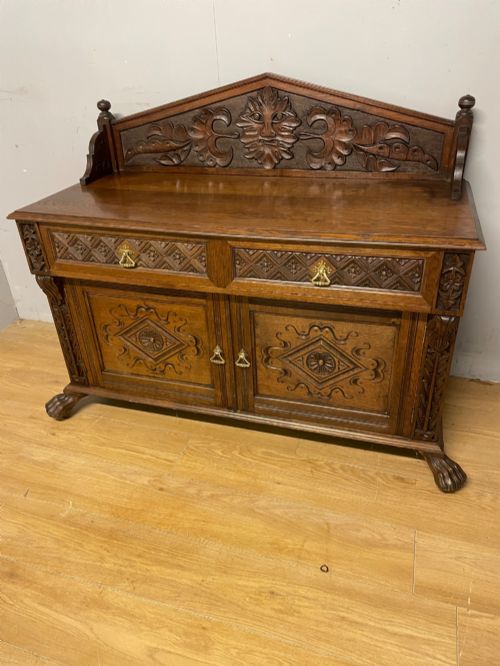
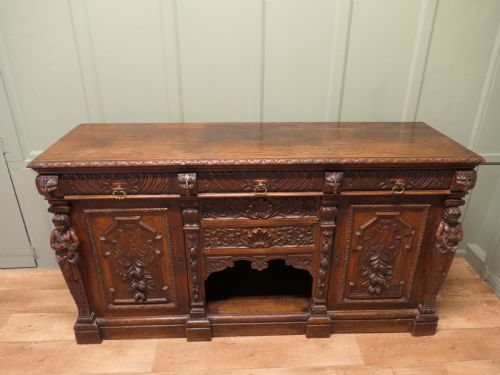
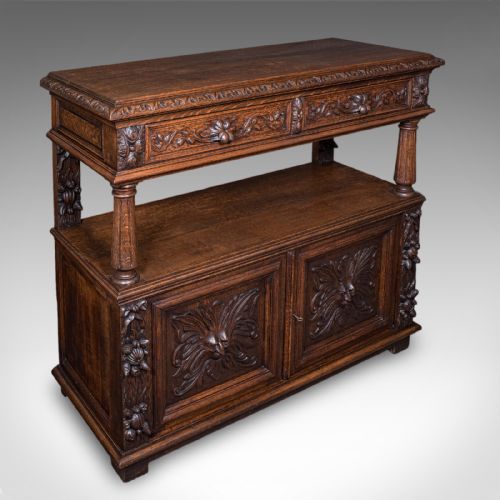
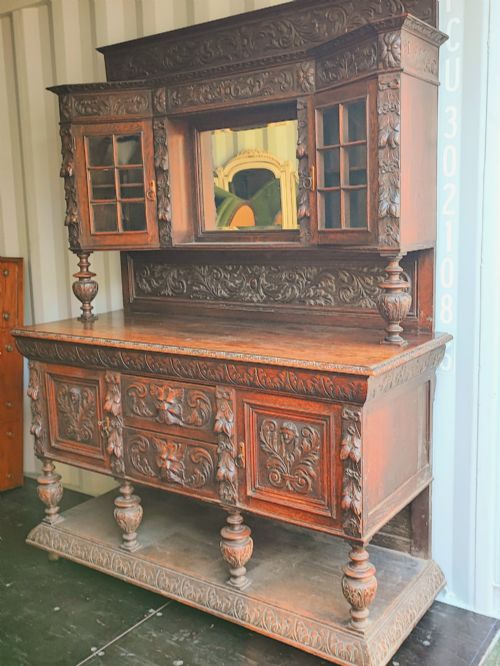
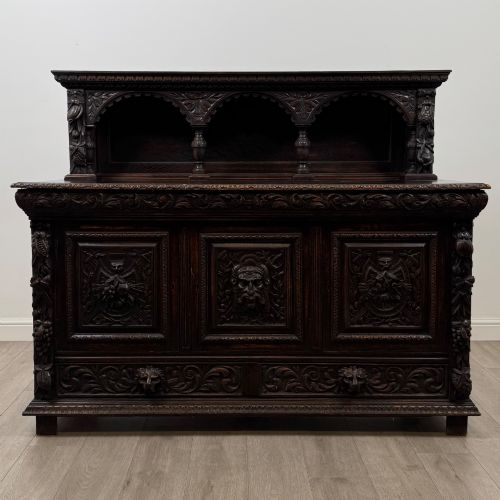

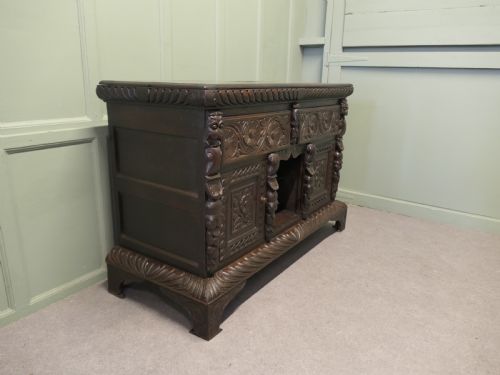


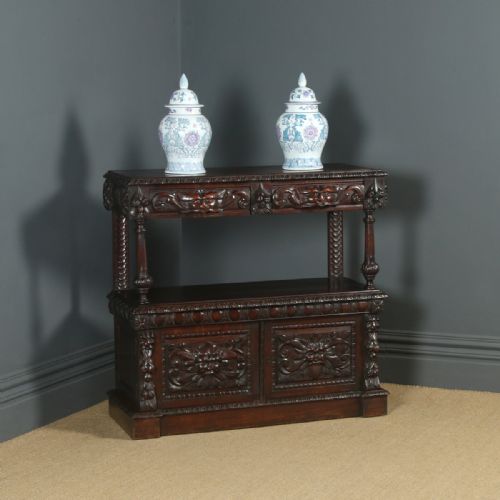


Green Man Carved Sideboard
A green man carved sideboard brings heavy Victorian presence and dense foliage-masked woodwork straight into a dining room or hall.
Green Man Carved Sideboard
When you examine a green man carved sideboard, you are looking at substantial Victorian furniture built to anchor a dining room or hall. These pieces emerge primarily from the nineteenth century, spanning periods from eighteen hundred through to late Victorian decades.
The form shifts between substantial buffets, servers, dresser bases, and large side cupboards. Most examples you meet on this page display heavy proportions and assertive architectural presence.
Makers drew on historicist aesthetics, producing pieces that function equally well as display surfaces and deep storage. Each survivor bridges utilitarian dining furniture and dramatic figurative sculpture.
How they were made
Cabinet makers relied on solid oak to build these carcass structures, allowing deep chisel work across panels and friezes. This dense timber accepted sharp relief carving without splitting along the grain.
Glaziers and metalworkers added functional details such as bevelled glass mirrors and brass hardware. These contrasting materials catch the light against dark, carved oak surfaces.
Listings draw exclusively from nineteenth-century periods, utilising solid oak alongside brass and bevelled glass mirrors.
What varies in quality
The depth and animation of the foliage masks dictate the sculptural standard across these examples. Crisp undercut relief work separates superior cabinet work from mechanical factory cutting.
Proportion and timber selection determine the architectural success of each piece. Well-balanced structures with figured grain command attention over plain, utilitarian carcasses.
The Green Man Carved Sideboard Glossary
- Green man
- A sculptural face carved from foliage, with branches or leaves sprouting from the mouth or cheeks. This motif dominates nineteenth-century revival furniture.
- Dresser base
- The lower section of a kitchen or dining dresser, fitted with drawers and cupboards below a flat top. These sturdy timber units often stand independently as serving boards.
- Bevelled glass
- Glass mirrors or panels featuring ground and polished angled edges. This technique creates a decorative prismatic border around the reflection.
- Gothic Revival
- An architectural and decorative style drawing on medieval forms, pointed arches, and heavy tracery. It heavily influenced Victorian interior woodwork.
Green Man Carved Sideboard: Frequently Asked Questions
Where should I put a sideboard?
These large oak pieces sit comfortably in a spacious dining room, hallway, or large living space where their heavy proportions command the room. They serve as practical display surfaces and deep storage units for tableware.
Ensure the floor space accommodates the substantial depth and width typical of nineteenth-century revival furniture before placing one against a wall.
How do I clean carved oak?
Dust the deep recesses of the foliage carving regularly with a soft brush to prevent grime buildup in the grain. Apply a traditional beeswax sparingly to nourish the timber without clouding the finish.
Avoid modern liquid polishes containing silicones, which can sink permanently into historic oak pores and attract dust over time.
Are these pieces Victorian?
Most examples on this page date from the nineteenth century, spanning early decades through to late Victorian production. Makers during this period embraced Gothic and Renaissance revival styles wholeheartedly.
Look for construction clues such as hand-cut dovetails and timber movement to confirm nineteenth-century origins against later reproductions.
What is a buffet server?
A buffet server functions as a low working surface and cabinet combination designed for dining rooms. It provides practical storage behind heavy doors while keeping serving dishes close at hand.
These pieces often incorporate mirrors or raised backs to display glassware and ceramics above the main timber counter.