
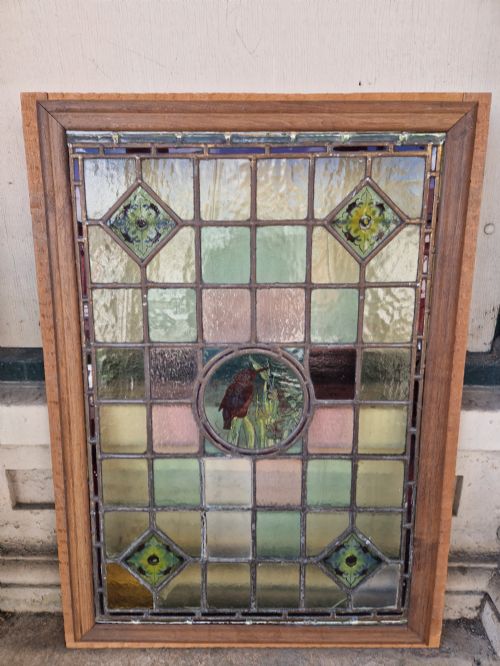


Green Leaded Glass Window
A green leaded glass window brings historic light and colour into a room, shaped by Victorian and Edwardian hands.
Green Leaded Glass Window
When you search for a green leaded glass window, you encounter architectural salvage gathered from domestic and ecclesiastical buildings. The pieces span the Victorian, Edwardian, and early twentieth century periods, reflecting diverse stylistic movements such as Arts and Crafts, Gothic Revival, and Art Nouveau.
The versions most commonly met on this page include stained glass panels and architectural windows featuring hand painted details. Designs range from geometric square and diamond panes to pictorial compositions with birds, flowers, fruit, and rural scenes.
Makers and glaziers utilised traditional techniques to combine lead, timber, and glass into cohesive decorative units. Surviving examples often incorporate amber bullseyes alongside green glass to create tonal depth and texture.
What varies in quality
The distinction between standard panels and superior examples rests on the complexity of the design and the artistry of the hand painting. Pictorial works depicting specific subjects like birds, landscapes, or figural scenes demand greater skill than repeating geometric patterns.
Material composition also dictates quality, particularly the inclusion of mouth-blown bullseyes, varied glass textures, and robust timber frames. Intricate leadwork that retains its rigidity and original solder joints indicates superior craftsmanship.
The listings on this site span the Victorian, Edwardian, and Art Nouveau periods, utilising lead, glass, timber, and stone.
The Green Leaded Glass Window Glossary
- Came
- The grooved lead strip used to hold individual pieces of glass together in a window. These strips are soldered at intersections to form a rigid structural net.
- Bullseye
- A circular roundel of glass formed at the centre of a glassblower's punty rod. They provide distinctive texture and varied colour within a panel.
- Stained glass
- Glass that has been coloured during its manufacture or painted and fired in a kiln. It forms the primary decorative medium for these architectural windows.
- Architectural salvage
- Building materials rescued from structures scheduled for demolition or alteration. This category preserves historic windows and panels for reuse.
- Gothic Revival
- An architectural and decorative style drawing inspiration from medieval design. It frequently manifests in pointed arch tops and diamond pane configurations.
Green Leaded Glass Window: Frequently Asked Questions
How do I hang a stained glass window?
These architectural panels require secure support around their entire perimeter rather than simple suspension from a single point. A custom metal frame or wooden rebate distributes the weight evenly and prevents the lead matrix from sagging over time.
Positioning the window in front of an existing light source or internal wall opening allows natural illumination to pass through the coloured glass without exposing the historic fabric to exterior weather.
How do I date a leaded glass window?
Dating relies on stylistic clues, the design motifs employed, and the framing materials. Victorian and Edwardian examples often feature specific aesthetic markers like stylized florals or heraldic patterns.
Examining the profile of the lead cames and the type of timber used in the surrounding frame provides further chronological context alongside any hand painted signatures or dates.
Are these windows suitable for exterior use?
Historic leaded panels were originally built for exterior installation, but older lead and timber require careful assessment before re-exposure to the elements. Modern protective secondary glazing is often fitted externally to shield the fragile glass and lead from wind damage.
Internal placement remains a popular choice for protecting delicate hand painted surfaces while still enjoying the transmitted colour within a room.
What is the difference between a panel and a window?
A stained glass panel typically refers to the decorative glazed section itself, designed to be fitted into a larger architectural framework or hung independently. A window usually includes both the leaded glass and its original wooden timber surround.
Church windows often exhibit specific structural forms such as arch tops, whereas domestic panels conform to standard rectangular domestic sash or casement dimensions.