

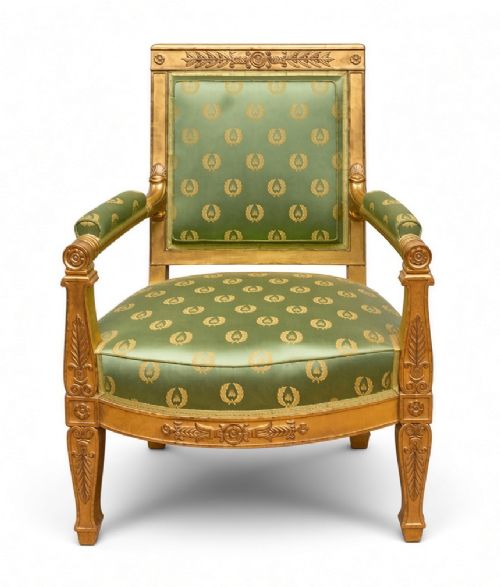
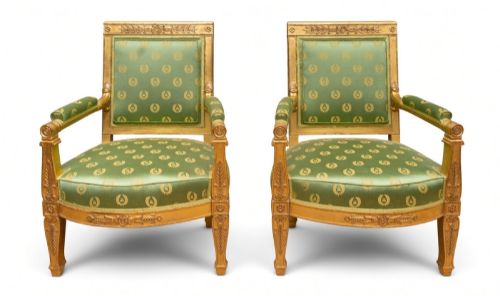
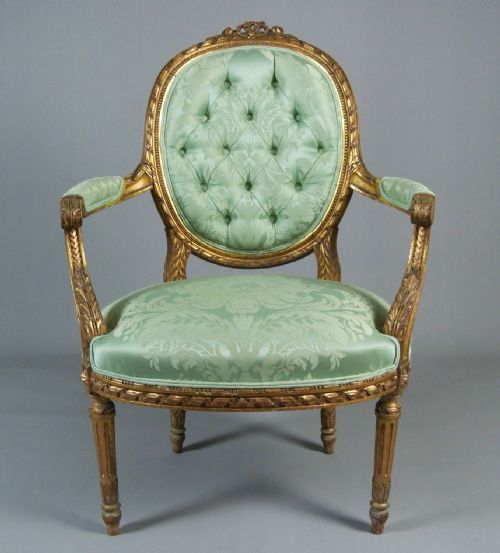
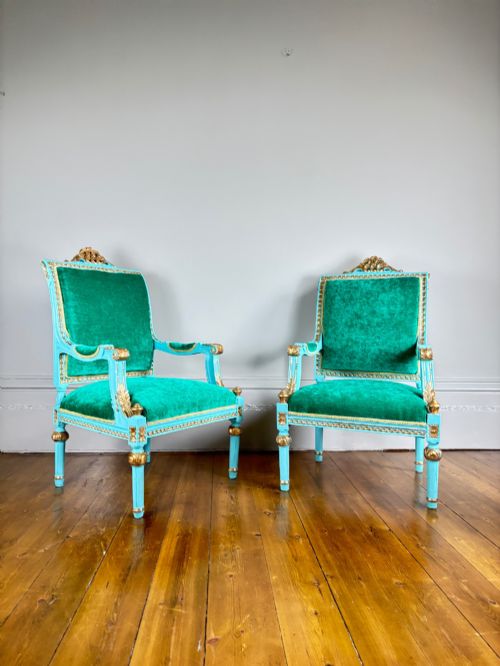


Green Giltwood Armchair
A green giltwood armchair brings together carved wooden frames, gold leaf, and rich fabric to anchor a formal interior.
Green Giltwood Armchair
A green giltwood armchair combines a gilded wooden frame with green upholstery, appearing in forms such as open armchairs, fauteuils, and salon chairs. These seating pieces span the eighteenth, nineteenth, and early twentieth centuries, reflecting classical revival styles and French influences.
The versions most commonly met on this page include nineteenth-century French salon chairs, Regency revival pieces, and George III neoclassical designs. Makers and workshops from different periods employ distinct structural lines, ranging from ornate carved flourishes to restrained classical proportions.
Buyers look for these chairs to add a touch of historical formality and colour to a room. The combination of green fabric and gold leaf creates a striking visual contrast that defines the character of each piece.
How they were made
Makers construct the foundational structure from wood, applying gesso as a smooth base before laying down thin sheets of gold leaf to create the gilt finish. Carved details adorn the arms, legs, and crest rails of the frame.
Upholstery techniques involve textiles such as silk damask, silk, and velvet secured over padding. These materials determine the tactile quality and colour of the seat and backrest.
Green Giltwood Armchair Retail Price Guide 2026
Typical asking prices for green giltwood armchair among the pieces listed under this phrase on Sellingantiques today, from the lower quarter to the upper quarter. They describe what is for sale here now, not the wider market.
The selection includes dining chairs, chaise longues, and open armchairs spanning multiple centuries.
What varies in quality
The depth and crispness of the wood carving separate standard production from superior examples, as skilled carvers produce intricate floral and classical motifs with sharp relief. The application of gold leaf also differs, with finer pieces showing careful burnishing and hand-finished detail across the gesso layer.
The integrity of the frame construction and the choice of original or period-appropriate textile upholstery influence the overall standing of an armchair. Pieces that retain their structural firmness and harmonious proportions command greater attention from collectors.
Jacob-Desmalter·Thomas Chippendale
The Green Giltwood Armchair Glossary
- Giltwood
- Wood coated with gold leaf applied over a prepared gesso ground. This finish provides the characteristic metallic sheen seen on antique frames.
- Gesso
- A plaster-like mixture applied to wooden frames to create a smooth surface for gilding. It allows carvers to achieve fine detail before applying gold leaf.
- Damask
- A reversible figured fabric woven on a loom, frequently utilised for period upholstery. Silk damask appears on many high-status seating pieces.
- Restauration
- A French design period spanning the early nineteenth century. It bridges the Empire style and later nineteenth-century revivals with restrained classical lines.
Green Giltwood Armchair: Frequently Asked Questions
Where should I place a green giltwood armchair?
These armchairs suit formal drawing rooms, libraries, or reception spaces where their gilded frames and green upholstery can stand as focal points.
They pair effectively with period furniture or serve as contrasting statement pieces in modern interior schemes.
How do I care for the gilded surface?
Dust the giltwood frame gently with a soft, dry cloth to prevent the accumulation of dirt on the gold leaf.
Avoid liquid cleaners, polishes, and direct sunlight, which can damage the delicate gesso and gilding over time.
Are these chairs comfortable for daily use?
Most antique armchairs feature upright proportions and firm padding designed for formal posture rather than lounging.
Their primary purpose historically was social entertaining, so they function best as occasional seating.
How do I distinguish a Regency revival piece?
Regency revival pieces date to the later nineteenth or early twentieth centuries while copying the classical motifs of the early 1800s.
Examination of the timber, tool marks, and construction methods helps separate these later interpretations from genuine Regency period items.