
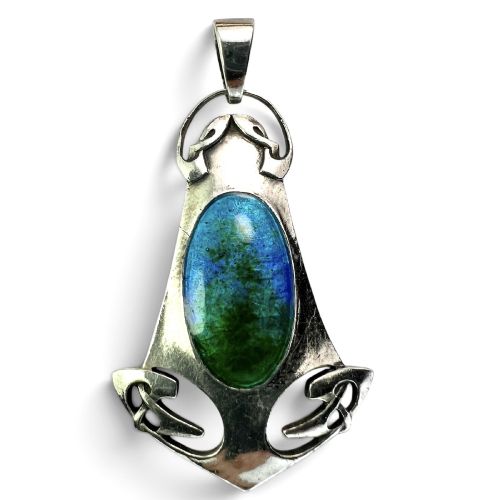
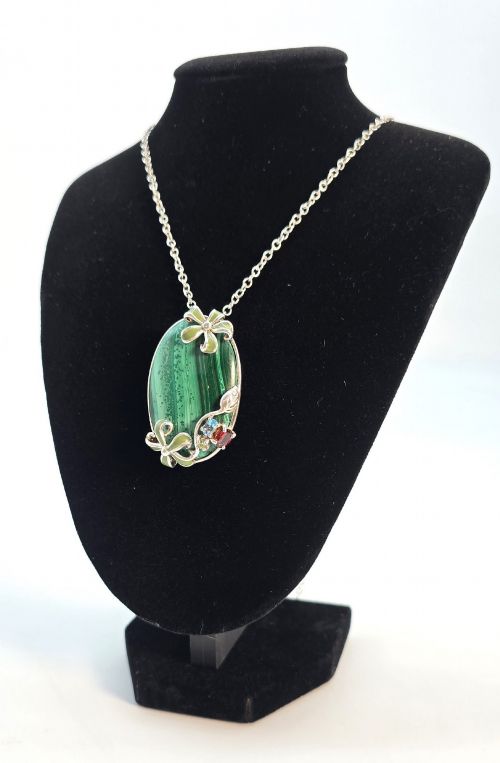


Green Enamel Pendant
Green enamel pendant lights and jewellery combine vibrant vitreous colour with period silver, steel and gold.
Green Enamel Pendant
A green enamel pendant brings together early twentieth-century industrial lighting and delicate Art Nouveau or Arts and Crafts jewellery. These pieces span from nineteen hundred to nineteen ten, incorporating both utilitarian factory shades and intricate silverwork.
Industrial lamps use robust steel shades coated in vitreous enamel, designed for factories and workshops. Jewellery pieces utilise sterling silver or silver gilt, often enhanced with stones such as citrine and pearl.
Buyers encounter both large commercial light fittings and wearable lockets or necklaces. The selection ranges from robust industrial lighting by makers like Thorlux to refined Art Nouveau designs.
How they were made
Makers fused powdered glass to metal surfaces at high temperatures to create durable vitreous enamel. This technique resulted in glossy, hard-wearing green finishes for both industrial lamp shades and delicate jewellery.
Jewellery pieces combine silver and silver gilt with specialised enamelling methods like plique-à-jour, which allows light to pass through translucent sections. Metalworkers set pearls, citrines and diamonds by hand into these frames.
Industrial shades rely on heavy steel construction coated thickly in enamel to withstand workshop environments. Wiring and structural mounts were built for functional longevity in commercial settings.
Green Enamel Pendant Retail Price Guide 2026
Typical asking prices for green enamel pendant among the pieces listed under this phrase on Sellingantiques today, from the lower quarter to the upper quarter. They describe what is for sale here now, not the wider market.
Listings combine nineteen hundred jewellery in silver and enamel with nineteen ten industrial factory light fittings.
What varies in quality
The distinction between ordinary and exceptional items lies in the finesse of the metalwork and the clarity of the enamel. Finer jewellery displays complex plique-à-jour techniques and well-set gemstones like citrine and pearl.
Industrial lighting quality is determined by the preservation of the original vitreous surface and the presence of maker markings. Smooth, glossy coatings without extensive loss separate superior lamp shades from heavily weathered examples.
Murrle Bennett·Archibald Knox·Liberty·Meyle and Mayer·Heinrich Levinger·Thorlux
The Green Enamel Pendant Glossary
- Vitreous Enamel
- A material made by fusing powdered glass to a substrate by firing, producing a durable and glossy coloured coating.
- Plique-à-jour
- An enamelling technique where the enamel is applied within a cellular framework, backing-free, resembling miniature stained glass.
- Silver Gilt
- Silver that has been coated with a thin layer of gold, giving it a warm, golden appearance while retaining a silver base.
- Festoon Necklace
- A necklace featuring a drape of chains, beads or links that hangs in a curved loop across the chest.
Green Enamel Pendant: Frequently Asked Questions
What is plique-à-jour enamel?
Plique-à-jour is an intricate enamelling technique where glass powder is fired in open wire cells without a solid backing. This allows light to shine directly through the translucent green enamel, much like miniature stained glass.
Jewellery makers in the early twentieth century favoured this method for its luminous quality. It requires exceptional skill to prevent the glass from cracking during the firing process.
How do I hang a factory pendant light?
Industrial pendant lights require secure ceiling fixings capable of supporting the combined weight of the steel shade and internal electrical components. A qualified electrician should handle the installation to ensure proper wiring standards.
These lights serve well over kitchen islands or dining tables, providing direct downward illumination. Ensure the hanging height complements the scale of the room and the dimensions of the shade.
Are these pieces from the Art Nouveau period?
Many of the jewellery pieces originate from around nineteen hundred, aligning squarely with the Art Nouveau and Arts and Crafts movements. These items feature organic motifs, flowing lines and traditional handcrafting methods.
Industrial lighting examples tend to date slightly later, around nineteen ten, focusing on utilitarian function rather than decorative styles. Both categories represent distinct design philosophies of the early twentieth century.
What metals are used in these items?
Jewellery pieces are typically fashioned from sterling silver or silver gilt, sometimes incorporating fourteen-carat gold in specific necklace designs. These metals provide a stable foundation for detailed decorative work and gemstone settings.
Industrial pendant lights use robust steel as the primary base metal for the shade. This steel is coated with vitreous enamel to protect against corrosion in factory environments.