
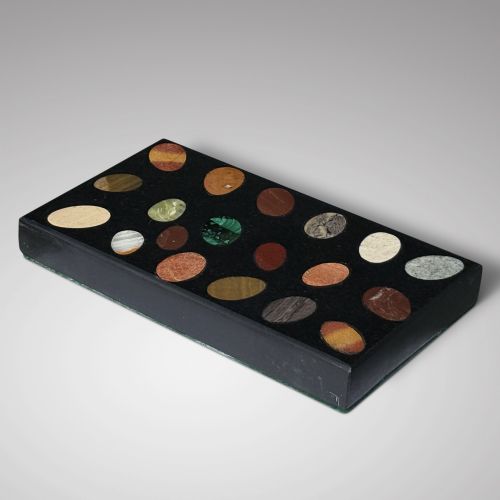


Grand Tour Marble Plaque
A grand tour marble plaque captures the classical ambition of past travellers, offering enduring miniature sculpture and mosaic for the modern desk or wall.
Grand Tour Marble Plaque
When you search for a grand tour marble plaque, you encounter souvenirs collected by travellers journeying through Italy during the eighteenth and nineteenth centuries. These pieces translate classical architecture, ancient sculpture, and literary heroes into portable formats.
The most common examples on this page are nineteenth-century works, often taking the form of wall plaques, profile reliefs, or decorative desk paperweights. Subjects range from Roman emperors and poets like Virgil and Dante to architectural emblems such as the St Mark's lion.
Originating predominantly from Italian workshops, these items utilise local stones, including black marble, Sienna marble, and Derbyshire Ashford marble. They bridge the gap between classical antiquity and domestic Victorian display.
Materials and Techniques
Craftsmen shaped these items from various stones and marbles, frequently employing intricate pietra dura inlay to construct pictorial scenes from semi-precious stones. Others feature carved bas-relief profiles where figures emerge sharply from the dark marble ground.
Micro-mosaic work appears alongside carved stone, incorporating tiny glass tesserae to form detailed central panels within cartouche-shaped tablets. Makers also utilised marble dust composites and slate bases to support these elaborate decorative surfaces.
Listings feature periods spanning from the eighteenth century through to nineteen-thirty, highlighting materials such as malachite, slate, and glass tesserae alongside various marbles.
Evaluating Quality and Execution
The distinction between ordinary and exceptional pieces rests upon the precision of the carving and the complexity of the inlay. Master carvers rendered facial expressions and classical drapery with acute anatomical accuracy, whereas lesser items rely on simpler, blockier silhouettes.
Material selection also dictates distinction, with panels incorporating diverse semi-precious stones or flawless micro-mosaic tesserae commanding greater attention. The crispness of the stone polish and the tightness of the mosaic joints reveal the artisan's skill.
Thorvalsen Workshop
The Grand Tour Marble Plaque Glossary
- Pietra dura
- An artistic technique using cut and fitted polished coloured stones to create images. This method produced elaborate floral and figurative panels on marble tabletops and paperweights.
- Micro-mosaic
- A meticulous craft assembling microscopic pieces of coloured glass to form detailed pictorial scenes. These panels typically served as central decorative motifs on nineteenth-century souvenirs.
- Bas-relief
- A sculptural technique where the figures project slightly from the flat background. This method was favoured for profile portraits of Roman emperors and literary figures.
- Grand tour
- The traditional trip of Europe undertaken by upper-class European young men of means. Souvenirs purchased during these journeys formed the core of many domestic collections.
- Tesserae
- Small blocks of stone or glass used in mosaic work. Artisans arranged these tiny units closely together to achieve pictorial depth.
Grand Tour Marble Plaque: Frequently Asked Questions
What is a grand tour marble plaque?
These items are carved stone panels, reliefs, and paperweights collected as souvenirs by travellers visiting classical sites in Italy during the eighteenth and nineteenth centuries.
They typically depict Roman emperors, classical sculpture, or literary figures, serving as portable expressions of classical taste for European homes.
How were micro-mosaic plaques made?
Artisans fused fine glass rods, pulled thin under heat, and sliced them into microscopic sections known as tesserae. These tiny units were then embedded in a matrix to form detailed miniature pictures.
This painstaking technique allowed makers to achieve remarkable colour graduation and pictorial clarity on small stone surfaces.
Where were these marble souvenirs crafted?
The majority originated in Italian workshops catering specifically to foreign visitors undertaking the grand tour. Local artisans in cities like Rome and Florence mastered the cutting of native marbles and semi-precious stones.
Similar techniques also spread to British centres, such as Derbyshire, where local stones were adapted for inlaid specimen panels.
How do I display a marble plaque?
Wall plaques generally feature integrated fixings or balanced relief profiles suited for secure hanging against a neutral background. Smaller pieces function effectively as desk paperweights or tabletop display items.
Keep them away from direct moisture and handle them carefully to protect fragile edges and inlaid stone sections.
How can I distinguish eighteenth and nineteenth-century pieces?
Eighteenth-century examples often display a sharper neoclassical severity in their carved bas-relief profiles and marble selection. Nineteenth-century production frequently embraces greater variety, incorporating micro-mosaics and complex pietra dura compositions.
Examining the treatment of the stone ground and the style of the portrait subject helps determine the likely period.