


Grand Canal Venice Landscape
A grand canal venice landscape brings the light and architecture of the lagoon straight onto the wall through nineteenth-century oil paintings and watercolours.
Grand Canal Venice Landscape
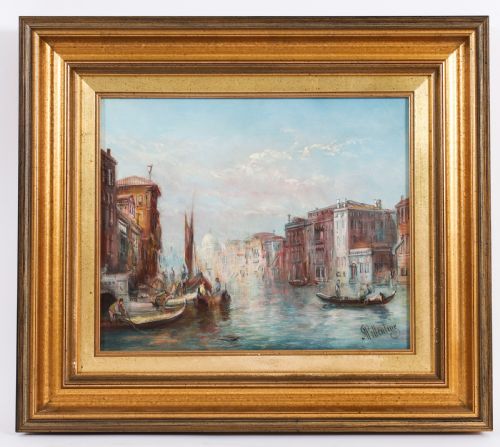
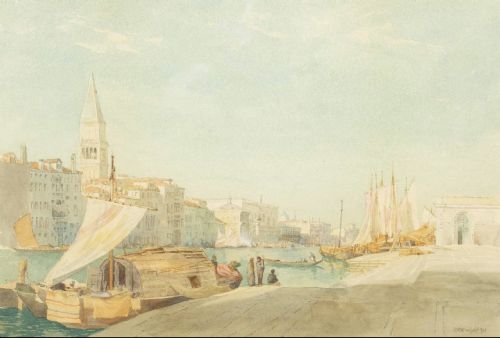
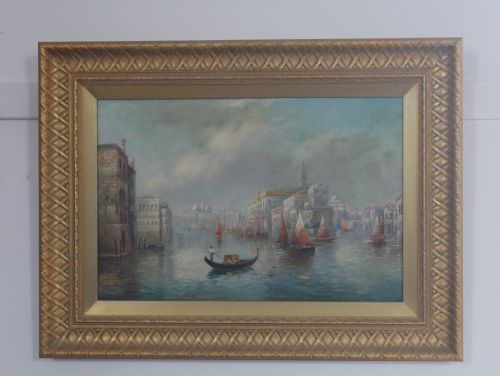
A grand canal venice landscape captures the famous waterway alongside landmarks such as the Doge's Palace, the Dogana, and the church of Santa Maria della Salute. Buyers seeking a grand canal venice landscape will encounter works spanning the nineteenth century up to the mid-twentieth century.
The dominant formats on this page are oil on canvas and watercolour painting, framed in wood or giltwood. These pieces range from traditional Italian townscapes to impressionist interpretations of gondoliers and historic palazzos.
Many works focus on specific architectural viewpoints along the water, including the Mocenigo Palace and the Bridge of Sighs. The selection reflects both detailed Victorian fine art and freer post-impressionist or romantic approaches to the lagoon.
Materials and techniques
Artists built these scenes using oil paint on canvas or watercolour applied to paper, occasionally incorporating gouache, pastel, and ink pen. Canvases are stretched over wood supports while works on paper sit behind glass.
Frames are constructed from wood and frequently finished in giltwood or gilded wood to complement the luminous quality of the painted water and skies. Brushwork varies from tight architectural precision in nineteenth-century veduta to looser impressionist handling.
Listings feature oil on canvas and watercolour paintings from the Victorian era, the nineteenth century, and twentieth-century decades up to nineteen-sixty.
Distinctions in quality
Quality rests in the handling of light on the water and the accuracy of perspective in complex architectural facades like the Rialto or the palazzos. Superior canvases display confident brushwork that defines the atmosphere of the lagoon rather than merely recording buildings.
The integrity of the original wood or giltwood frame and the condition of the canvas or paper surface also distinguish finer examples. Works by documented painters command attention for their established brush technique and tonal balance.
Alfred Pollentine·Richard Henry Wright·F J Aldridge·Antoine Bouvard Senior·E Perez Senet·William Raymond Dommersen·Benedetto Salviati·Hercules Brabazon Brabazon·William Knox·Henry Wimbush·Jane Vivian·J Yates
The Grand Canal Venice Landscape Glossary
- Veduta
- A highly detailed, topographical painting of a cityscape, popular in eighteenth and nineteenth-century Italy. These works record urban architecture with rigorous perspective.
- Giltwood
- Wood carved and treated with a thin layer of gold leaf or gilt, commonly found on traditional frames. This finish adds reflective warmth around the artwork.
- Molo
- The stone quay in Venice situated between the Doge's Palace and the lagoon. It provides a classic viewpoint for artists looking towards the entrance of the Grand Canal.
- Gouache
- An opaque method of water-based painting that uses gum as a binder, yielding solid colours. Artists often combine it with watercolour for highlights on paper.
- Dogana
- The historic customs house of Venice, positioned at the confluence of the Grand Canal and the Giudecca Canal. Its distinctive tower appears frequently in townscapes.
Grand Canal Venice Landscape: Frequently Asked Questions
What periods do these paintings date from?
The selection spans the nineteenth century, including Victorian works, alongside pieces from the early and mid-twentieth century.
Artists worked across different decades, ranging from the eighteen-fifties through to nineteen-sixty, capturing the changing artistic styles of each era.
Are these works painted on canvas or paper?
The listings include both oil paintings on canvas and watercolours executed on paper, sometimes featuring gouache or pastel.
Canvases are typically stretched on wood, while works on paper are preserved behind glass.
Which landmarks appear most often in the views?
Common subjects include the Santa Maria della Salute, the Doge's Palace, the Dogana, and the Bridge of Sighs.
Artists frequently positioned their viewpoints along the water or from the Molo to capture the bustling traffic of gondolas.
How are the paintings framed?
Many pieces retain traditional wooden frames, often finished in giltwood or gilded wood.
These frames complement the tones of the oil on canvas and watercolour mediums.