
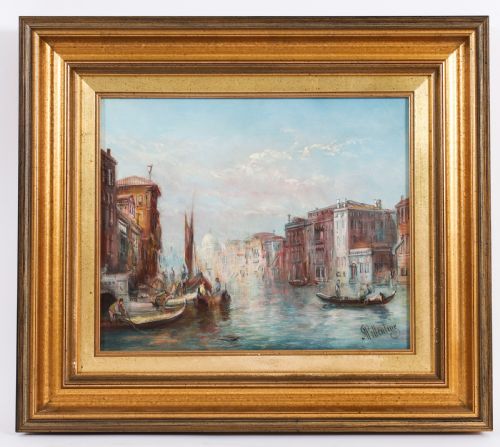
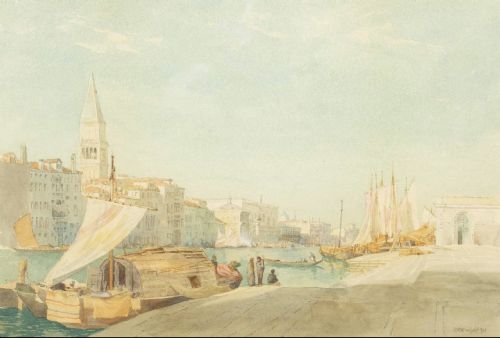
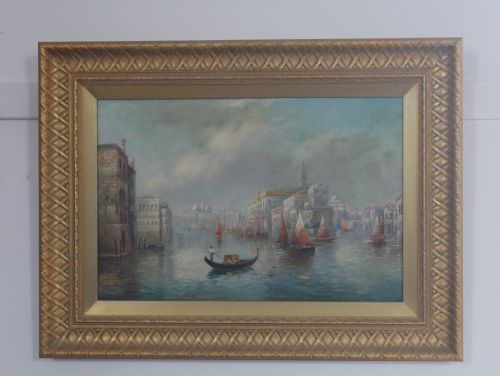


Grand Canal Landscape Painting
A grand canal landscape painting captures the light and architecture of Venice, bringing centuries of Italian romanticism into a room.
Grand Canal Landscape Painting
A grand canal landscape painting depicts iconic Venetian viewpoints such as the Doge's Palace, the Rialto, and Santa Maria della Salute. These works range from detailed nineteenth-century vedute to looser impressionist interpretations.
The pieces on this page appear in oil on canvas, watercolour, and mixed media formats. Nineteenth-century examples sit alongside later twentieth-century interpretations.
Framed works dominate the selection, often housed in giltwood or carved wooden frames that complement the traditional subjects.
Materials and technique
Artists relied primarily on oil on canvas and delicate watercolour on paper to capture the luminous atmosphere of the lagoon. Pigments were applied to build up the interplay of light on water and stone.
Frames utilise wood and gilded wood, often matching the period of the painting. Glazing protects works on paper, while oil paintings remain unglazed on stretched canvas.
Venetian subjects frequently centre on the Dogana, the Bridge of Sighs, and the grand palazzos lining the waterways.
Judging quality
Quality rests in the handling of light and perspective, distinguishing a lively topographical record from a stiff reproduction. Stronger examples display confident brushwork and a convincing sense of atmospheric depth across the water.
The preservation of the original canvas, pigment stability, and the integrity of the period frame contribute significantly to the standing of an individual work.
Alfred Pollentine·Richard Henry Wright·Antoine Bouvard Senior·Hercules Brabazon Brabazon·Jane Vivian
The Grand Canal Landscape Painting Glossary
- Veduta
- A detailed, topographical painting of a cityscape, highly popular among nineteenth-century travellers in Italy. These works prioritized accurate architectural rendering alongside atmospheric canal life.
- Giltwood
- Wood that has been coated with a thin layer of gold leaf or gilt powder. This finish was standard for framing fine nineteenth-century oil paintings.
- Gouache
- An opaque water-based pigment used alone or alongside watercolour and pastel. It provides heavier coverage and brighter highlights on paper.
- Impressionist
- A style focusing on the visual impression of the moment, particularly the shifting effects of light and colour. In Venetian scenes, this translates to looser brushstrokes and vibrant water reflections.
Grand Canal Landscape Painting: Frequently Asked Questions
How do I identify a nineteenth-century Venetian painting?
Nineteenth-century works usually rely on traditional veduta composition or romanticised palettes, often executed in oil on canvas or detailed watercolour.
Examine the stretcher bars, canvas texture, and artist signatures to help determine the period alongside stylistic clues.
What is the difference between oil and watercolour views?
Oil paintings on canvas offer richer texture and deeper colour saturation, suitable for prominent wall placement.
Watercolours on paper deliver a lighter, more translucent quality that requires protective glass framing.
How should I care for a framed oil painting?
Keep oil paintings away from direct sunlight and dramatic temperature fluctuations to prevent canvas slackening and pigment cracking.
Dust the canvas gently with a soft, dry brush and avoid liquid cleaners on both the painting surface and the frame.
Are these paintings original works?
The selection consists of original hand-painted works by various artists rather than modern mass-produced prints.
Signatures, brushwork variation, and medium texture confirm the hand-painted nature of each piece.