

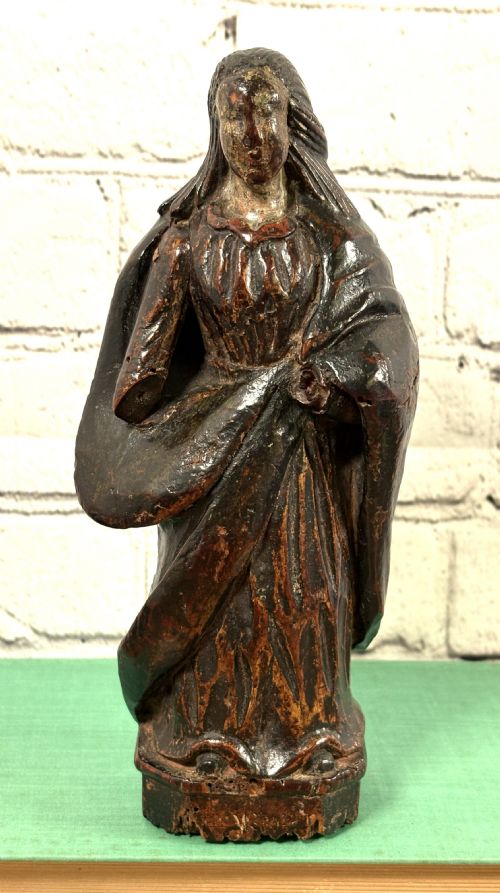


Gothic Wooden Saint Statue
These gothic wooden saint statue examples are centuries-old devotional carvings hewn from solid timber, sought after for their quiet ecclesiastical presence.
Gothic Wooden Saint Statue
A gothic wooden saint statue is a hand-carved devotional figure originating from ecclesiastical contexts across Europe, spanning from the pre-16th century medieval period through to the 19th century Gothic Revival. You will frequently encounter figures carved from sturdy oak or limewood, depicting identifiable holy figures such as the Virgin Mary, St. John, or St. Catherine. These pieces range from substantial church sculptures to smaller fragments, often bearing traces of their original function in altarpieces or church groups.
The selection on this page leans heavily towards continental European works, particularly from German, Flemish, and French workshops of the late medieval and Renaissance eras. Alongside these early pieces, later 18th and 19th-century interpretations reflect a sustained interest in Gothic and Baroque forms. Whether representing a bishop, an apostle, or a donor figure, each piece carries the distinct sculptural language of its period.
Materials and construction methods
Many surfaces received preparatory layers of gesso before being finished with polychrome pigments, gilding, or plain wax. Giltwood and polychrome wood finishes added vibrancy and light reflection in dimly lit ecclesiastical interiors, remnants of which often survive beneath centuries of patina.
Keep an eye out for hidden cherubs and smiling young bishops peering out from beneath heavy medieval hoods.
Factors that define quality
The distinction between ordinary and exceptional carving lies in the confidence of the chisel work and the anatomical understanding displayed in the hands, face, and drapery. Superior figures possess a natural fluidity in the folds of fabric and a distinct personality in the expression, whereas lesser works can appear stiff or formulaic.
The Gothic Wooden Saint Statue Glossary
- Polychrome wood
- Wood sculpture finished in multiple colours of paint. This technique was widely used in medieval and Renaissance Europe to bring religious figures to life.
- Gesso
- A plaster-like mixture applied to wood as a smooth base for gilding and paint. It provides the foundation for delicate surface decoration.
- Giltwood
- Timber decorated with gold leaf applied over a prepared surface. It catches candlelight effectively in sacred settings.
- Limewood
- A fine-grained, pale wood favoured by continental carvers for detailed work. It resists splitting and allows for extremely crisp undercut details.
- Donor figure
- A sculpture depicting the person who commissioned a religious work of art. These figures often appear kneeling in prayer alongside saints.
Gothic Wooden Saint Statue: Frequently Asked Questions
Were these statues painted originally?
Most historic church figures were brightly painted or gilded to enhance their visual impact in dim chapels. Over the centuries, many pieces were stripped down to the bare timber by later owners or restorers.
Faint microscopic traces of pigment or gesso remaining in the recesses of the wood often indicate that a statue was once fully polychromed. Preserving these microscopic remnants is crucial for maintaining the historical integrity of the piece.
How should I display one at home?
Position these sculptures away from direct sunlight and sudden temperature fluctuations to prevent the timber from warping or cracking. Placing them on a stable surface against a neutral wall allows the form and patina to take centre stage.
Ensure the mounting is secure, as many older figures have uneven bases or were originally designed to fit into architectural niches. A stable, interior environment with consistent humidity keeps the wood stable for years to come.
What is the difference between oak and limewood figures?
Oak figures tend to originate from regions where durable local hardwoods were standard for substantial structural and sculptural work, resulting in heavier, robust pieces. Limewood, particularly favoured in German and Flemish workshops, allowed carvers to achieve finer details and deeper undercuts.
While oak offers a dense, coarse grain that patinates richly over centuries, limewood provides a smoother canvas for delicate facial expressions and elaborate drapery folds.