
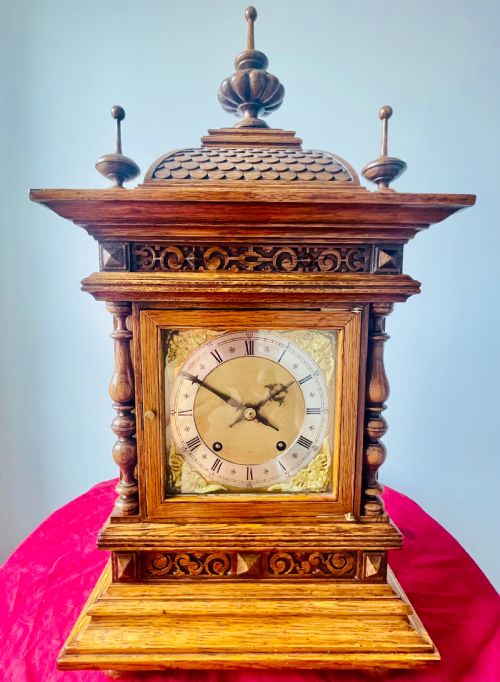


Gothic Brass Chime
These gothic brass chime pieces bring heavy Victorian presence into a room, offering rich acoustic weight and dark timber framing.
Gothic Brass Chime
A gothic brass chime typically manifests as a substantial dinner gong or bracket clock housed in dark woods like oak and walnut. These objects reflect the heavy decorative revival movements of the nineteenth century.
The versions most commonly met on this page combine cast brass hanging gongs or movement dial rings with carved timber architectural frames. They range from domestic mantel pieces to monumental hall furnishings.
Makers drew heavily on medieval ecclesiastical motifs, pairing pointed arches and tracery with robust metalwork. This creates a distinct visual silhouette dominated by vertical lines and solemn metallic resonance.
How they were made
The structural framework relies on dense timbers such as oak, mahogany, walnut, and rosewood, shaped into revival architectural forms. Cabinetmakers employed deep carving and applied mouldings to echo gothic stonework.
Metal components utilise heavy cast brass for the chime bars, gongs, and dial bezels, often paired with glass viewing panels and enamel chapter rings. These materials ensure both structural longevity and a resonant acoustic tone.
Listings span Victorian, Edwardian, and Georgian periods, uniting brass with oak, walnut, mahogany, and rosewood.
What varies in quality
The depth and crispness of the timber carving set superior examples apart from standard production pieces. Finer items display meticulously hand-chiselled tracery rather than shallow mechanical moulding.
Acoustic performance dictates the upper tier of value, determined by the thickness and alloy composition of the brass gong or bell. Heavier, well-cast metal produces a cleaner, more sustained harmonic ring.
Winterhalder and Hofmeier·Cording of London
The Gothic Brass Chime Glossary
- Gothic Revival
- An architectural and decorative style drawing inspiration from medieval forms. It dominates the aesthetic of these gongs and clocks through pointed arches and quatrefoil motifs.
- Bracket Clock
- A portable clock designed to sit on a bracket or table. Many examples in this category incorporate striking mechanisms or musical trains.
- Dinner Gong
- A suspended metal disc or tube struck with a mallet to summon guests to a meal. These pieces are frequently mounted in substantial carved wooden frames.
- Lancet Top
- A pointed, arched architectural silhouette resembling a medieval lancet window. This shape appears frequently on the upper cases of period clocks.
- Ting-Tang
- A two-hammer striking mechanism that sounds two distinct notes on the quarters. It provides the characteristic dual tone heard in these clocks.
Gothic Brass Chime: Frequently Asked Questions
What are gothic brass chime gongs?
These pieces are large acoustic summons instruments suspended within carved wooden frames, designed for domestic use during the Victorian era.
They utilise heavy cast brass tubes or discs struck with a mallet to produce a deep, resonant tone throughout a household.
How do I date a gothic clock?
Dating relies on examining the timber species, case architecture, and the style of the brass dial and movement components.
Victorian and Edwardian pieces typically feature heavier revival carving, while earlier Georgian items lean towards restrained mahogany proportion.
Where were these gongs displayed?
Larger dinner gongs stood in entrance halls or dining rooms where their sound could carry across the entire house.
Smaller bracket clocks and mantel pieces sat on prominent ledges or tables in formal reception rooms.
What woods were used?
Cabinetmakers predominantly utilised dark, dense timbers that complemented the sombre tone of the cast brass metalwork.
Oak and walnut dominate the gothic revival pieces, alongside refined applications of mahogany and rosewood.