


Gold Tie Pin
A gold tie pin secures a cravat or lapel with period character, taking forms from the Regency to the mid-twentieth century.
Gold Tie Pin
A gold tie pin serves to fasten neckwear or adorn a lapel, appearing across this selection in forms that span stick pins, bar brooches, and novelty items. Buyers seek these items for their historical craftsmanship and wearable scale, connecting them to periods ranging from the Regency through the Victorian and Edwardian eras to the Art Deco movement and the mid-twentieth century.
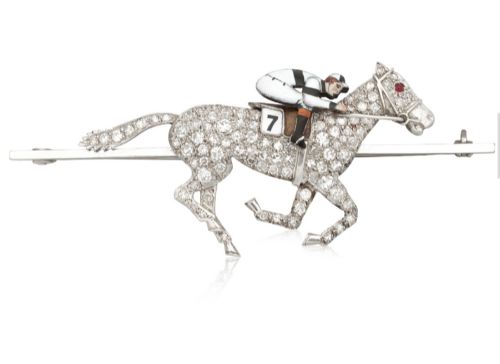
Origins stretch from English workshops to French ateliers, bringing distinct regional styles into the selection. Pieces vary from simple geometric bars to elaborate figural pins depicting hunting bugles, horses, and miniature portraits.
Materials and construction
Metals span nine-carat, fifteen-carat, and eighteen-carat gold alongside platinum and silver settings, providing the structural foundation for each piece. Goldsmiths combined these precious metals with natural pearls, rose-cut and brilliant-cut diamonds, garnets, rubies, and vitreous enamel to build contrast and colour.
Techniques relied on hand fabrication, casting, and stone setting executed by period artisans. Pins were soldered to secure findings, while stones were flush-set, bezel-set, or mounted in platinum overlays to enhance the brilliance of diamonds against yellow gold.
Tiny gold hunting bugles and running foxes let you carry an entire stable on your lapel.
Distinctions in quality
Quality rests on the precision of the goldsmith's work, the integrity of the stone settings, and the retention of original components. Superior examples display crisp chasing on figural elements, secure claw or bezel settings that hold gems firmly, and metalwork that shows minimal wear.
The choice of materials also divides the range, with higher-carat golds and platinum combined with well-matched natural pearls or clean diamonds marking out the finer pieces. Minor alterations to pins or replacements of stones diminish the historical coherence of an item.
The Gold Tie Pin Glossary
- Stick pin
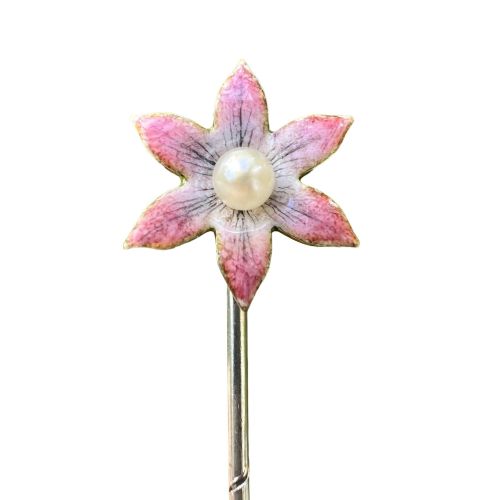
- A long pin with an ornamental head designed to secure a cravat, tie, or lapel. These items sit on a slender metal shaft that often retains its original length.
- Bar brooch
- A horizontal metal bar, frequently set with gems or centred on a motif, secured by a pin stem and catch on the reverse. Many examples double as tie or lapel pins in contemporary usage.
- Essex crystal
- A convex rock crystal piece reverse-painted with a miniature scene, creating a three-dimensional effect. These stones appear mounted in gold stick pins.
- Rose-cut diamond
- A gemstone cut with a flat base and a faceted dome comprising triangular facets. This historical cut predates the modern brilliant.
- Carat
- A unit of measure for the fineness of gold alloys or the weight of gemstones. In gold, twenty-four carats represents pure metal.
Gold Tie Pin: Frequently Asked Questions
How do I wear a gold tie pin?
A gold tie pin pushes through the fabric of a tie or cravat, often secured behind the material with a small cap or safety chain. They also function well secured to the lapel of a jacket or coat.
When placing the pin on a tie, position it in the lower third of the knot or just below it for balance. Ensure the pin passes through the inner lining to protect delicate silks.
Are these pins meant for men or women?
Historical stick pins and tie pins served both gentlemen and ladies during the nineteenth and early twentieth centuries. Gentlemen wore them in cravats and ties, while ladies used them on hats, lapels, and cravats.
Today, these distinctions no longer restrict how buyers wear the pieces. The scale and pin length suit any lapel or neckwear regardless of historical gender association.
How do I date an antique tie pin?
Dating relies on the style of the mounting, the cut of any gemstones, and hallmarks stamped into the gold. Georgian and early Victorian pieces often feature foiled stones or closed-back settings, while Edwardian items frequently utilise platinum on gold.
Motifs also offer clues, such as Art Deco geometric lines or Victorian sporting themes. Hallmarks, where present, provide specific assay office marks and date letters.
Do antique pins require special care?
Antique jewellery requires gentle handling due to age and delicate construction. Avoid ultrasonic cleaners, harsh chemicals, or prolonged immersion in water, particularly for pieces containing pearls or enamel.
Clean the metal and stones with a soft, dry cloth after wearing. Store each pin separately in a lined box to prevent scratching between items.