
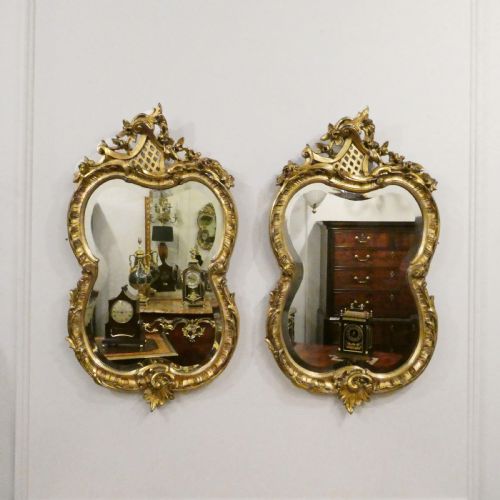


Gold Scrollwork Mirror
A gold scrollwork mirror brings warmth and movement to a room through undulating frames and bright metallic surfaces.
Gold Scrollwork Mirror
A gold scrollwork mirror typically takes the form of a wall mirror with an ornate, flowing frame. These pieces draw on historical decorative movements, appearing frequently in Rococo revival, Baroque, and Florentine styles.
The selection ranges from grand Italian carved giltwood wall mirrors to smaller French and English designs. Buyers often encounter pieces spanning the eighteenth, nineteenth, and early twentieth centuries, including Victorian examples and Edwardian brass frames.
Formats include rectangular wall mirrors, oval shapes, and shield-shaped designs. Many incorporate organic motifs, floral elements, and asymmetrical curves characteristic of classical revival periods.
Materials and construction methods
Frames are constructed from wood such as mahogany or carved timber, often layered with gesso to create crisp relief details. Artisans applied gold leaf or gilt finishes to achieve a bright metallic surface.
Alternative materials include cast brass and gilt metal, particularly in Edwardian and late nineteenth-century examples. Mirror glass is set within these frames, occasionally featuring bevelled edges.
Listings feature examples from the eighteenth, nineteenth, and early twentieth centuries, utilising materials like giltwood, gesso, brass, and mirror glass.
Distinguishing quality and craftsmanship
The depth and crispness of the carving separate standard frames from superior examples. Hand-carved wooden frames exhibit intricate undercutting and fluid movement in the scrollwork compared to simpler moulded pieces.
The application of the gilt finish influences the overall presence of the object. Traditional gold leaf yields a richer, warmer patina over time than modern metallic paints or basic lacquers.
The Gold Scrollwork Mirror Glossary
- Giltwood
- Wood that has been coated with gold leaf or a gold-coloured finish. This technique provides a durable and brilliant metallic surface for decorative frames.
- Gesso
- A plaster-like mixture applied to wood frames to create a smooth surface for carving and gilding. It allows artisans to shape intricate relief ornamentation.
- Rococo Revival
- A nineteenth-century design style that revives the ornate, asymmetrical scrolls and natural motifs of the eighteenth-century movement. It dominates the aesthetic of many decorative wall mirrors.
- Florentine
- A regional Italian style known for elaborate, deeply carved wooden frames finished in gold. These pieces often feature dense foliage and scroll motifs.
- Bevelled glass
- Mirror glass with an angled edge cut and polished to a specific width. This treatment refracts light and adds dimensional depth to the piece.
Gold Scrollwork Mirror: Frequently Asked Questions
Where should I hang a heavy giltwood mirror?
Hang these pieces on a sturdy wall using appropriate fixings secured directly into masonry or wall studs. The considerable weight of carved wooden frames requires reliable structural support.
Position the mirror at eye level or above a focal point like a mantelpiece to balance the room and reflect natural light effectively.
How do I clean an antique gold leaf frame?
Dust the frame gently with a soft, dry brush to remove surface debris without damaging the delicate metallic surface. Avoid using liquid cleaners, chemical solvents, or abrasive cloths.
Moisture and modern detergents can strip the historical gilding and underlying gesso layers. Keep the mirror away from direct heat sources and damp environments.
What is the difference between gesso and carved wood?
Carved wood involves shaping the actual timber frame using chisels and gouges to create three-dimensional forms. Gesso is a plaster mixture applied over a simpler wooden base to build up fine decorative details.
Many antique frames combine both techniques, using a carved wooden foundation enhanced with moulded gesso ornamentation.
How can I date a nineteenth-century gilt mirror?
Examine the construction of the wooden backing, the type of mirror glass, and the characteristics of the gilt finish. Nineteenth-century pieces often display hand-cut joinery and subtle signs of age in the silvering of the glass.
Stylistic cues such as Rococo revival motifs or Victorian registration marks further help narrow down the period of manufacture.