

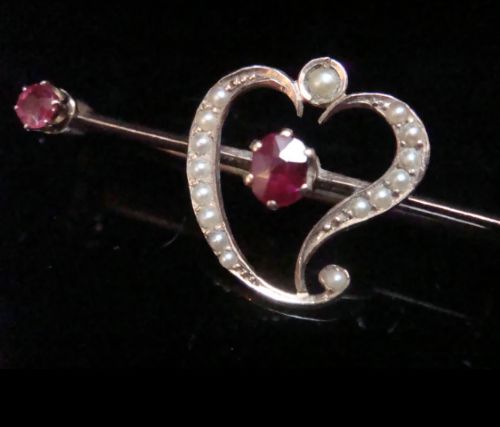


Gold Ruby Bar Brooch
A gold ruby bar brooch offers a slim line of precious metal set with crimson stones, spanning Victorian, Edwardian, Art Deco and mid-century periods.
Gold Ruby Bar Brooch
A gold ruby bar brooch is a linear garment fastener designed to secure lapels, scarves and collars while displaying coloured gems. The pieces found here range from simple linear mounts to elaborate pictorial designs shaped like bicycles, hearts, crescents and birds.
Most examples date from the Victorian, Edwardian and Art Deco eras, with occasional pieces stretching into the mid-twentieth century. The predominant forms combine red corundum with diamonds, pearls or enamel set across precious metal bars.
Buyers will encounter both strict linear bars and shaped variations such as floral clusters, crescent moons and novelty figures. These jewels served as everyday adornment for fastening clothing in past decades.
How they were made
Goldsmiths constructed these jewels using 9ct gold, 15ct gold, 18ct gold, rose gold, yellow gold, white gold and platinum. Precious metals were drawn into wire, cast or fabricated into slim bar foundations to support the gemstones.
Gemstones including rubies and diamonds were secured using claw settings, bezel mounts or flush settings alongside pearls and enamel work. Construction methods varied from hand-wrought Victorian pieces to the geometric precision of the Art Deco period.
Listings feature items spanning Victorian, Edwardian, Art Deco and mid-century periods, utilising 9ct gold, 18ct gold, platinum, rubies and diamonds.
What varies in quality
Quality rests upon the depth of the ruby colour, the cut and clarity of accompanying diamonds, and the weight of the gold or platinum mount. Substantial metal gauges and fine gemstone selection distinguish superior examples from lighter production.
Artisanal execution in complex motifs, such as enamel cockerels, floral arrangements or bicycle frames, dictates the refinement of the piece. Well-preserved settings and crisp metalwork show the maker's original intent clearly.
The Gold Ruby Bar Brooch Glossary
- Bar brooch
- A slender horizontal pin fastener that lies flat against fabric. These pieces form the structural basis for many antique gem-set jewels.
- Ruby
- A pink to blood-red gemstone of the mineral corundum. It provides the primary red colour in these historic bar brooches.
- Edwardian
- A stylistic period spanning the early twentieth century. Jewels from this era often feature light platinum work and delicate diamond and ruby arrangements.
- Art Deco
- A design movement prominent in the 1920s favouring geometric lines and stylised motifs. Pieces from this era display sharp symmetry alongside rubies and diamonds.
- Crescent brooch
- A curved ornament shaped like a waxing moon. Makers frequently filled these frames with graduated rubies, pearls and diamonds.
Gold Ruby Bar Brooch: Frequently Asked Questions
How do I wear a bar brooch?
Pin the jewel horizontally or diagonally across the lapel of a coat, the front of a heavy woollen jumper, or the fabric of a structured scarf.
Ensure the pin catch fastens securely behind the bar before trusting the piece to heavier fabrics.
Are these brooches made of solid gold?
The listings show pieces fashioned from various purities including 9ct, 14ct, 15ct and 18ct yellow, rose and white gold, alongside platinum mounts.
Makers selected different metal purities according to the prevailing standards of the Victorian, Edwardian and Art Deco periods.
How do I date a gold ruby bar brooch?
Examine the stylistic clues, such as the curved floral motifs of Victorian and Edwardian work or the geometric symmetry typical of the 1920s Art Deco movement.
Materials like platinum combined with yellow gold often point towards the Edwardian era, while novelty animal subjects appear across multiple turn-of-the-century years.
What stones accompany the rubies?
Diamonds and pearls appear frequently alongside rubies in these bar brooches, adding contrasting white sparkle or lustrous spherical texture.
Enamel work also supplements the gemstone settings in specific pictorial designs like bird and insect motifs.