




Gold Mantel Clock Set
A gold mantel clock set brings monumental symmetry to a room, pairing a central striking timepiece with matching garnitures like candelabras or urns.
Gold Mantel Clock Set
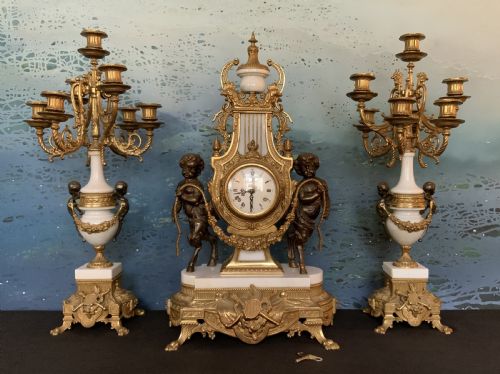
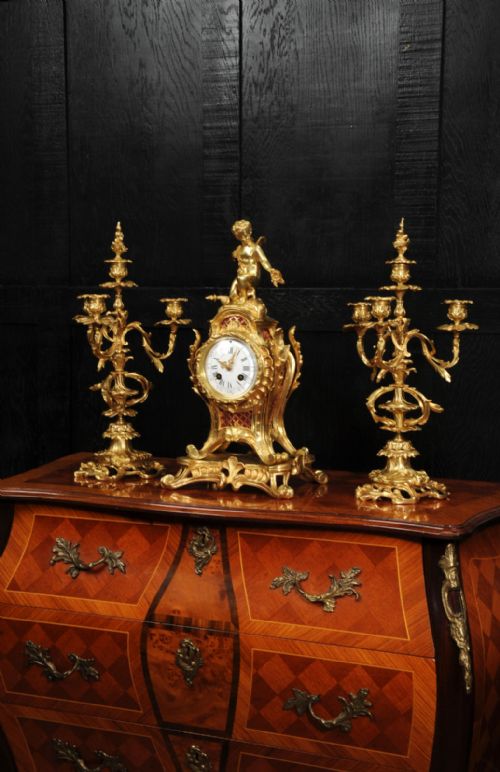
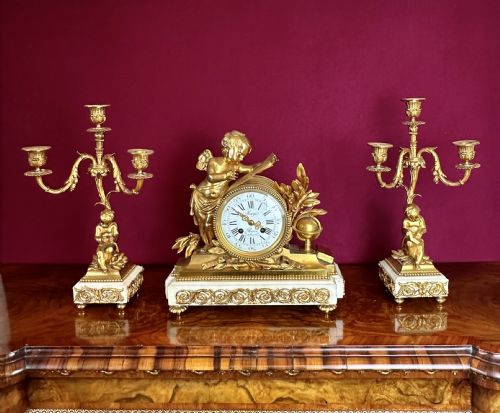
A gold mantel clock set typically comprises a central timepiece accompanied by matching side ornaments such as candelabras or urns, creating a balanced decorative display. These suites frequently date from the nineteenth century, spanning Victorian and Napoleon III periods.
The dominant aesthetic draws heavily on French stylistic revivals, particularly Louis XVI, Neoclassical, and Rococo designs. Buyers frequently encounter three-piece configurations that combine striking metalwork with contrasting stone bases.
Materials and construction
Maker workshops utilised cast metals finished with mercury gilding or ormolu to achieve a bright, reflective golden surface. Bronze, brass, and gilt metal form the structural casings of both the clocks and their accompanying garnitures.
Marble, including white variants, frequently provides a heavy plinth or column support beneath the metal mounts. Enamel dials, often featuring painted numerals, are integrated into the clock faces alongside exposed pendulums and detailed figural castings.
Many sets include mischievous bronze cherubs peering out from behind clock faces or clinging determinedly to the sides of heavy candelabras.
Assessing quality in garniture sets
Superior sets exhibit exceptional crispness in the chasing and casting of decorative motifs such as cherubs, floral garlands, and architectural columns. Finer examples integrate heavier, more dense marble bases and higher-grade mercury gilt bronze rather than simpler painted finishes.
The sophistication of the internal movement and the matching quality of the side pieces dictate the standing of the ensemble. When the candelabras or side urns share the exact sculptural vocabulary and heavy gilding of the main clock case, the composition holds greater authority.
Henry Dasson·Raingo Fres Paris·Deniere Paris·Vincenti·Japy Freres·A.D Mougin
The Gold Mantel Clock Set Glossary
- Ormolu
- A technique of applying finely ground, high-carat gold to a bronze object using a mercury amalgamation process. This yields a rich, durable golden lustre characteristic of fine nineteenth-century French metalwork.
- Garniture
- A set of matching ornamental objects designed to be displayed together on a mantelpiece or sideboard, usually consisting of a central clock flanked by two matching vases, urns, or candelabras.
- Louis XVI Style
- An aesthetic revival characterised by classical restraint, straight architectural lines, symmetrical proportions, and motifs drawn from ancient Greece and Rome. It frequently appears in nineteenth-century gilt bronze and marble clock sets.
- Patinated Bronze
- A chemically induced surface coloration applied to bronze to produce dark brown, green, or black tones. This dark finish often contrasts sharply against bright ormolu mounts.
- Candelabra
- A branched candlestick holding multiple lights that frequently accompanies a mantel clock as part of a three-piece or larger matched set.
Gold Mantel Clock Set: Frequently Asked Questions
What is a clock garniture?
A clock garniture is a matched decorative ensemble consisting of a central mantel clock accompanied by side pieces such as candelabras or urns. These suites were designed to create visual balance on a fireplace mantel or large console table.
The matching side pieces share the same materials, period style, and decorative motifs as the clock housing, creating a unified display.
How do I identify the period?
Dating relies on stylistic clues, material combinations, and movement signatures. Nineteenth-century French pieces often incorporate Louis XVI or Rococo revival details alongside white marble bases and gilt bronze casting.
Maker stamps on the movement plates or cast signatures on the bronze cases also help pinpoint the exact workshop and decade of production.
Where were these clocks placed?
These sets were designed for prominent display in domestic reception rooms, parlours, and drawing rooms of grand nineteenth-century homes. The mantelpiece above a fireplace served as the traditional centrepiece for the arrangement.
The reflective ormolu and symmetrical side candelabras were intended to catch the light of oil lamps or daylight in formal entertaining spaces.
How do I care for ormolu?
Maintaining gilt bronze and ormolu requires gentle dusting with a soft, dry brush to prevent abrasive particles from scratching the delicate gold surface. Avoid chemical polishes, which can strip away the historical mercury gilding.
Keeping the metal away from direct moisture and handling the pieces with clean cotton gloves preserves the original finish.