


Gold Leaf Upholstered Settee
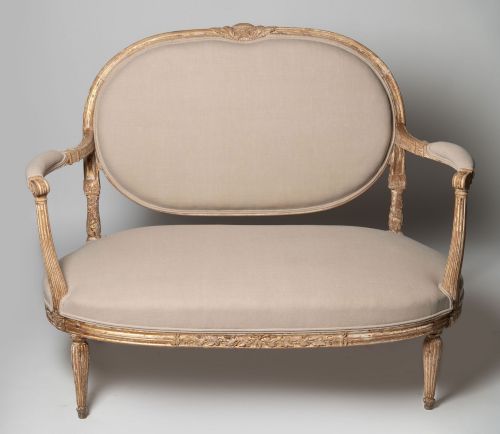
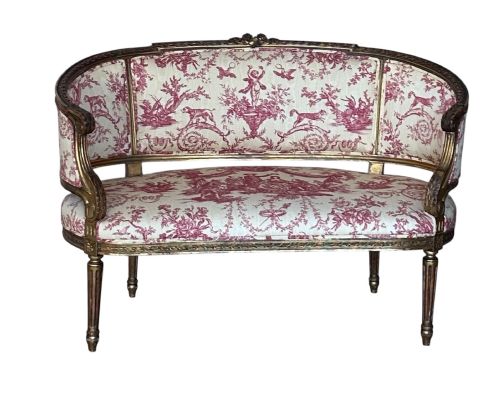
A gold leaf upholstered settee brings grand continental seating into a room, combining carved giltwood frames with generous textile cushions.
Gold Leaf Upholstered Settee
A gold leaf upholstered settee offers formal seating derived from eighteenth-century French and continental traditions, adapted through nineteenth-century revivals. When searching for a gold leaf upholstered settee, a buyer encounters pieces from the Victorian era down to nineteen-ten, reflecting Louis Quinze, Louis Seize, Swedish Empire, and Adam styles.
The common form on this page is the large giltwood or painted frame sofa, often French or English in origin, upholstered in linen or cotton textiles. These range from two-seater settees and window seats to grand salon suite components designed for formal entertaining spaces.
Continental workshops produced the majority of these variations, favouring carved gilt wood surfaces paired with neutral or patterned linen covers. A buyer selects among nineteenth-century country house sofas, Italian neoclassical benches, and French canapés depending on scale and interior proportion.
Materials and construction
Makers shaped structural frames from beech and other dense hardwoods capable of supporting intricate hand-carved ornamentation. Artisans applied thin sheets of gold leaf over preparation layers on the timber, creating the characteristic luminous finish of giltwood.
Upholstery techniques relied on traditional textile webbing, springs or stuffing, and durable outer covers in linen, cotton, and various decorative weaves. Brass tacks or decorative gimp often secured the fabric edges directly to the wooden rails.
Some nineteenth-century French artisans carved secret palm signatures beneath the seat rails, leaving an invisible nod to the hands that laid the gold leaf.
What separates the finest examples
Quality rests in the crispness and depth of the wood carving on the frame, where hand-tooled details outclass mechanical production. The integrity of the original gold leaf surface, showing natural wear rather than heavy modern repainting, defines a superior piece.
Proportion and scale dictate the visual success of the settee, with balanced armrests and harmonious back curves marking better craftsmanship. The quality of the underlying joinery ensures the frame remains rigid and capable of withstanding daily use.
The Gold Leaf Upholstered Settee Glossary
- Giltwood
- Timber decorated with a thin layer of gold leaf applied over a prepared gesso surface. This finish provides a warm, reflective metallic sheen distinct from modern metallic paint.
- Canapé
- A traditional French term for an upholstered sofa or settee, typically featuring an exposed wooden frame. These pieces often incorporate carved rails and cabriole or tapered legs.
- Louis XVI Style
- A neoclassical design vocabulary characterised by straight lines, symmetrical geometry, and classical motifs such as fluting and acanthus leaves. It emerged in opposition to the preceding Rococo curvature.
- Salon Suite
- A matched group of seating furniture designed for a formal drawing room or parlour. Such suites commonly include a central settee accompanied by matching armchairs.
Gold Leaf Upholstered Settee: Frequently Asked Questions
How do I clean giltwood frames?
Dust the carved wooden surfaces gently with a soft, dry brush to prevent accumulation without disturbing the delicate gold leaf layer. Avoid liquid cleaners and harsh chemicals, which can strip or discolour the metallic finish.
Consult a professional restorer if the gilding shows flaking or structural instability. Preventative care relies on keeping the furniture away from direct sunlight and excessive humidity.
Can these settees handle daily sitting?
Nineteenth-century frames are structurally robust, constructed from hardwoods like beech designed for active use in period homes. Modern placement benefits from assessing the internal webbing and upholstery support.
Heavier daily lounging may require reinforcing historical joints or updating internal padding while preserving the outer textile. Regular gentle use maintains the equilibrium between decorative impact and practical seating.
How do I identify Louis XV from Louis XVI style?
Louis XV pieces feature asymmetrical curves, scrolling motifs, and undulating cabriole legs inspired by natural organic forms. The overall aesthetic prioritises flowing lines and exuberant decorative carving.
Louis XVI design shifts toward straight lines, geometric symmetry, fluted columns, and classical urn or ribbon motifs. This transition reflects an eighteenth-century return to architectural restraint and antiquity.
What fabrics work best for reupholstery?
Historical accuracy points toward traditional linens, damasks, and woven cottons that complement the period aesthetic of the giltwood frame. Neutral linens offer a contemporary contrast to ornate gold leaf carvings.
Selecting durable textile weaves ensures the upholstery withstands friction while maintaining a complementary texture. Historic context guides the choice between plain fabrics and patterned lampas designs.