



Gold Leaf Framed Miniatures
Gold leaf framed miniatures bring intimate portraits and delicate scenes within reach, framed in bright gilded wood and metal.
Gold Leaf Framed Miniatures
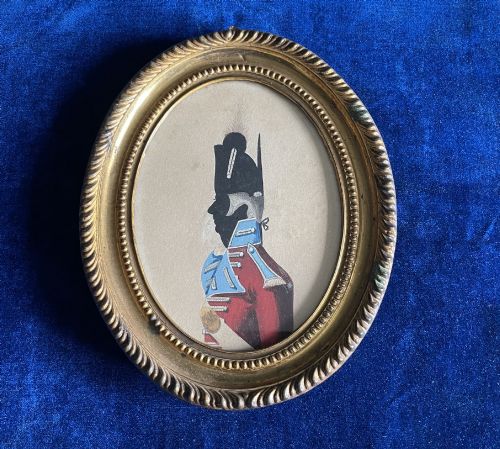
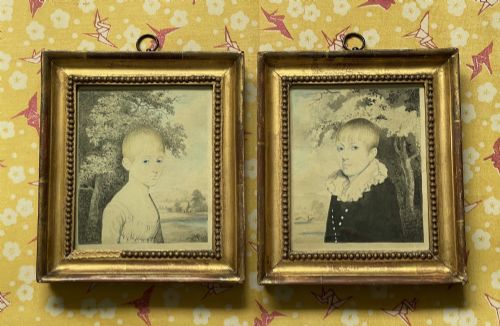
Gold leaf framed miniatures comprise small-scale paintings, watercolours, pastels, silhouettes and mirrors enclosed within giltwood or gilt metal surrounds. These pieces span the eighteenth and nineteenth centuries, taking forms such as oval portrait pairs, rectangular paintings and small wall mirrors.
Georgian and Regency examples sit alongside mid-nineteenth-century works, showing how framing styles shifted from simple classical profiles to ornate revival designs. Buyers will encounter paper, vellum and tinplate supports protected beneath glass within their original frames.
Materials and construction methods
Artists painted these works on paper, card, tinplate and prepared panels using watercolour, gouache, pastel, pencil and ink, sometimes employing hand-cut paper for silhouettes. Chrystoleums combined photographic prints with hand-colouring beneath convex glass to create depth.
Frames were constructed from wood and cast metal before receiving applications of gold leaf or gilt finishes. Glazing protected the delicate pigments from dust and handling, whilst small stands or hanging loops allowed the pieces to be displayed on desks or walls.
Miniatures of beloved pets occasionally turn up, proving that our ancestors loved posting pictures of their dogs just as much as we do.
Factors determining quality
The integrity and originality of the gold leaf frame contribute heavily to the piece, particularly where gilding remains undisturbed on carved gesso and wood. Intact convex glass and original backing papers help preserve the condition of the artwork within.
James Sharples·George Hargreaves·Louis Léopold Boilly·Ozias Humphry
The Gold Leaf Framed Miniatures Glossary
- Portrait miniature
- A small-scale painting, typically executed in watercolour or gouache on paper, ivory or vellum. These works gained immense popularity in the eighteenth and nineteenth centuries as portable tokens of affection.
- Giltwood
- Wood that has been coated with a thin layer of gold leaf or gold paint. It provides the characteristic bright metallic finish seen on antique frames.
- Silhouettes
- Profile portraits cut from black paper or painted in monochrome against a pale background. They offered an accessible form of likeness before the widespread adoption of photography.
- Chrystoleum
- A photograph applied to convex glass, rendered transparent with oil or varnish, and then hand-painted from the reverse. This technique created a luminous, three-dimensional effect popular in the nineteenth century.
- Gouache
- An opaque water-based paint composed of pigment, water and a binding agent such as gum arabic. It allows for rich, solid areas of colour in small-scale works.
Gold Leaf Framed Miniatures: Frequently Asked Questions
How were portrait miniatures displayed?
These small works were frequently hung in tight clusters on drawing room walls or kept close at hand on desks and dressing tables. Many featured easel stands or rings for hanging.
Their intimate scale meant they were designed for private viewing rather than grand architectural display, allowing owners to hold them in the hand.
What is a chrystoleum?
A chrystoleum is a coloured photograph placed behind convex glass, popular during the Victorian period. Artisans applied oil paints to the back of the image to create a rich, dimensional picture.
Protected by the curved glass surface, these works often retained vibrant colouration through the decades.
How do I date a framed miniature?
Dating relies heavily on the style of the costume, the technique of the painting, and the construction of the frame. Georgian frames often display simpler neoclassical lines, whilst nineteenth-century examples lean towards ornate revival patterns.
The materials used for the support, such as hand-cut paper or tinplate, also point to specific periods of manufacture.
Are these pieces hand painted?
The majority of the works in this category are original hand-painted watercolours, gouaches or pastels executed directly by artists. Skilled hands rendered minute details onto paper, card or metal supports.
Only specific later formats, such as chrystoleums, incorporated photographic bases beneath their painted layers.