



Gold Leaf Centre Table
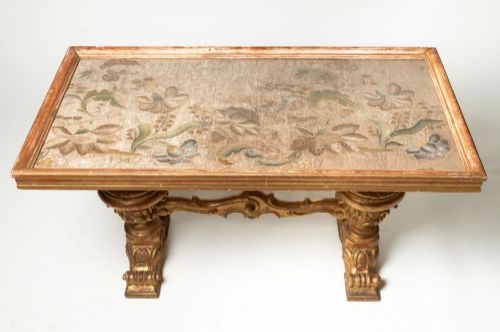
A gold leaf centre table brings immediate presence to a room, offering grand carved surfaces and rich historic ornament.
Gold Leaf Centre Table
A gold leaf centre table stands ready to anchor a principal room, designed to be viewed from all sides rather than pushed against a wall. The pieces collected under this term span several distinct eras, moving from Georgian grand scale and nineteenth century revival pieces down to twentieth century interpretations.
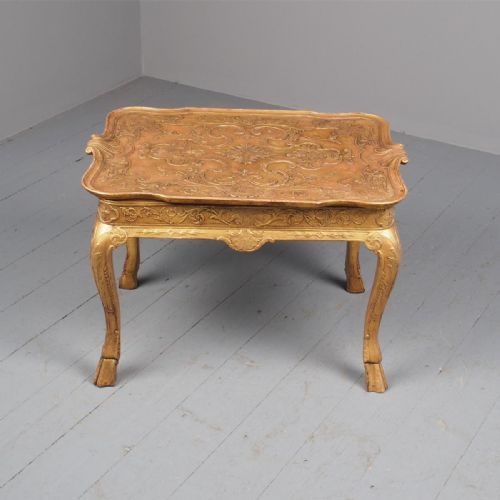
The most frequent examples found here display ornate continental influences, drawing heavily on French rococo, Italian baroque, and neoclassical Venetian design. Alongside true centre tables, the selection includes related low tables, console tables, and occasional tables sharing the same gilt surface treatment.
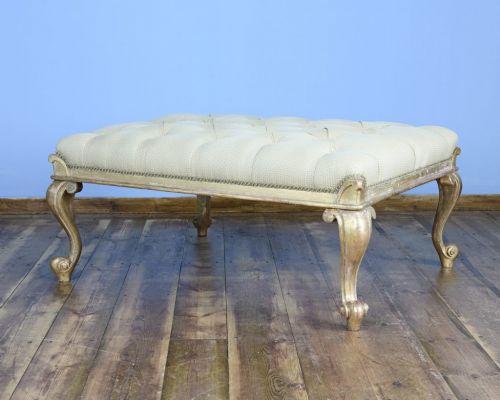
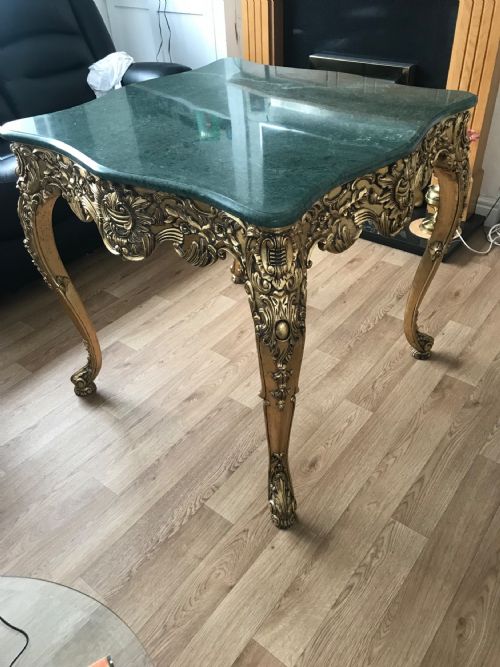
Forms vary from robust parcel gilt footstools and stands to substantial coffee tables fitted with solid polished marble tops. Buyers encounter everything from intricately carved wooden frames featuring swans and classical motifs to simpler geometric occasional pieces.
Materials and construction methods
Makers relied on solid wood foundations, gesso preparation layers, and delicate applications of gold leaf or giltwood to achieve a luminous metallic finish. Carved wooden structures provide the heavy structural integrity required for large tables.
Many surviving examples incorporate heavy solid marble tops, particularly polished green marble, contrasting sharply with the bright reflective surfaces of the gilded frames below. Occasional textile elements and upholstery fabric appear on related seating and stool forms.
Materials recorded across the inventory include carved gesso, solid polished marble, and traditional textile upholstery.
Judging the quality of gilding and carving
Quality rests entirely in the crispness of the hand carving beneath the gilding and the depth of the metal leaf application. Superior pieces display deeply undercut wood ornaments where shadows pool naturally, rather than flat cast resin or hurried plaster mouldings.
The integrity of the underlying wood and marble tops dictates the long term stability of heavier forms. A successful table balances grand decorative ambition with structural joinery that withstands daily use.
The Gold Leaf Centre Table Glossary
- Giltwood
- Wood that has been coated with thin sheets of gold leaf over a prepared gesso ground. This traditional finish provides a warm, reflective surface that ages gracefully over the centuries.
- Gesso
- A plaster mixture applied to wood frames to create a smooth, sealed base for gilding. Master craftsmen carved intricate details directly into this layer before applying the gold leaf.
- Console table
- A table designed to stand against a wall, frequently supported by ornamental brackets or legs. Some historic variants bridge the boundary between console and freestanding centre tables.
- Parcel gilt
- A decoration method where only specific raised portions of an object are gilded while the remaining wood is painted or left exposed. This technique highlights particular carved motifs.
Gold Leaf Centre Table: Frequently Asked Questions
Where should a centre table go?
A centre table belongs in the middle of a principal room or a wide hallway where it can be appreciated from all angles. Because these pieces are finished on every side, pushing them against a wall obscures their best decorative work.
Ensure there is enough clearance to walk completely around the piece without disrupting the flow of the room. They serve naturally as display surfaces for lamps, books, or large decorative objects.
Are marble tops original to these tables?
Many nineteenth and twentieth century tables were constructed specifically to hold heavy stone inserts. Solid green marble and polished white marble tops provide necessary weight and stability to balance ornate gilded bases.
When examining a piece, look closely at how the stone sits within the wooden rebate. A proper fit usually indicates that the top has belonged to the frame for a very long time.
How do I date a gilded table?
Dating relies heavily on the style of the carving and the underlying construction methods of the wooden frame. Georgian and nineteenth century examples often display hand cut joinery and dense timbers beneath the gesso. Caches from the early twentieth century frequently adopt earlier French rococo or Venetian revivals while utilising slightly lighter internal framing. Comparing the specific decorative motifs against known period styles clarifies the origin.