


Gold Framed Fish Artwork
Gold framed fish artwork brings together maritime scenes, coastal life and sporting catches preserved in period oil and watercolour.
Gold Framed Fish Artwork
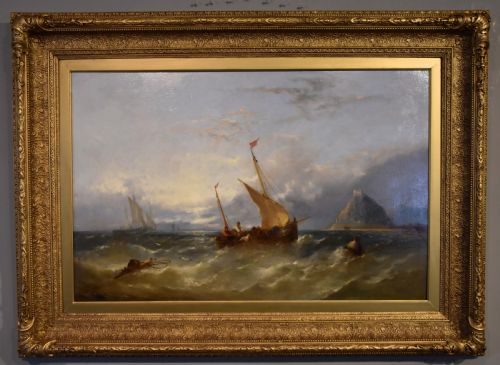
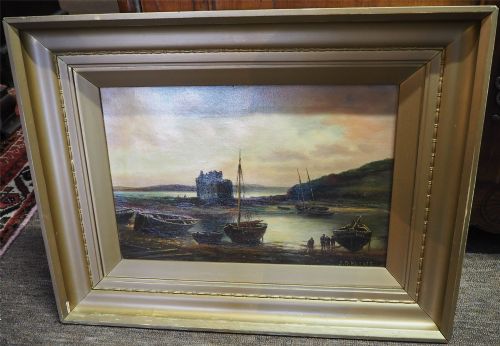
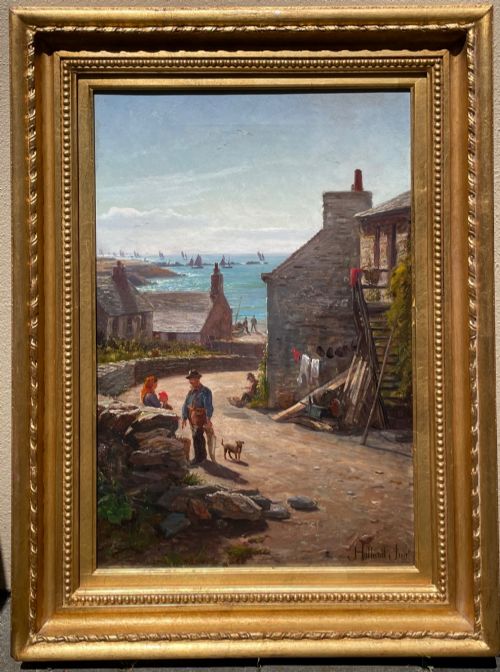
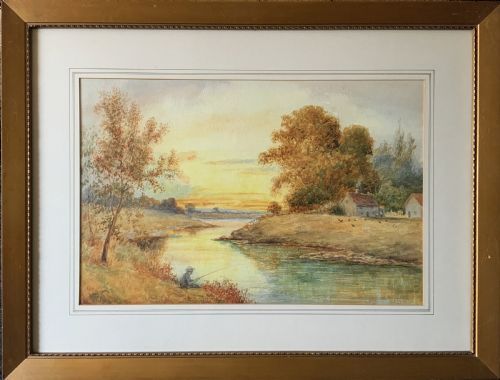
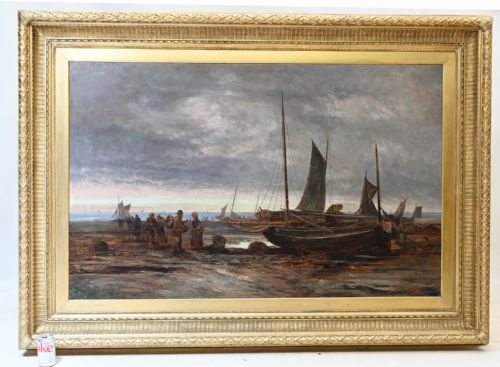
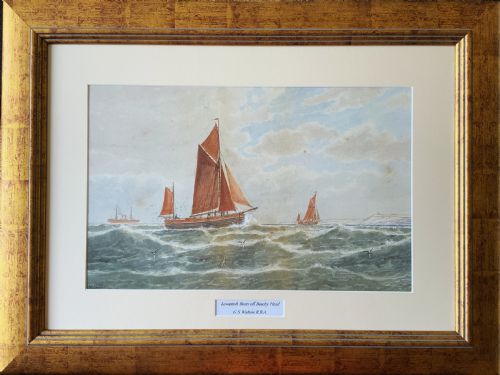
When you search for gold framed fish artwork, you encounter nineteenth-century oils and watercolours depicting coastal fishing boats, river anglers and landed catches. These pieces range from Victorian marine art to Dutch school seascapes housed in gilt wood frames.
You are most likely to meet Victorian oil paintings on canvas or board that show harbour scenes, coastal villages and specific fish species like pike or trout. The metallic leaf moulding of the frame serves to isolate the water and sky within the composition.
Materials and construction
These works rely on oil paint or watercolour applied to canvas, panel, card or paper, often supported by wooden stretcher frames. Painters built up marine atmospheres and aquatic subjects using layered pigments.
The characteristic frames utilise carved or moulded wood finished with gold leaf, giltwood or gilt paint. This reflective outer border protects the edge of the canvas and adds warmth to the painted palette.
Listings feature oil paintings and watercolours on canvas, panel, board and card from the nineteenth and twentieth centuries.
Evaluating quality and handling
Quality rests in the handling of light on water, the anatomical accuracy of the subject and the cohesion between the painting and its original gilt frame. Stronger works demonstrate assured brushwork in the depiction of choppy seas and marine vessels.
The integrity of the canvas support, the stability of the pigment layer and the preservation of the original gesso and gold leaf ornamentation determine the standing of each piece.
William Henry Williamson·John Holland·George Stanfield Walters·Charles Napier Hemy·Gustave De Bréanski·Pieter Cornelis Dommersen·James Kyd·George SHAW·T.S. Wallis·George Gregory·Frank Hyde·George Henry Knight·Paul H Ellis·WILLEM E.ROELOFS jr·Antonio Godoy·John Arthur Lomax·Horatio Henry Couldery·William Edward Webb·W.E.Barrington-Browne·James ward·Hubert Thornley·James Russell·Benjamin CALLOW
The Gold Framed Fish Artwork Glossary
- Giltwood
- Wood carved and coated with gold leaf or metallic powder. This finish provides a reflective border that frames the canvas.
- Marine Art
- Genre depicting ships, coastal views and maritime activities. It forms a large portion of the available painted works.
- Oil on Canvas
- Pigment mixed with drying oil applied to a woven fabric stretched across a frame. This combination allows for rich colour depth.
- Watercolour
- Paint consisting of water-soluble pigments on paper or card. It produces translucent washes often seen in coastal studies.
Gold Framed Fish Artwork: Frequently Asked Questions
What periods do these pieces span?
The available selection spans the nineteenth century through to the mid-twentieth century, with a concentration of Victorian maritime and genre painting.
Dates reflect the operational periods of the artists and the prevailing regional schools of painting active across Britain and Europe.
How should I care for a gilt frame?
Gilt wood frames require dry dusting with a soft brush and protection from direct sunlight and high humidity. Avoid liquid cleaners that can strip or discolour the metallic leaf.
Maintain stable room temperatures to prevent the underlying wood and gesso from cracking or separating from the rabbet.
Are these paintings signed by the artist?
Many examples feature artist signatures, monograms or contemporary inscriptions on the front or reverse of the canvas, board and frame. Attributions are also recorded in exhibition labels and historical provenance.
Unsigned pieces are categorised by school and period, relying on stylistic evidence and material analysis to determine their origin.
Where were these marine subjects painted?
Artists worked along British and European coasts, recording harbours, rivers and fishing communities from Cornwall to the North Sea. Locations often include specific coastal landmarks, castles and fishing ports.
These working environments provided direct observation for painters capturing maritime weather and daily trade.