



Green Fish Canvas Painting
Green fish canvas painting works bring rural riverbanks and coastal shores indoors through oils.
Green Fish Canvas Painting
When you search for green fish canvas painting, you encounter a range of nineteenth-century and early twentieth-century oil paintings depicting angling, marine life, and coastal fishing scenes. These works capture rivers, harbours, and catch portraits across Victorian and Edwardian periods.
You are most likely to meet pieces from the nineteenth century and the 1930s on this page, framed in wood or gilt wood. The subjects span British Impressionism, French Realism, and the Newlyn School alongside Dutch school seascapes.
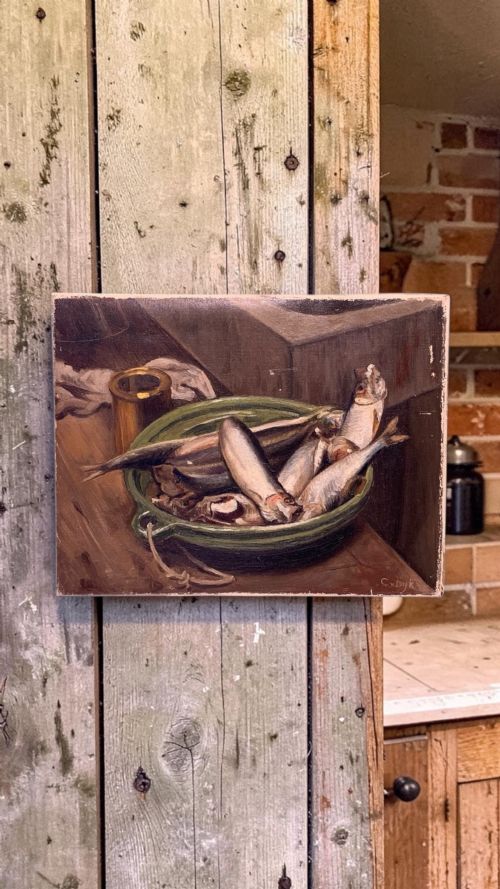
The assortment includes portraits of anglers, fishing boats, still life studies with fish, and river landscapes featuring fishers. These canvases record domestic and European waters through traditional oil paint techniques.
Materials and construction
These works utilise oil paint applied directly onto woven canvas supports. The pigments build up texture and depth across both water surfaces and subject details.
Frames are constructed from wood, frequently finished with gilt detailing. These surrounds provide structural support and framing for the stretched fabric.
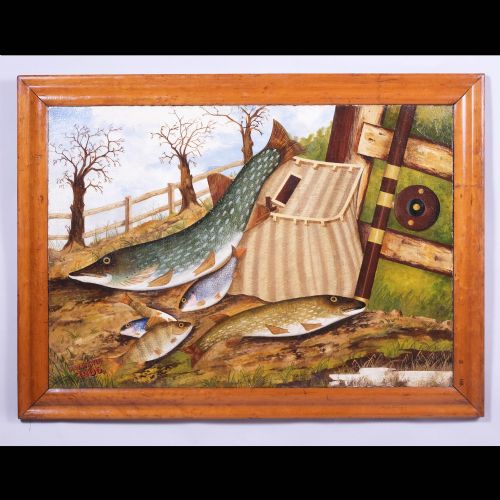
Anglers surface with northern pike and netted salmon, captured eternally mid-catch under willow trees.
Distinctions in quality
The handling of light on water and the articulation of atmospheric conditions distinguish finer works from simpler compositions. Superior brushwork brings movement to seascapes and rivers.
The preservation of the original canvas and the integrity of the wooden or gilt frame influence the overall character of the piece.
George Graham·William Lambert Bell·Sonia Mervyn·Samuel Bough
The Green Fish Canvas Painting Glossary
- Canvas
- A heavy woven fabric used as a surface for painting. It provides the tensile strength required for stretched oil compositions.
- Gilt
- A thin layer of gold leaf or gilt finish applied to wooden frames. It adds a reflective border to the oil painting.
- Oil Paint
- Pigment suspended in a drying oil binder. This medium allows for blended tones and rich surface textures.
- Newlyn School
- An art movement based in Cornwall focusing on realism and plein air painting. Members captured local fishing communities and coastal life.
Green Fish Canvas Painting: Frequently Asked Questions
What periods do these paintings cover?
The works span the nineteenth century through to the 1930s. This includes Victorian and Edwardian eras alongside specific decades like 1910 and 1920.
Styles represented range from French Realism and British Impressionism to the Newlyn School and Dutch school marine painting.
How should I frame these canvases?
Many pieces come housed in their original wood or gilt wood frames. Maintaining these surrounds preserves the historic presentation of the artwork.
Ensure any hanging environment avoids excessive moisture or direct sunlight to protect both canvas and paint layers.
What subjects feature in these scenes?
Common subjects include river landscapes with anglers, coastal fishing boats, and harbour views. Still life arrangements featuring fish also appear.
Locales stretch from Cornish fishing ports like Mevagissey to Scottish waters and continental European rivers.
Are these works signed by artists?
Several canvases bear the names or attribution of known painters from the nineteenth and early twentieth centuries. Signatures or studio records link specific pieces to named practitioners.
Anonymous works are categorised under broader regional schools such as the English School.