
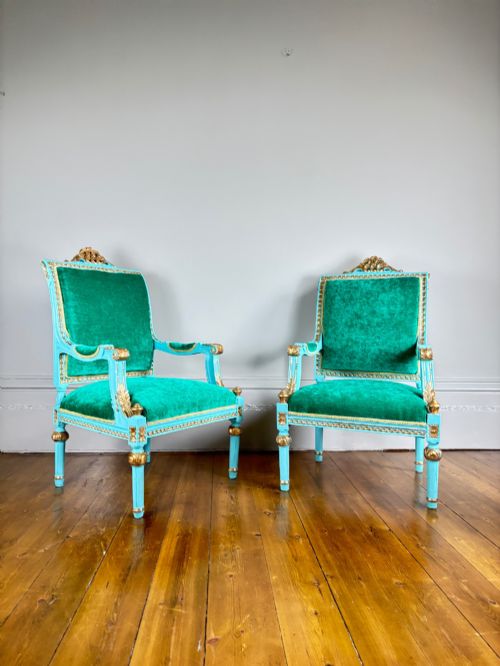
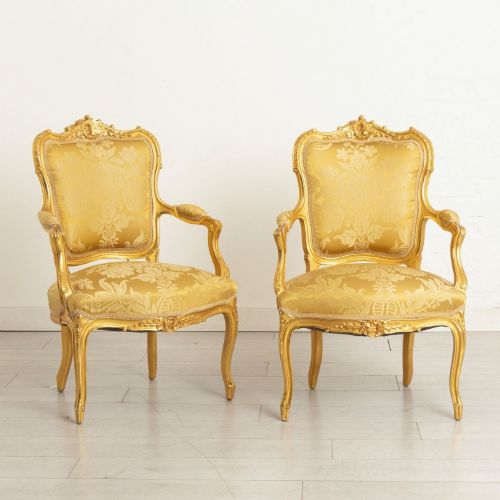


Giltwood Fauteuil Pair
A giltwood fauteuil pair brings the grand proportion and carved splendour of the French salon directly into a sitting room.
Giltwood Fauteuil Pair
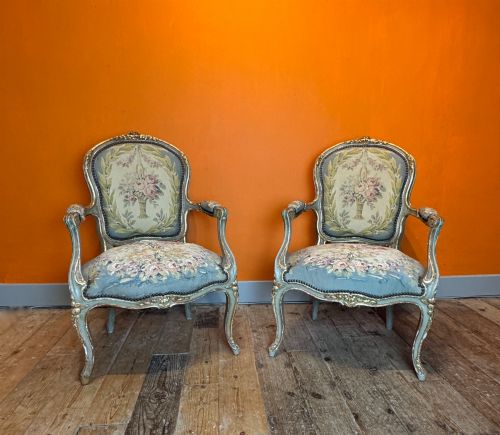
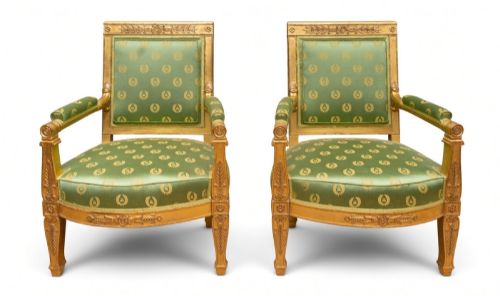
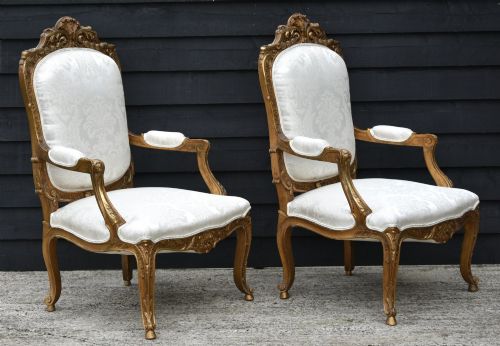
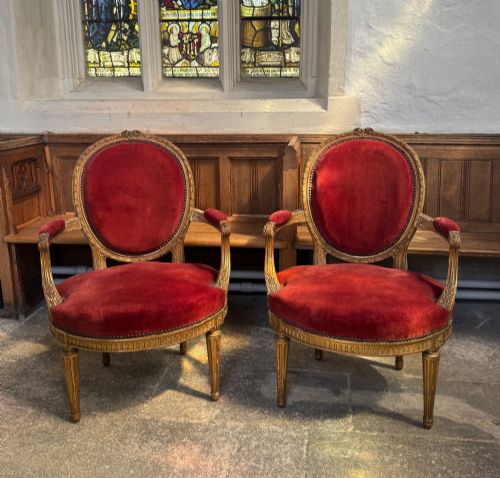
A giltwood fauteuil pair consists of matching open-armed seating designed for formal reception rooms, commonly encountered in nineteenth-century interpretations of earlier French aesthetics. These pieces typically display traditional open armrests, carved wooden frames, and upholstered seats intended for drawing rooms and grand parlours.
The selection ranges from eighteenth-century originals to later revival pieces created in the French chateau or neoclassical manner, often described as salon chairs or throne chairs. Most options appearing on this page belong to the nineteenth century, drawing heavily on Louis XVI or Rococo stylistic traditions.
Makers and workshops across France, Italy, and England produced these matching chairs, utilising beech, timber, and carved wood finished with gold leaf or silver gilt. Buyers frequently encounter variations in scale, from intimate bedroom chairs to large-scale throne armchairs upholstered in silk, velvet, or tapestry.
Materials and construction methods
Construction relies primarily on sturdy timber frames, with beech frequently selected by cabinetmakers for its ability to hold intricate carved details. Artisans shaped these wooden structures by hand before applying a fine layer of metallic leaf or gilding to create the characteristic golden surface.
Upholstery completed the seating, utilising textiles such as silk, velvet, tapestry, and plain fabric stretched over padded internal supports. Over the decades, many pairs have received new upholstery while retaining their original nineteenth-century or eighteenth-century gilded wooden frameworks.
Listings feature pieces spanning from the eighteenth century to the early twentieth century, with nineteenth-century French examples forming the majority.
Evaluating craftsmanship and character
Quality rests heavily on the depth and crispness of the hand-carved ornamentation across the wooden frame, where superior examples exhibit sharp floral motifs and fluid scrolling lines. The application of the gilt surface also dictates standard, with finer pieces showing rich patination rather than flat or uniform modern metallic paint.
Proportion and structural integrity define the higher tier of these chairs, ensuring the open arms and backrests offer both visual balance and robust daily support. Provenance and historical attribution, such as documented maker signatures or origin in notable collections, further elevate certain pairs above standard decorative seating.
Jacob-Desmalter·Holland & Sons
The Giltwood Fauteuil Pair Glossary
- Giltwood
- Wood covered with a thin layer of gold leaf or metallic powder. This finish creates the luminous golden appearance characteristic of formal antique seating.
- Fauteuil
- An open-armed upholstered armchair originating in France. The distinctive design leaves the wooden armrests exposed rather than padded with fabric.
- Louis XVI Style
- A neoclassical design aesthetic defined by straight tapered legs, geometric symmetry, and classical ornamentation. It emerged during the eighteenth century and inspired numerous nineteenth-century revivals.
- Rococo
- An ornate artistic style characterised by asymmetric curves, C-scrolls, and naturalistic plant motifs. It heavily influences many nineteenth-century salon chairs on this market.
Giltwood Fauteuil Pair: Frequently Asked Questions
What is a giltwood fauteuil pair?
A giltwood fauteuil pair comprises two matching open-armed chairs featuring carved wooden frames covered in gold leaf or metallic gilding. These seating items originated in France for formal reception rooms.
Today, they function as statement pieces in sitting rooms, bringing historical elegance and traditional craftsmanship to domestic interiors.
How do I distinguish revival periods?
Revival pieces from the nineteenth century often imitate eighteenth-century Louis styles through machine-assisted carving or softer detailing compared to genuine period originals. Examining the timber maturity and the wear of the gilt surface helps clarify the exact age.
Consulting the specific construction methods and upholstery backing provides additional clues regarding whether a set dates to the eighteenth or nineteenth century.
Were these chairs used for daily seating?
Historically, fauteuils were designed for formal salons and drawing rooms where guests gathered for conversation rather than lounging in private quarters. Their upright posture and open arms accommodated the bulky fashion of earlier centuries.
In modern homes, they suit low-traffic areas or reading corners where their decorative presence can be appreciated without excessive daily wear.
How should I care for silk upholstery?
Silk and delicate fabric upholstery require protection from direct sunlight to prevent fading and fibre degradation over time. Gentle surface dusting with a soft brush helps maintain the textile.
Professional cleaning is recommended for antique fabrics to avoid water staining or structural damage to the underlying padding.