
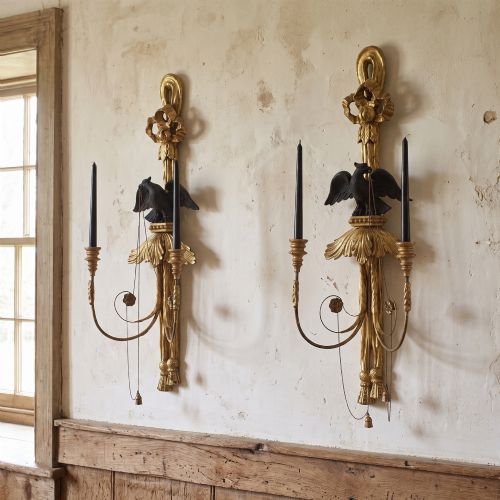
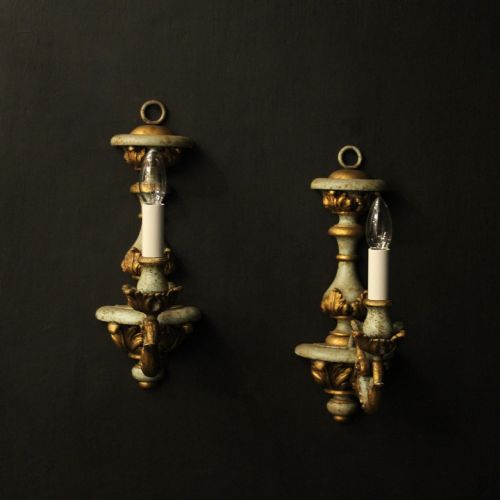
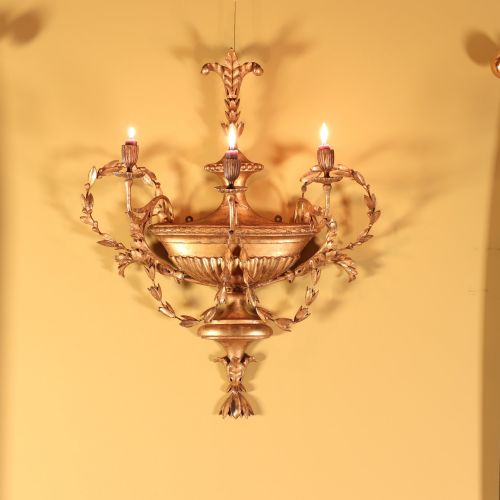
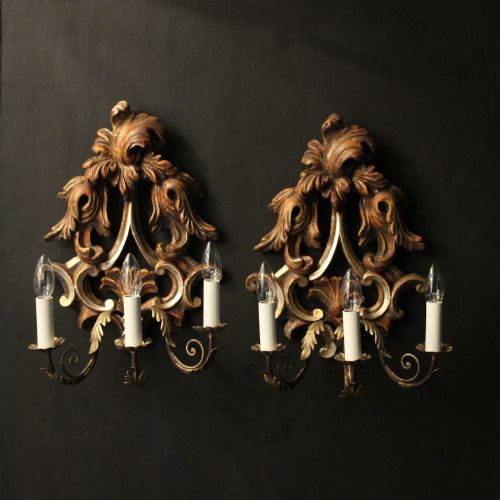


Giltwood Candle Brackets
These giltwood candle brackets bring warmth and reflected light to a room through carved timber and gold leaf.
Giltwood Candle Brackets
Giltwood candle brackets are wall-mounted light fittings designed to hold candles, appearing here in forms such as wall lights, wall sconces, and wall mirrors. The selection spans from the seventeenth century through the Victorian era and into the early twentieth century.
Pairs dominate the selection, often arranged with single, twin, three, or four branches to project light outward from a wall. Buyers will frequently encounter Florentine designs alongside George III style and Italian Neoclassical pieces.
The objects serve both a practical lighting function and a decorative role, utilising carved wood structures finished in gold leaf or silver leaf. Origin points range across Italian, French, and British workshops.
Materials and construction
Carvers shaped timber cores from wood before applying layers of gesso to create smooth surfaces for detail work. Artisans then laid gold leaf or silver leaf over the prepared ground to achieve a metallic sheen.
Makers incorporated iron and other metals for structural support in multi-branch wall lights and sconces. Polychrome finishes and toleware elements appear alongside traditional giltwood surfaces in several examples.
The listings span eight distinct periods, stretching from the seventeenth century through to 1930.
Quality and craftsmanship
Depth and crispness of the wood carving distinguish finer brackets from simpler productions, particularly in scrolling foliage and figural elements. The precision in applying gold leaf or silver leaf dictates how effectively the surface catches and reflects light.
Proportion and balance between the backplate and the projecting candle branches determine the structural harmony of each piece. Surviving examples retain the integrity of their original construction methods across different centuries.
The Giltwood Candle Brackets Glossary
- Giltwood
- Wood coated with gold leaf or powder. This finish provides the characteristic metallic brilliance seen on historical wall fixtures.
- Gesso
- A plaster mixture applied to wood surfaces as a base for gilding. It allows artisans to carve intricate details before applying leaf.
- Sconce
- A wall-mounted lighting fixture designed to carry candles or lamps. Sconces project illumination forward into a space.
- Toleware
- Enamelled or lacquered metalware used in decorative objects. It often appears combined with carved wood elements in continental lighting.
- Appliqué
- A decorative wall fitting applied to a surface. The term is frequently used interchangeably with wall lights in continental European pieces.
Giltwood Candle Brackets: Frequently Asked Questions
How do I mount giltwood candle brackets safely?
Wall brackets require secure fixings into solid masonry or proper wall studs to support their weight and the downward pull of the branches. Professional installation ensures the backplate sits flush against the wall without straining the historical timber.
Position the brackets at a height that protects surrounding textiles from open flames while distributing light evenly across the room.
Can these antique brackets hold modern candles?
Many historical brackets accommodate standard taper candles, though sizing can vary depending on the original drip pans and nozzle diameters. Candle adapters or dripless candles help prevent wax from reaching the delicate giltwood surfaces.
Electric conversions also exist, though many owners prefer traditional wax candles for historical authenticity.
How do I clean giltwood surfaces?
Dust giltwood gently using a soft, dry brush to remove particles without disturbing the thin gold leaf layers. Avoid liquid cleaners, abrasives, or harsh solvents that strip the historical gesso and gilding.
Professional conservators handle deeper cleaning when accumulated grime obscures the carved details.
How do I tell Florentine styles apart from Neoclassical pieces?
Florentine pieces often feature exuberant scrolling foliage, rich surface ornamentation, and deep relief carving influenced by baroque traditions. They frequently display silver giltwood or polychrome highlights.
Neoclassical designs lean towards symmetrical restraint, architectural motifs, and cleaner geometric lines drawn from classical antiquity.