
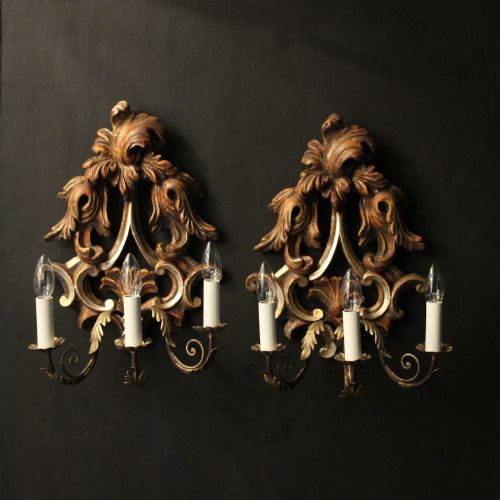


Giltwood Candle Appliques
These giltwood candle appliques bring carved timber and metal armatures to a wall, catching candle flame across centuries of European craft.
Giltwood Candle Appliques
These giltwood candle appliques comprise wall lights and sconces designed to hold multiple candles upon carved wooden brackets. The selection spans seventeenth-century origins through to twentieth-century revivals in French and Italian workshops.
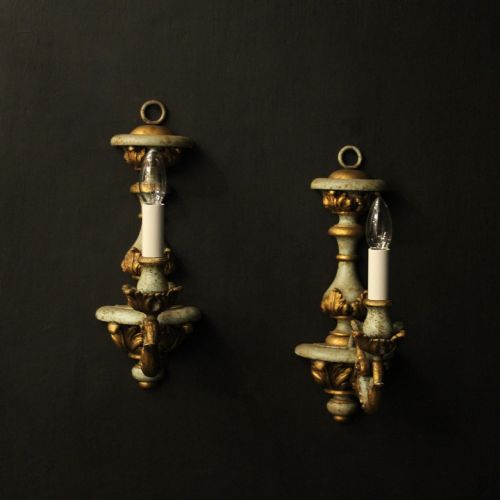
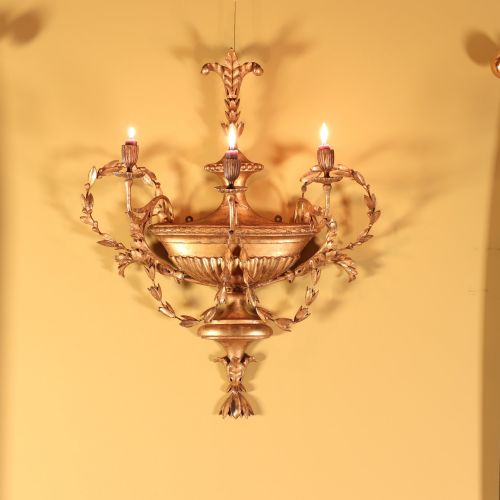
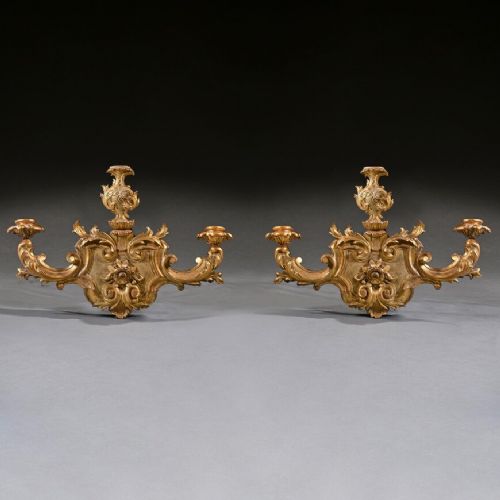
Most examples appearing here take the form of paired wall fixtures, frequently styled in Florentine Rococo or George III manners. Single arm variants sit alongside larger twin, triple, and four-branch configurations.
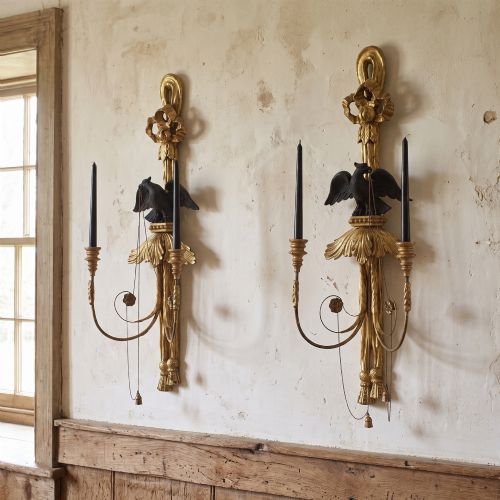
Originating predominantly from British, French, and Italian sources, these pieces utilise carved wood foundations shaped into scrolling foliage, eagles, and lire forms.
Materials and construction
Makers shaped the core structure from carved wood, applying layers of gesso to smooth the surface before adding gold leaf or silver leaf gilding. Some regional variants incorporate polychrome pigments or ebonised highlights alongside the metallic finish.
Metal armatures and candle nozzles integrate with the carved wooden backplates to support single or multiple light branches. The interplay between carved gesso and applied leaf creates the characteristic reflective sheen when lit.
Eagle motifs peer out from nineteenth-century shadows, eternally poised to supervise the dining room illumination.
Standards of craftsmanship
The depth and definition of the wood carving distinguish finer appliques from simpler production pieces, particularly where acanthus leaves and animal motifs are rendered by hand. Crisp gesso work ensures the underlying relief remains sharp beneath the gold leaf layers.
Proportion and balance across paired sconces dictate the visual weight when mounted on a wall, especially in larger multi-branch formats. The integration between the wooden backplate and the metal candle arms reveals the structural ambition of the maker.
The Giltwood Candle Appliques Glossary
- Giltwood
- Timber that has been decorated with a thin layer of gold leaf over a prepared ground. This technique provides a warm, reflective surface that catches ambient light.
- Gesso
- A plaster-like mixture applied to carved wood to create a smooth, durable base for gilding. It allows for intricate relief details to be modelled before leaf is laid.
- Sconce
- A wall-mounted lighting fixture designed to hold candles or lamps. These fixtures project forward from the wall surface to illuminate surrounding spaces.
- Polychrome
- The practice of decorating surfaces in multiple colours. In these pieces, painted details often complement the giltwood areas.
- Applique
- A decorative wall fitting or architectural ornament applied to a surface. The term frequently describes wall-mounted candleholders of continental origin.
Giltwood Candle Appliques: Frequently Asked Questions
How were appliques used historically?
These fixtures were mounted on drawing room and salon walls to reflect candlelight and brighten dark panelled interiors.
Positioned strategically opposite mirrors or windows, they maximised the available light from candles before the arrival of electricity.
How do I mount heavy wall sconces?
Secure fixing requires locating proper wall studs or using heavy-duty cavity anchors appropriate for the weight of carved timber and gesso.
Because many pieces feature extended arms or heavy wooden backplates, professional installation ensures the fixture remains stable.
How should I clean giltwood surfaces?
Dusting requires only a very soft, dry brush to prevent abrasive particles from scratching the delicate gold leaf layer.
Moisture and modern chemical cleaners must be avoided entirely, as they strip the historic gesso and gilding from the carved wood.
Are these fixtures wired for electricity?
Most examples retain their original configuration for candles, though some pieces accommodate discreet internal wiring for modern bulbs.
Conversion depends on the hollow channels within the wooden backplate and whether the candle sockets permit safe adaptation.
How do I distinguish French and Italian styles?
French designs often lean towards ornate lire shapes and formal Louis XIV motifs with balanced, sweeping proportions.
Italian pieces, particularly those from Florentine workshops, frequently showcase exuberant Rococo scrolling and rich polychrome or silver gilt finishes.