


Gilt Silver Tea Spoons
These gilt silver tea spoons bring gold-plated lustre to the table, spanning Georgian elegance, Victorian work and enamelled Continental styles.
Gilt Silver Tea Spoons
When you search for gilt silver tea spoons, you encounter everything from single Georgian shovel caddy spoons to matched cased sets of twelve from the Victorian era and the mid-twentieth century. The selection ranges widely across origins, encompassing Ottoman, French, Russian and American pieces alongside British items.
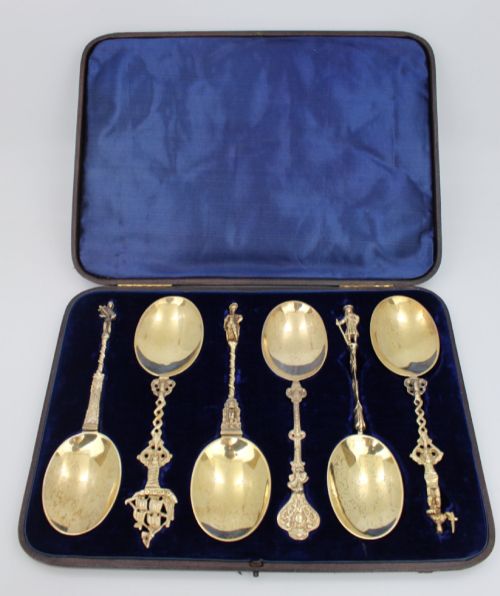
You meet various forms on this page, including standard teaspoons, coffee spoons, caddy spoons and sifter spoons, often accompanied by sugar bowls or tongs. Many survive in fitted cases lined with silk and velvet, preserving the bright gold wash upon the silver base.
How they were made
Makers shaped these pieces from sterling silver or solid silver before applying a gold wash, often termed vermeil or silver gilt, via fire gilding or electroplating methods. Enamel work frequently decorates the handles and bowls, utilising cloisonne, guilloche or champleve techniques to add intense colour.
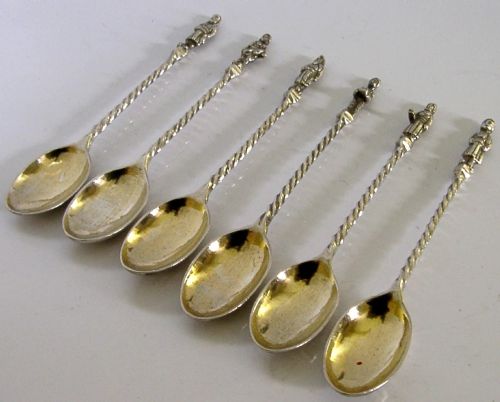
Some examples display detailed figural elements, cast grape vine designs, or crests, while others rely on the smooth contrast between polished silver and rich gilding. Cased sets demonstrate coordinated manufacturing, where spoons and matching accessories were housed together from the outset.
Materials documented across the inventory include sterling silver, solid silver, gold gilt, enamel, velvet and silk.
What varies in quality
The distinction between ordinary and exceptional pieces lies primarily in the crispness of the chasing and the preservation of the gold layer over the silver. Heavy gauge solid silver provides a substantial feel in the hand, setting apart superior items from lighter productions.
Enamel work introduces another measure of distinction, where undamaged cloisonne cells or smooth guilloche patterns require high technical skill. Complete cased sets with matching tongs or sifter spoons command greater interest than assembled groups or solitary survivors.
David Andersen·Vasily Agafonov·Charles Boyton·Georg Jensen·Pierre Queille
The Gilt Silver Tea Spoons Glossary
- Silver Gilt
- Silver that has been coated with a thin layer of gold. This treatment protects the underlying metal from tarnishing while offering a rich golden appearance.
- Caddy Spoon
- A specialised spoon designed for measuring loose tea leaves from a caddy. They often feature shallow, wide bowls shaped like leaves, shells or shovels.
- Cloisonne
- An enamel technique where metal wire is soldered to the metal base to create compartments, which are then filled with coloured glass paste and fired. It produces intricate patterns of distinct colour areas.
- Guilloche
- A decorative mechanical technique where a precise, intricate repeating pattern is engraved into a metal surface beneath a translucent enamel layer. This creates a shimmering, wave-like visual effect.
- Vermeil
- High-quality silver plated with a heavy layer of gold. The term originates from French tradition and denotes a robust gold coating over solid silver.
Gilt Silver Tea Spoons: Frequently Asked Questions
How do I clean gilt silver tea spoons?
Wash them gently in warm soapy water using a soft cloth, avoiding abrasive dips or harsh scrubbing that can wear away the delicate gold layer.
Dry them thoroughly with a soft lint-free towel immediately after washing to prevent water spots and preserve the polished finish.
Can I use these spoons for daily tea?
Many people choose to use them on special occasions rather than every day, as vintage enamel and thin gold washes require gentle treatment.
Hand washing is essential, and storing them in fitted cases or felt rolls protects the surfaces from scratches caused by other cutlery.
What is the difference between silver gilt and solid gold?
Silver gilt consists of a silver base covered with a microscopic or thin layer of gold, combining the strength and weight of silver with the appearance of gold.
Solid gold items are made entirely of gold alloy throughout their structure, making them far heavier and distinct in precious metal content.
How do I date a set of spoons?
Hallmarks stamped on the metal provide the most reliable evidence, pointing to specific assay offices, date letters and makers' marks.
Stylistic clues such as mid-century modern lines, Victorian grape motifs or Georgian shovel bowl shapes also help narrow down the decade of creation.