


19th Century Russian Silver
These 19th century russian silver pieces unite imperial workshops and regional traditions through solid silver, niello, and cloisonne enamel.
19th Century Russian Silver
When you search for 19th century russian silver, you encounter items ranging from solid silver vodka cups and spoons to ritual objects and decorative vessels. The examples on this page span the nineteenth century, including specific dates such as eighteen forty-eight, eighteen ninety-six, and nineteen hundred.
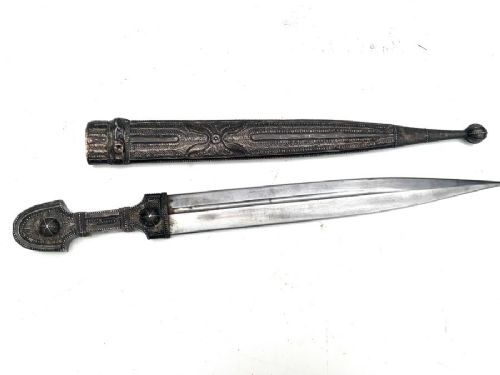
You meet various functional and ceremonial forms, such as kovsh cups, salt cellars, kindjal daggers, walking sticks, icons, and table snuff boxes. These objects originate from centres like Moscow and St Petersburg, alongside Caucasian regional workshops.
The materials deploy silver, silver-gilt, vermeil, and steel, frequently enhanced by niello work, enamel, cloisonne enamel, and jade. Surviving items demonstrate the breadth of imperial output from utilitarian cutlery sets to presentation pieces.
How they were made
Silversmiths constructed these pieces using solid silver and silver-gilt, applying hammering and casting techniques to shape bowls, handles, and casings. Artisans integrated steel blades into daggers and walking sticks, while others mounted jade and wood elements.
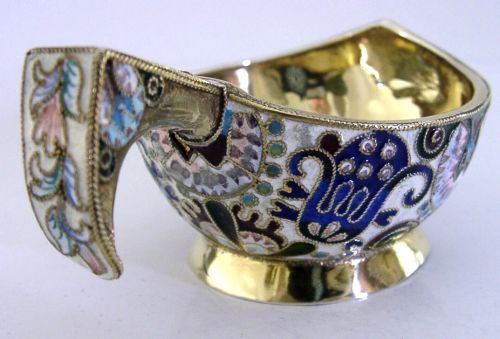
Decoration relied heavily on niello inlay, where a dark metallic alloy fused into engraved silver designs to create contrasting patterns. Cloisonne enamel and polychrome enamel work added vibrant colour fields, separated by delicate wire partitions soldered onto the silver surface.
Listings feature items from Moscow and St Petersburg, alongside Caucasian daggers from eighteen fifty.
What varies in quality
Quality rests upon the precision of the silversmith's handwork, particularly the crispness of niello engravings and the flawless distribution of enamel across cloisonne cells. Superior pieces display rigorous control over complex decorative programmes without surface crowding or uneven soldering.
The reputation of the maker and the clarity of city assay marks, purity numbers, and master stamps establish the baseline for authenticity and execution. Workshop pedigree directly influences the finesse found in handles, mounts, and structural fittings.
Aleksandr Timofeyevich Shevyakov·Vasily Agafonov·J.E. Sallman·P. Barabanon·Michael Alexandrovich Romanov
The 19th Century Russian Silver Glossary
- Niello
- A black metallic alloy of sulphur, silver, lead, and copper fused into engraved designs on silver. This technique produces high-contrast geometric or pictorial motifs.
- Cloisonne
- An enamelling method where thin metal wires form compartments on a metal base, which are then filled with coloured glass paste and fired. The resulting cells create distinct patterns.
- Kovsh
- A traditional Russian drinking vessel shaped like a boat with a flat, hook-like handle. They appear in silver and enamel for decorative and presentation uses.
- Silver-gilt
- Silver objects coated with a thin layer of gold on the surface, sometimes referred to as vermeil. This treatment protects the silver base and gives a warm gold interior or exterior.
19th Century Russian Silver: Frequently Asked Questions
What is niello silver?
Niello is a black metallic alloy inlaid into engraved silver channels to form dark patterns against the bright metal.
This decorative method appears frequently on nineteenth-century Russian snuff boxes, vesta cases, and spoons.
How do I identify Russian silver marks?
Russian pieces typically display silver purity numbers like eighty-four, alongside city assay marks and makers' initials.
St Petersburg and Moscow served as the primary hubs where master silversmiths registered their stamps.
How should I clean silver enamel?
Enamelled silver requires gentle dusting with a soft cloth to protect the delicate glass paste compartments.
Harsh silver dips or abrasive polishes will damage the cloisonne wires and the surrounding enamel surfaces.