




Gilt Painted Folding Screen
These gilt painted folding screens divide a room with painted scenes and gold leaf, offering privacy and decorative impact.
Gilt Painted Folding Screen
When you search for a gilt painted folding screen, you encounter multi-panel divisions spanning room dividers and fire screens. These pieces originate across several periods, notably the eighteenth century, the nineteenth century, and the early twentieth century.
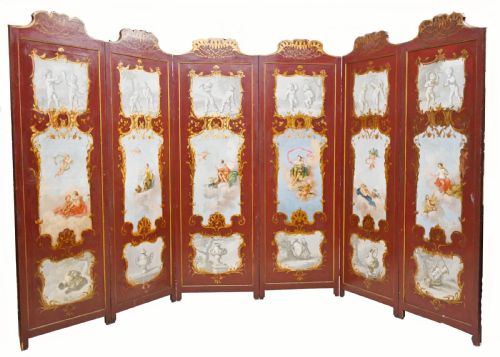
The forms on this page include four-leaf freestanding screens, three-fold screens, and six-panel room dividers. Origins range from French and Dutch workshops to Chinese and Japanese export pieces.
You meet various stylistic interpretations, including Chinoiserie, Rococo Revival, and Spanish work. The most common survivals combine painted imagery with gilt leaf upon wood or leather.
How they were made
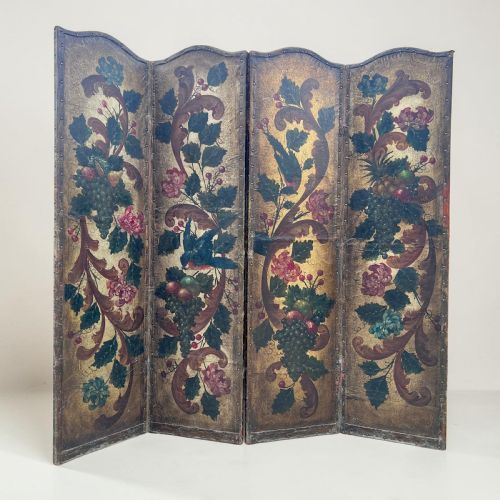
Maker construction relies heavily on wood frameworks or heavy leather panels joined by brass hinges. Artisans applied layers of oil paint and lacquer to form the base surface of the panels.
Gold leaf and gilt embossing were then applied by hand to highlight decorative borders, motifs, and pictorial scenes. Leather examples frequently received embossed details before the painting and gilding stages.
Current listings feature wooden and leather panels decorated with oil paint, lacquer, and gold leaf across Chinoiserie and Rococo styles.
What varies in quality
Quality separates ordinary joinery from exceptional craftsmanship through the crispness of the hand-painted details and the purity of the gold leaf. The depth of the gilt embossing on leather panels also indicates the level of skill involved.
Makers such as Paul Sormani demonstrate superior cabinetmaking in their frames and hinges compared to standard workshop production. The preservation of the original lacquer and oil paint surfaces dictates the overall integrity of the piece.
Paul Sormani
The Gilt Painted Folding Screen Glossary
- Chinoiserie
- European decorative style inspired by Chinese artistic traditions, often featuring imaginary landscapes and figures. This style appears frequently on screens from various centuries.
- Cordoban leather
- Heavy leather originating from Córdoba in Spain, heavily worked, embossed, and painted. Examples from the eighteenth century utilise this robust material.
- Giltwood
- Wood carved and subsequently covered with gold leaf or gilt paint. It forms the structural or decorative framing of several screens.
- Lacquer
- Protective and decorative finish applied in multiple coats and polished to a hard sheen. Asian export pieces rely heavily on this technique.
- Rococo Revival
- Nineteenth-century style drawing on eighteenth-century French ornamentation, characterised by asymmetric curves and scrolls. This aesthetic defines many Victorian screens.
Gilt Painted Folding Screen: Frequently Asked Questions
How do I place a folding screen?
Position a screen against a plain wall to add colour and texture, or use it to define zones within a larger living space.
Ensure the panels are angled correctly to maintain stability without straining the hinges.
Were these screens used for fires?
Smaller three-fold versions served as fire screens to protect occupants from the intense heat of an open hearth.
Larger four-fold and six-fold variants functioned purely as room dividers and draught excluders.
How do I clean painted leather?
Dust the surfaces gently with a soft, dry cloth to prevent abrasive particles from scratching the paint and gold leaf.
Avoid liquid cleaners and moisture, as water damages both antique leather and oil paint.
How do I date a screen?
Examine the construction of the hinges, the type of wood, and the wear patterns on the lacquer or leather.
Stylistic markers such as Rococo Revival scrolls or Chinoiserie motifs provide clues to the period of manufacture.