


Gilt Foyer Table
A gilt foyer table brings gilded warmth and classical proportion to an entrance hall, grounding the space with architectural presence.
Gilt Foyer Table
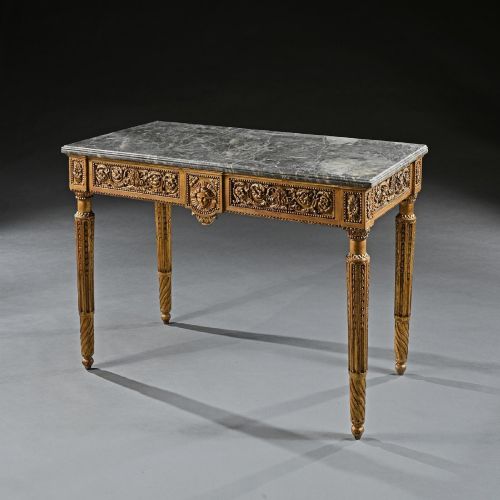
A gilt foyer table encompasses grand entrance furnishings designed with gilded surfaces, frequently appearing as wall-fixed console tables or freestanding centre tables. These pieces draw from French Empire, Regency, Louis XVI, and Italian Baroque Revival styles, bringing formal presence to a hallway.
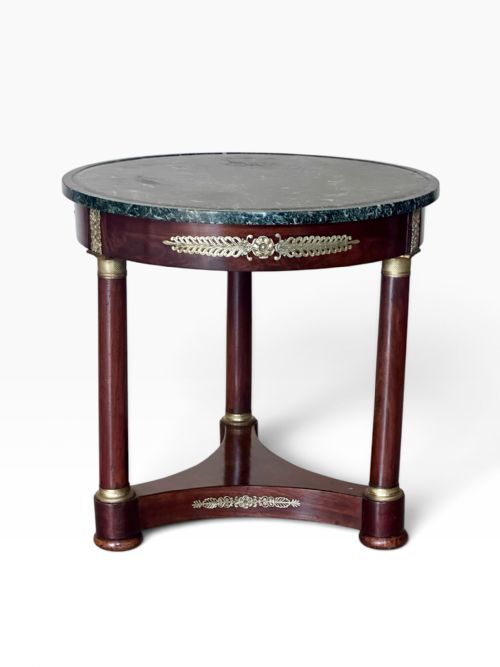
The version most commonly encountered on this page pairs a carved wooden framework finished in gold leaf or giltwood with a heavy stone surface. Marble tops in white, breccia, or porphyry appear regularly alongside timber structures in mahogany, rosewood, kingwood, or amboyna.
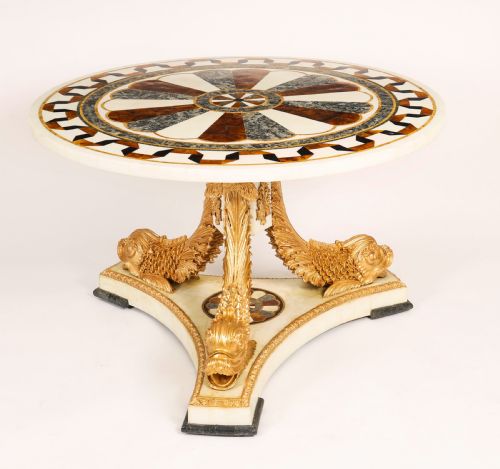
Formations range from console tables with lion's paw supports and matching mirror sets to round centre tables and occasional pieces. Makers utilised neoclassical dolphin motifs, parcel gilding, and intricate marquetry inlay to articulate the surfaces of these entrance tables.
Distinctions in craftsmanship
The refinement of the hand-carved wooden ornament dictates much of the distinction across these tables, separating deeply undercut foliage and crisp architectural mouldings from softer, shallower execution. Superior examples display meticulous joinery and substantial weight in their timber carcasses.
The quality of the gilding itself creates a clear division, where burnished gold leaf reflects light with varied depth compared to flat, uniform modern paints. Similarly, the mineral selection and polishing grade of the marble top indicate the original maker's ambition and budget.
Listings for this phrase frequently incorporate 19th century pieces featuring French Empire and Regency design influences.
François Linke
The Gilt Foyer Table Glossary
- Giltwood
- Wood that has been coated with gold leaf over a prepared gesso ground. This finish gives furniture a bright, reflective metallic surface that ages with a warm patina.
- Ormolu
- Finely chased and gilt bronze mounts applied to furniture as decorative accents. The technique involves coating bronze with a mercury-gold amalgam and firing.
- Console table
- A table designed to stand against a wall, frequently secured to it with brackets. These pieces often feature ornamental legs at the front and simpler supports at the back.
- Centre table
- A freestanding table intended to be viewed from all sides, placed in the middle of a room or hall. These frequently adopt round or oval formats.
- Parcel gilt
- A decorative treatment where only specific portions of an object are gilded, leaving the underlying wood grain or paint exposed elsewhere.
Gilt Foyer Table: Frequently Asked Questions
Where should a foyer table be placed?
A foyer table functions best against a primary wall in an entrance hall, where it greets visitors and anchors the room. Wall-mounted console versions require secure fixing to support heavy stone tops, while freestanding centre tables sit in the middle of larger vestibules.
Leaving adequate clearance around the piece ensures smooth movement through the entranceway. Pairing a console with a matching mirror creates a complete visual composition for checking attire before leaving the house.
How do I care for a marble top?
Marble requires gentle cleaning with a soft cloth and neutral soap to preserve the polished surface. Acidic liquids like citrus juice or wine can etch the stone and should be wiped away immediately.
Applying a specialist stone wax periodically helps protect the surface from moisture and everyday wear. Avoid placing abrasive or heavy unpadded objects directly onto the stone to prevent scratching.
What is the difference between a console and a centre table?
A console table is built to stand flat against a wall, frequently utilising front legs while relying on wall fixings or brackets for total stability. These are shaped specifically to project minimally into a hallway.
A centre table is built symmetrically as a freestanding object designed to be walked around. These occupy the middle of a space and feature finished ornament on all sides.
How do I identify Regency style furniture?
Regency style pieces draw heavily on classical Greek, Roman, and Egyptian motifs, reflecting early nineteenth-century British design tastes. Look for clean architectural lines, sabre legs, and classical mounts in brass or ormolu.
Dark exotic woods like rosewood and mahogany feature prominently, often enhanced with parcel gilt details. The overall aesthetic balances bold structural form with restrained classical ornamentation.