
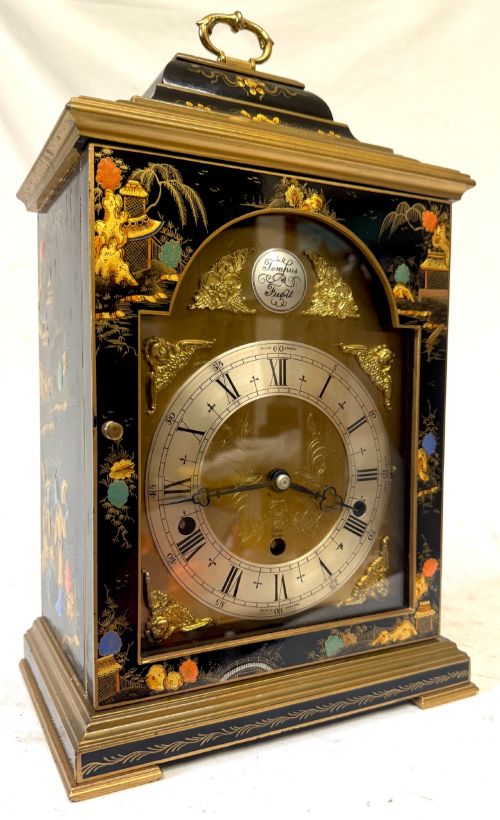
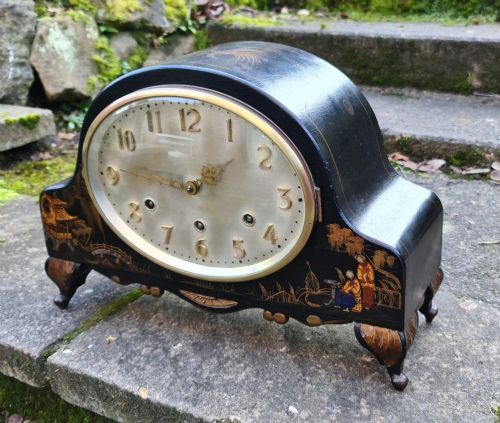
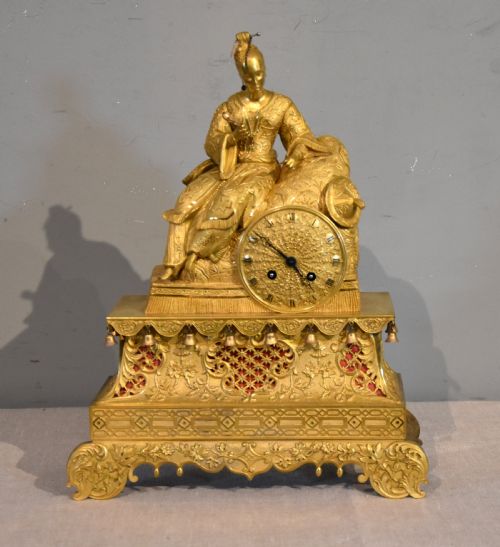
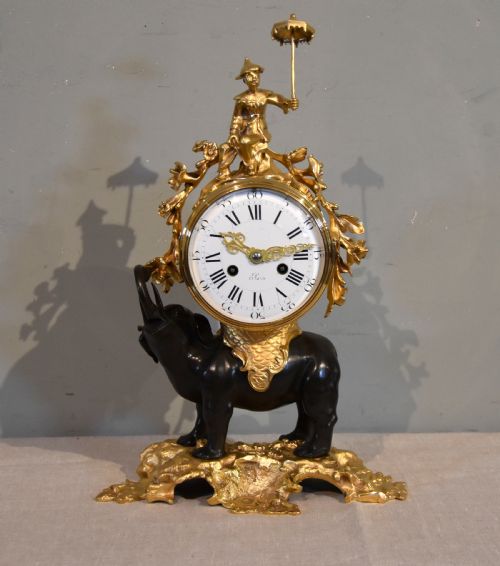


Gilt Chinoiserie Mantel Clock
A gilt chinoiserie mantel clock brings painted lacquer and gilt bronze together to mark the hours with decorative flair.

Gilt Chinoiserie Mantel Clock
A gilt chinoiserie mantel clock combines decorative lacquered woodwork with gilt bronze mounts, striking or musical movements, and Asian-inspired figurative scenes to sit upon a mantelpiece or shelf. These pieces range from compact green or black lacquer models to large bracket clocks housed in red and gold finishes.
The selection here draws on examples spanning the eighteenth, nineteenth, and twentieth centuries, alongside period interpretations such as seventeenth century style bracket clocks made around nineteen hundred. English makers like James Smith and Chater & Son sit alongside French ormolu designs and twentieth century pieces from makers like Elliott London.
Buyers meet variations involving black, red, and green lacquer surfaces adorned with gilt details, paired with brass dials or enamel panels. Formats stretch from small desk clocks to massive bracket models and figural mantel clocks.
How they were made
Construction relies on timber cases finished in layered lacquer, applying red, green, or black grounds decorated with gold painted motifs. Ormolu, gilt bronze, and silvered bronze mounts frame the dials and corners.
Clockmakers housed eight-day, three-train, or striking movements within these timber and metal housings, sometimes incorporating musical mechanisms or French movements into English bracket clock cases.
Listings feature pieces spanning the eighteenth to the twentieth centuries, utilising brass, glass, enamel, lacquer, and ormolu.
What varies in quality
Quality rests in the crispness of the gilt bronze or ormolu casting and the depth of the lacquer work. Finer examples exhibit hand-painted chinoiserie details with durable layers of lacquer rather than flat printed decoration.
The sophistication of the internal movement dictates worth, distinguishing standard timepieces from complex three-train musical or striking mechanisms by established London or continental workshops.
Elliott London·James Smith London·Chater And Son·Jaeger Le Coultre
The Gilt Chinoiserie Mantel Clock Glossary
- Chinoiserie
- European decorative art imitating Chinese and East Asian artistic styles. It appears frequently in lacquer finishes and painted gold motifs on clock cases.
- Ormolu
- Gilded bronze used for decorative mounts and feet. This technique creates a rich gold-coloured surface on metal fittings.
- Bracket Clock
- A portable house clock originally designed to sit upon a wall bracket. Many examples now stand directly on mantelpieces or desks.
- Three Train Movement
- A clock mechanism operating three separate gear trains for timekeeping, striking, and playing music or chiming quarters.
- Enamel Panel
- A fused glass surface fired onto metal, often used for clock dials with painted Roman or Arabic numerals.
Gilt Chinoiserie Mantel Clock: Frequently Asked Questions
How do I wind an antique mantel clock?
Use the designated key to turn the arbors clockwise or counter-clockwise depending on the train instructions. Take care not to over-wind the mainspring.
Consult the specific movement type before adjusting hands or resetting the strike sequence to prevent internal damage.
Where should I place a lacquer clock?
Position the piece away from direct sunlight and heat sources to protect the wooden substrate and lacquer finish. Stable humidity prevents wood movement.
Ensure the mantelpiece or shelf is level so the pendulum beats evenly and the clock keeps accurate time.
How do I tell an eighteenth century clock from a later copy?
Examine the construction of the movement plates, hand-cut screws, and the ageing of the timber case. Earlier London bracket clocks display distinct maker signatures on brass dials.
Twentieth century reproductions or later interpretations often utilise standardised French or English movements housed in period style lacquer.
What maintenance does gilt bronze require?
Dust the ormolu and gilt bronze mounts gently with a dry, soft microfibre cloth. Avoid abrasive cleaners that strip the gilding.
Professional servicing every few years ensures the brass pivots and gears remain properly lubricated and free from accumulated dust.